---
title: Bronze Figurine with Babylonian Cuneiform Inscription from Western Iran
author: National Museum of Iran
source: https://www.worldhistory.org/image/18666/bronze-figurine-with-babylonian-cuneiform-inscript/
format: machine-readable-alternate
updated: 2024-03-08
---
# Bronze Figurine with Babylonian Cuneiform Inscription from Western Iran
_Authored by National Museum of Iran_
## Image File
[](https://www.worldhistory.org/uploads/images/18666.jpg)
## Image Caption
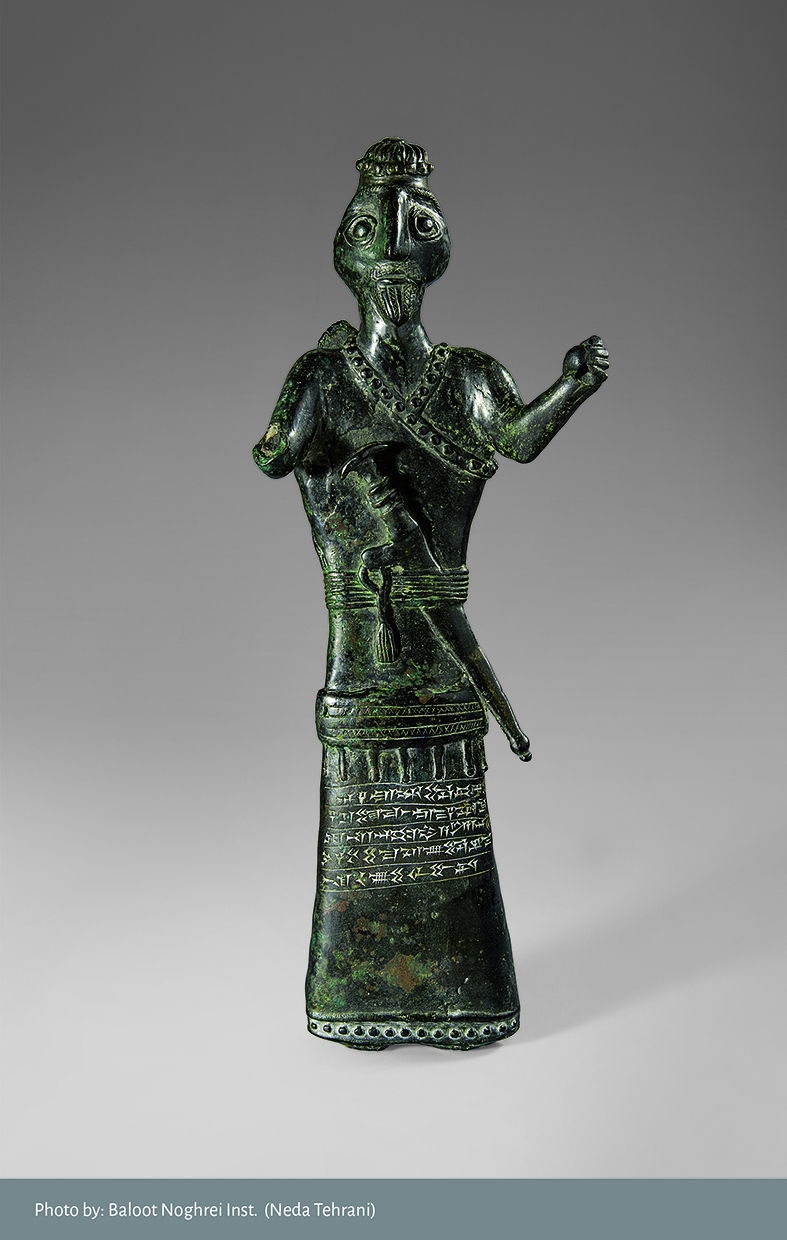
[Bronze](https://www.worldhistory.org/disambiguation/bronze/) figurine with Babylonian [cuneiform](https://www.worldhistory.org/cuneiform/) inscription found in Luristan Province, c. 1000-900 BCE ([Iron Age](https://www.worldhistory.org/disambiguation/Iron_Age/) II),
National Museum of Iran, Tehran, inv. no. 1408.
Photo by Neda Tehrani (Baloot Noghrei)
The cultural influence of [Mesopotamia](https://www.worldhistory.org/Mesopotamia/) in pre-[Achaemenid](https://www.worldhistory.org/disambiguation/Achaemenid/) Iran is underlying and unignorable – thanks to the Elamites, Babylonian Amorites and Kassites, and Assyrians among others. Their impact is particularly apparent in the visual personification of gods in the form of warrior kings. The inscribed bronze figurine from Luristan, however, displays several special features. His rather plain, long robe is a precursor of the Median chieftain paraphernalia a few centuries later. His quiver fastened on studded leather bands, perhaps completed with a now lost bow in his raised hand, corresponds with the Zagros-Median, and later Achaemenid, reputation in archery par excellence. That said, the Babylonian inscription, most likely a later addition, takes us to a peculiar pinnacle. It reads:
> Iltirgazi, the [god](https://www.worldhistory.org/God/) of the [city](https://www.worldhistory.org/city/) who was kidnapped and placed in Burnaku. [Marduk](https://www.worldhistory.org/Marduk/)-Sarani, son of Sulmanu Asaridu, ruler of the land Semanis returned him and put him in his place.
As it is understood, Marduk-Sarani (Sharrani), a lesser-known governor of the [Elamite](https://www.worldhistory.org/elam/) [city-state](https://www.worldhistory.org/Polis/) of Semanis (Shemanis), finds this sacred [sculpture](https://www.worldhistory.org/disambiguation/Sculpture/) of the patron deity of Iltirgazi, perhaps a small city in his territory, in the city of Burnaku. Some scholars assume that this discovery was an aftermath of his [conquest](https://www.worldhistory.org/warfare/) of Burnaku, and, more importantly, that Marduk-Sarani’s motivation for returning the god of Iltirgazi was the "divine blessings and social recognition" (Berlejung, 118) gained through the admired act of repatriation – reinstallation and restoration of a deity that had desecrated by being carried away from his house/[temple](https://www.worldhistory.org/temple/)/city. It is almost inevitable to recall the famous (hypothetical) example of this kind of sacrilege, namely taking the stele of [Code of Hammurabi](https://www.worldhistory.org/Code_of_Hammurabi/) from [Babylon](https://www.worldhistory.org/babylon/) to [Susa](https://www.worldhistory.org/susa/) by the Elamite king, Shukrut-Nakhunte I (r. 1184-1155 BCE).
#### Editorial Review
This human-authored image has been reviewed by our editorial team before publication to ensure accuracy, reliability and adherence to academic standards in accordance with our [editorial policy](https://www.worldhistory.org/static/editorial-policy/).
## Bibliography
- [Berlejung, Angelika. *Divine Secrets and Human Imaginations.* Mohr Siebrek Ek, 2021.](https://www.worldhistory.org/books/3161600347/)
- [El Zorro: A Journey in Time .1st stop Tehran: 6 Bronzeware of the Museum of Archaelogical Iran (時間之旅 :第一站 . 德黑蘭之六: 伊朗考古博物館之銅器)](https://elzorro927.blogspot.com/2015/01/a-journey-in-time-1st-stop-tehran-6.html "El Zorro: A Journey in Time .1st stop Tehran: 6 Bronzeware of the Museum of Archaelogical Iran (時間之旅 :第一站 . 德黑蘭之六: 伊朗考古博物館之銅器)"), accessed 7 Mar 2024.
## External Links
- [National Museum of Iran – Official Site For National Museum Of Iran](https://irannationalmuseum.ir/en/)
## Cite This Work
### APA
Iran, N. M. o. (2024, March 08). Bronze Figurine with Babylonian Cuneiform Inscription from Western Iran. *World History Encyclopedia*.
### Chicago
Iran, National Museum of. "Bronze Figurine with Babylonian Cuneiform Inscription from Western Iran." *World History Encyclopedia*, March 08, 2024. .
### MLA
Iran, National Museum of. "Bronze Figurine with Babylonian Cuneiform Inscription from Western Iran." *World History Encyclopedia*, 08 Mar 2024, .
## License & Copyright
Original image by **National Museum of Iran**. Submitted by [Nathalie Choubineh](https://www.worldhistory.org/user/nathalie.choubineh/ "User Page: Nathalie Choubineh"), published on 08 March 2024. The copyright holder has published this content under the following license: [Copyright](http://en.wikipedia.org/wiki/Copyright). You cannot use, copy, distribute, or modify this item without explicit permission from the author. Please note that content linked from this page may have different licensing terms.