---
title: Map of Roman Rule in Asia Minor, c. 200 CE
author: Simeon Netchev
source: https://www.worldhistory.org/image/18561/map-of-roman-rule-in-asia-minor-c-200-ce/
format: machine-readable-alternate
license: Creative Commons Attribution-NonCommercial-NoDerivs (https://creativecommons.org/licenses/by-nc/4.0)
updated: 2025-09-06
---
# Map of Roman Rule in Asia Minor, c. 200 CE
_Authored by [Simeon Netchev](https://www.worldhistory.org/user/simeonnetchev/)_
## Image File
[](https://www.worldhistory.org/uploads/images/18561.png)
## Image Caption
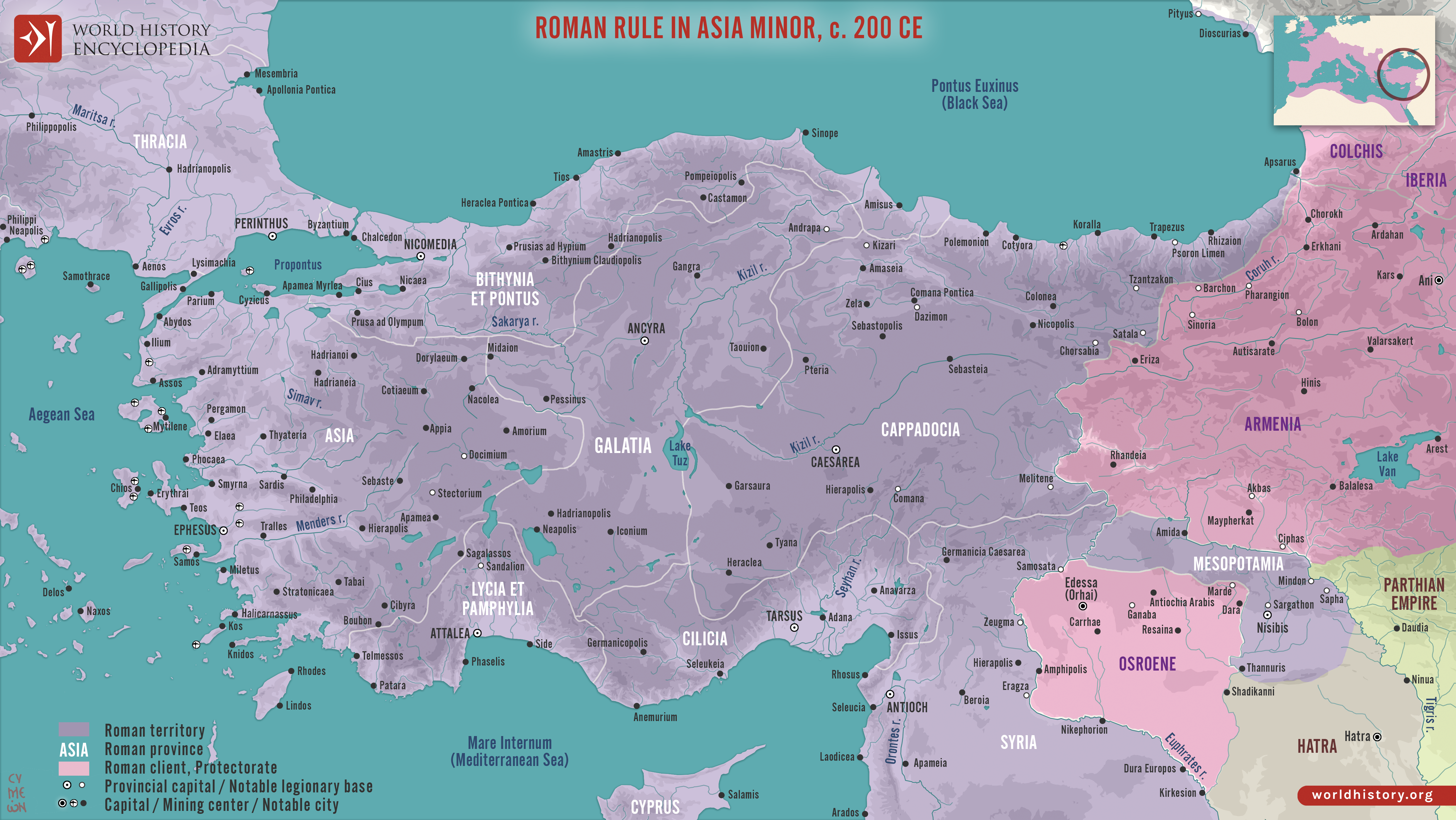
This map illustrates the geopolitical landscape of [Asia Minor](https://www.worldhistory.org/Asia_Minor/) during the reign of Emperor [Septimius Severus](https://www.worldhistory.org/Septimius_Severus/) (193–211 CE), around the year 200 CE. By this time, the peninsula (modern-day [Turkey](https://www.worldhistory.org/Asia_Minor/)) had been under [Roman](https://www.worldhistory.org/disambiguation/Roman/) rule for more than two centuries, following successive campaigns of the Republic and annexations under the early [empire](https://www.worldhistory.org/empire/). Asia Minor formed one of the empire’s most prosperous regions, integrated into Roman administration and [culture](https://www.worldhistory.org/disambiguation/culture/) while also serving as a strategic bridge between [Europe](https://www.worldhistory.org/europe/) and the eastern provinces.
Administratively, Asia Minor was divided into several provinces, including Asia, Bithynia et Pontus, [Galatia](https://www.worldhistory.org/galatia/), Cappadocia, [Cilicia](https://www.worldhistory.org/Cilicia/), and [Lycia](https://www.worldhistory.org/lycia/) et Pamphylia, each overseen by Roman governors. [Cities](https://www.worldhistory.org/city/) such as [Ephesus](https://www.worldhistory.org/ephesos/), [Pergamon](https://www.worldhistory.org/pergamon/), and [Antioch](https://www.worldhistory.org/Antiochia/) flourished with Roman infrastructure, civic life, and [trade](https://www.worldhistory.org/disambiguation/trade/), while Latin and [Greek](https://www.worldhistory.org/disambiguation/greek/) cultural influences blended. To the east, client kingdoms like [Armenia](https://www.worldhistory.org/armenia/) and Osroene maintained complex, shifting relations with [Rome](https://www.worldhistory.org/Rome/), often serving as buffer states in the ongoing rivalry with [Parthia](https://www.worldhistory.org/disambiguation/Parthia/). Although occasional unrest and revolts occurred, the Severan era in Asia Minor was largely a period of stability and prosperity, leaving a deep imprint on the region’s urban, cultural, and political development.
#### Editorial Review
This human-authored image has been reviewed by our editorial team before publication to ensure accuracy, reliability and adherence to academic standards in accordance with our [editorial policy](https://www.worldhistory.org/static/editorial-policy/).
## About the Author
Simeon is a freelance visual designer and history educator, passionate about the human stories that shape the past.
- [Linkedin Profile](https://www.linkedin.com/in/simeon-netchev/)
## Cite This Work
### APA
Netchev, S. (2024, February 27). Map of Roman Rule in Asia Minor, c. 200 CE. *World History Encyclopedia*.
### Chicago
Netchev, Simeon. "Map of Roman Rule in Asia Minor, c. 200 CE." *World History Encyclopedia*, February 27, 2024. .
### MLA
Netchev, Simeon. "Map of Roman Rule in Asia Minor, c. 200 CE." *World History Encyclopedia*, 27 Feb 2024, .
## License & Copyright
Submitted by [Simeon Netchev](https://www.worldhistory.org/user/simeonnetchev/ "User Page: Simeon Netchev"), published on 27 February 2024. The copyright holder has published this content under the following license: [Creative Commons Attribution-NonCommercial-NoDerivs](https://creativecommons.org/licenses/by-nc/4.0deed.en). This licence only allows others to download this content and share it with others as long as the author is credited, but they can't change the content in any way or use it commercially. When republishing on the web a hyperlink back to the original content source URL must be included. Please note that content linked from this page may have different licensing terms.