---
title: Government of the Roman Republic
author: Simeon Netchev
source: https://www.worldhistory.org/image/18382/government-of-the-roman-republic/
format: machine-readable-alternate
license: Creative Commons Attribution-NonCommercial-NoDerivs (https://creativecommons.org/licenses/by-nc/4.0)
updated: 2025-09-15
---
# Government of the Roman Republic
_Authored by [Simeon Netchev](https://www.worldhistory.org/user/simeonnetchev/)_
## Image File
[](https://www.worldhistory.org/uploads/images/18382.png)
## Image Caption
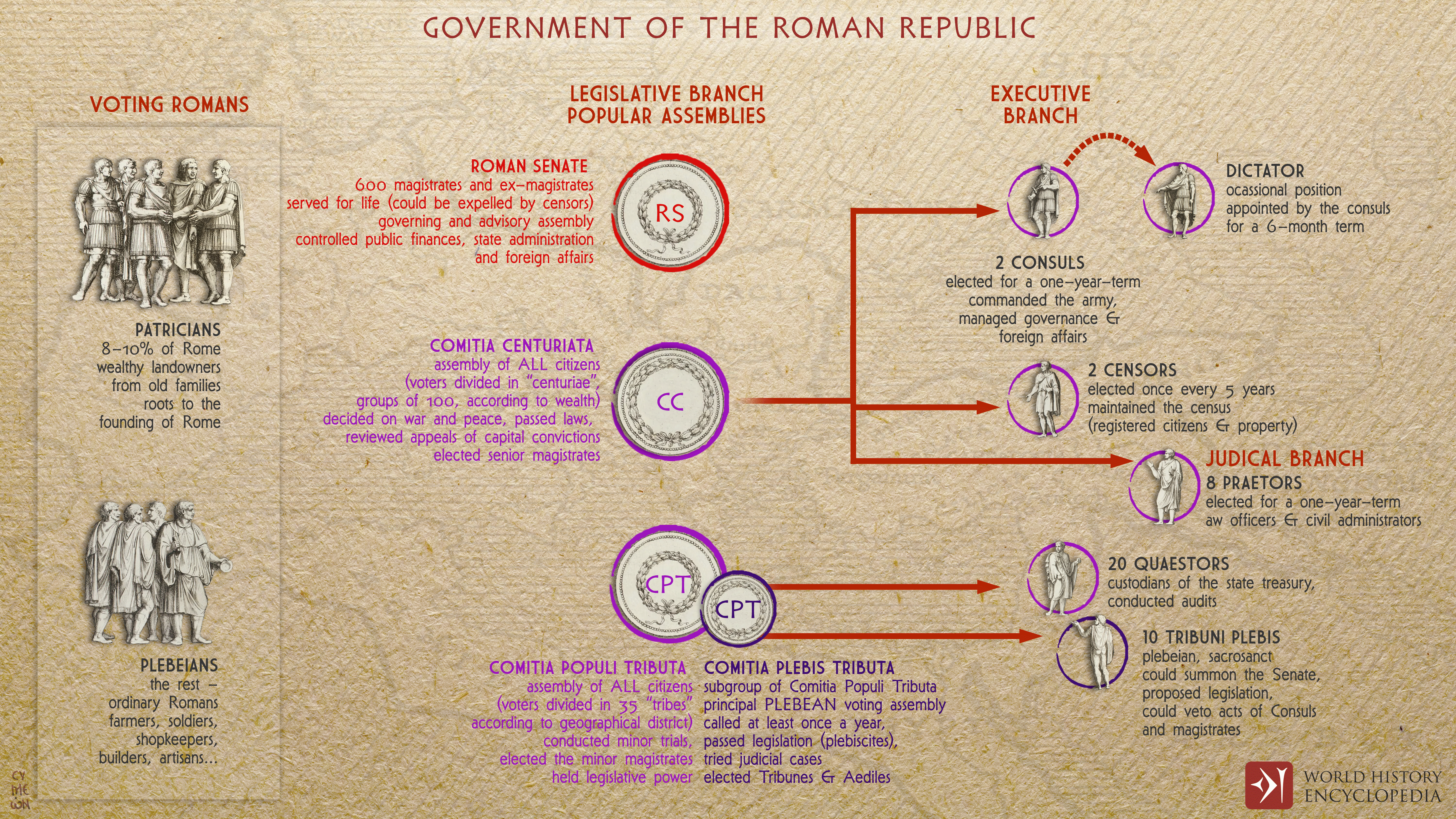
This infographic illustrates the government of the [Roman Republic](https://www.worldhistory.org/Roman_Republic/) (c. 509–27 BCE), a political system that combined elements of monarchy, aristocracy, and democracy. Over nearly five centuries, the Republic developed institutions designed to distribute authority, prevent tyranny, and balance the interests of [Rome](https://www.worldhistory.org/Rome/)’s social classes.
At its core, executive power was held by two consuls, elected annually, who commanded armies and presided over state affairs, but each could veto the other’s decisions. The Senate, a body dominated by [patrician](https://www.worldhistory.org/Patrician/) aristocrats, advised magistrates and directed foreign and financial policy, while popular assemblies of [Roman](https://www.worldhistory.org/disambiguation/Roman/) citizens passed laws, elected officials, and voted on [war](https://www.worldhistory.org/disambiguation/War/) and peace. Over time, additional magistracies such as the praetors (judicial officials), quaestors (financial officers), aediles (public works and markets), and censors (census and moral oversight) added further complexity. Crucially, the office of [tribune](https://www.worldhistory.org/Tribune/) of the plebs (established 494 BCE) gave [plebeians](https://www.worldhistory.org/Plebeians/) a political voice and the power of veto, reflecting the Republic’s effort to mediate between patrician and plebeian interests. This carefully balanced system of checks and balances provided a model for later constitutional thought and influenced the development of modern republican and democratic institutions.
#### Editorial Review
This human-authored image has been reviewed by our editorial team before publication to ensure accuracy, reliability and adherence to academic standards in accordance with our [editorial policy](https://www.worldhistory.org/static/editorial-policy/).
## About the Author
Simeon is a freelance visual designer and history educator, passionate about the human stories that shape the past.
- [Linkedin Profile](https://www.linkedin.com/in/simeon-netchev/)
## Cite This Work
### APA
Netchev, S. (2024, January 20). Government of the Roman Republic. *World History Encyclopedia*.
### Chicago
Netchev, Simeon. "Government of the Roman Republic." *World History Encyclopedia*, January 20, 2024. .
### MLA
Netchev, Simeon. "Government of the Roman Republic." *World History Encyclopedia*, 20 Jan 2024, .
## License & Copyright
Submitted by [Simeon Netchev](https://www.worldhistory.org/user/simeonnetchev/ "User Page: Simeon Netchev"), published on 20 January 2024. The copyright holder has published this content under the following license: [Creative Commons Attribution-NonCommercial-NoDerivs](https://creativecommons.org/licenses/by-nc/4.0deed.en). This licence only allows others to download this content and share it with others as long as the author is credited, but they can't change the content in any way or use it commercially. When republishing on the web a hyperlink back to the original content source URL must be included. Please note that content linked from this page may have different licensing terms.