---
title: The Scientific Revolution (c. 1500–1700): From Tradition to Empiricism in Early Modern Europe
author: Simeon Netchev
source: https://www.worldhistory.org/image/18023/the-scientific-revolution--c-1500-1700/
format: machine-readable-alternate
license: Creative Commons Attribution-NonCommercial-NoDerivs (https://creativecommons.org/licenses/by-nc/4.0)
updated: 2026-04-10
---
# The Scientific Revolution (c. 1500–1700): From Tradition to Empiricism in Early Modern Europe
_Authored by [Simeon Netchev](https://www.worldhistory.org/user/simeonnetchev/)_
## Image File
[](https://www.worldhistory.org/uploads/images/18023.png)
## Image Caption
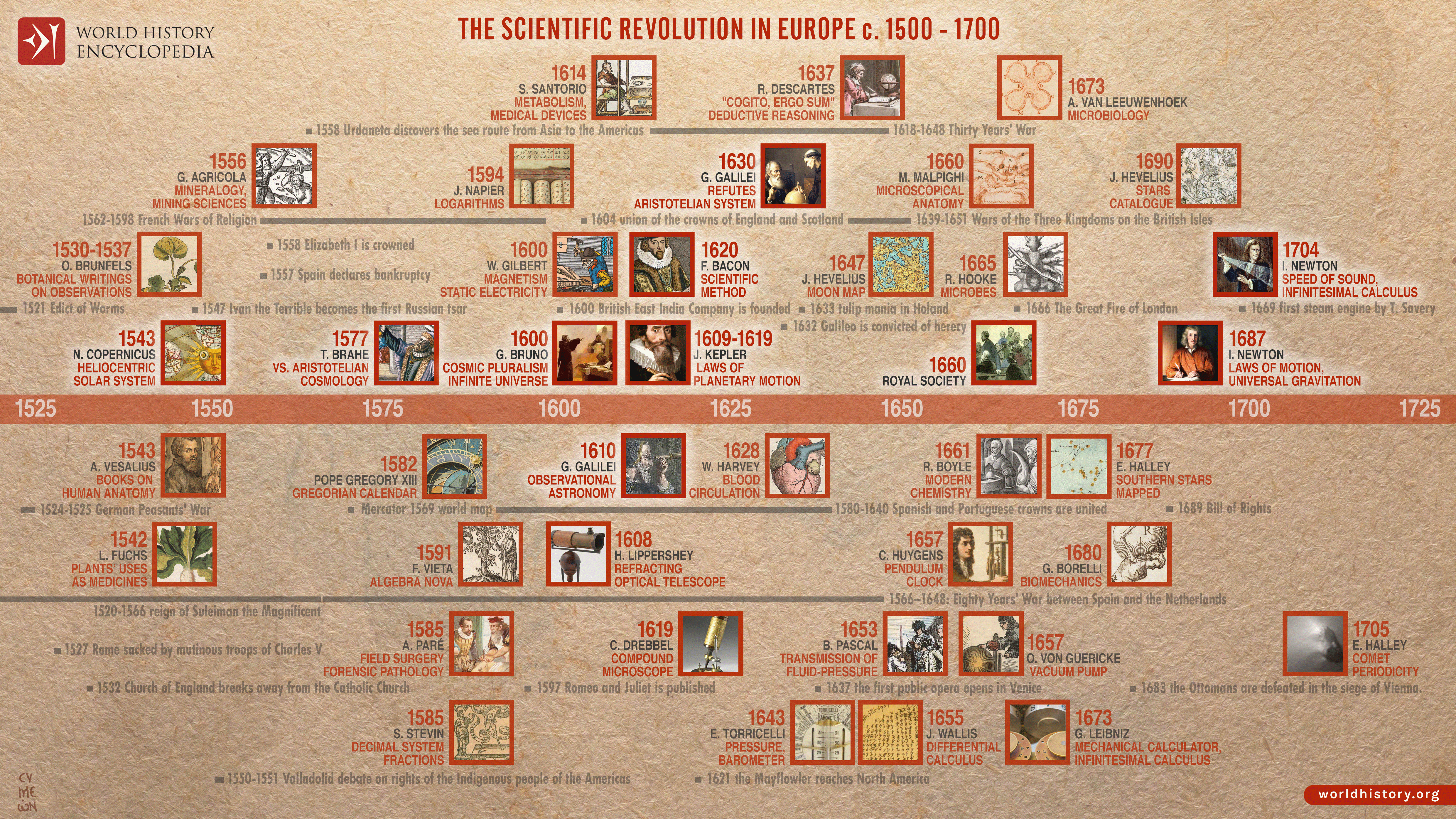
The [Scientific Revolution](https://www.worldhistory.org/Scientific_Revolution/) (c. 1500–1700) marks a transformative phase in European intellectual history, during which long-standing medieval frameworks were increasingly challenged by empirical observation and mathematical reasoning. Emerging within the broader context of the Renaissance and early modern state formation, this period saw a gradual shift away from Aristotelian and Ptolemaic models toward a new understanding of the natural world grounded in experimentation and verification. The transition was neither uniform nor uncontested, but it fundamentally reshaped approaches to knowledge, laying the foundations for modern scientific inquiry across disciplines such as astronomy, physics, and natural [philosophy](https://www.worldhistory.org/philosophy/).
Key figures played pivotal roles in redefining scientific thought. [Nicolaus Copernicus](https://www.worldhistory.org/Nicolaus_Copernicus/) (1473–1543) proposed a heliocentric model of the cosmos, later supported and refined by [Galileo Galilei](https://www.worldhistory.org/Galileo_Galilei/) (1564–1642) and [Johannes Kepler](https://www.worldhistory.org/Johannes_Kepler/) (1571–1630), whose laws of planetary motion advanced mathematical astronomy. [Francis Bacon](https://www.worldhistory.org/Francis_Bacon/) (1561–1626) articulated principles of empirical methodology, while [Isaac Newton](https://www.worldhistory.org/Isaac_Newton/) (1642–1727) synthesized earlier developments through his laws of motion and universal gravitation. Together, these contributions established the intellectual framework of the [scientific method](https://www.worldhistory.org/Scientific_Method/) and reinforced the principle that systematic observation and experimentation could yield reliable knowledge about the natural world.
#### Editorial Review
This human-authored image has been reviewed by our editorial team before publication to ensure accuracy, reliability and adherence to academic standards in accordance with our [editorial policy](https://www.worldhistory.org/static/editorial-policy/).
## About the Author
Simeon is a freelance visual designer and history educator, passionate about the human stories that shape the past.
- [Linkedin Profile](https://www.linkedin.com/in/simeon-netchev/)
## Cite This Work
### APA
Netchev, S. (2026, April 10). The Scientific Revolution (c. 1500–1700): From Tradition to Empiricism in Early Modern Europe. *World History Encyclopedia*.
### Chicago
Netchev, Simeon. "The Scientific Revolution (c. 1500–1700): From Tradition to Empiricism in Early Modern Europe." *World History Encyclopedia*, April 10, 2026. .
### MLA
Netchev, Simeon. "The Scientific Revolution (c. 1500–1700): From Tradition to Empiricism in Early Modern Europe." *World History Encyclopedia*, 10 Apr 2026, .
## License & Copyright
Submitted by [Simeon Netchev](https://www.worldhistory.org/user/simeonnetchev/ "User Page: Simeon Netchev"), published on 10 April 2026. The copyright holder has published this content under the following license: [Creative Commons Attribution-NonCommercial-NoDerivs](https://creativecommons.org/licenses/by-nc/4.0deed.en). This licence only allows others to download this content and share it with others as long as the author is credited, but they can't change the content in any way or use it commercially. When republishing on the web a hyperlink back to the original content source URL must be included. Please note that content linked from this page may have different licensing terms.