---
title: Roman Roads: Engineering an Empire: Construction, Mobility & Imperial Power
author: Simeon Netchev
source: https://www.worldhistory.org/image/17723/roman-roads-engineering-an-empire/
format: machine-readable-alternate
license: Creative Commons Attribution-NonCommercial-NoDerivs (https://creativecommons.org/licenses/by-nc/4.0)
updated: 2026-09-26
---
# Roman Roads: Engineering an Empire: Construction, Mobility & Imperial Power
_Authored by [Simeon Netchev](https://www.worldhistory.org/user/simeonnetchev/)_
## Image File
[](https://www.worldhistory.org/uploads/images/17723.png)
## Image Caption
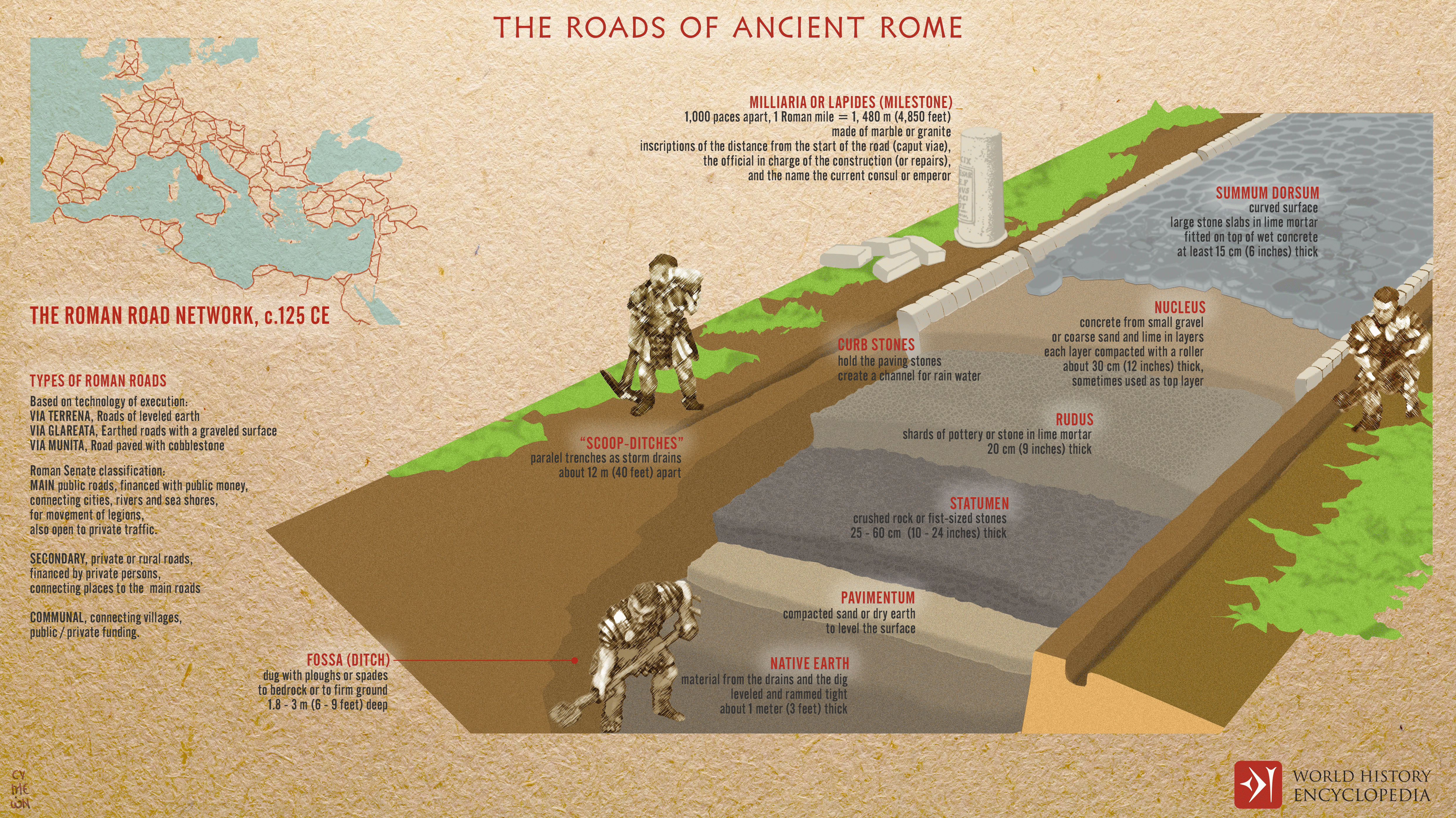
[Roman roads](https://www.worldhistory.org/article/758/roman-roads/) were an extensive system of overland routes developed, expanded, and maintained across the [Roman](https://www.worldhistory.org/disambiguation/Roman/) world to connect [cities](https://www.worldhistory.org/city/), ports, military zones, and provincial centers. Their construction was not uniform: engineers adapted existing routes and used different combinations of earth, stone, gravel, paving, raised roadbeds, drainage ditches, and cambered surfaces according to terrain, available materials, and intended use. Roads also differed legally and administratively. Major *viae publicae* were public routes maintained under state authority, while private and local roads connected estates, villages, and communities to the wider network.
The road system illustrates the relationship between technology and imperial power. Reliable routes helped [Rome](https://www.worldhistory.org/Rome/) move troops, officials, messages, and supplies across its territories, strengthening administration and military control, but their effects extended far beyond the state. Merchants, migrants, pilgrims, and other travelers used the same networks, facilitating [trade](https://www.worldhistory.org/disambiguation/trade/), communication, and cultural exchange between regions. Recent research has reconstructed nearly 300,000 km of Roman-period routes, although much of their precise course remains uncertain, emphasizing both the extraordinary reach of Roman connectivity and the limits of the surviving evidence.
#### Editorial Review
This human-authored image has been reviewed by our editorial team before publication to ensure accuracy, reliability and adherence to academic standards in accordance with our [editorial policy](https://www.worldhistory.org/static/editorial-policy/).
## About the Author
Simeon is a freelance visual designer and history educator, passionate about the human stories that shape the past.
- [Linkedin Profile](https://www.linkedin.com/in/simeon-netchev/)
## Cite This Work
### APA
Netchev, S. (2026, September 26). Roman Roads: Engineering an Empire: Construction, Mobility & Imperial Power. *World History Encyclopedia*.
### Chicago
Netchev, Simeon. "Roman Roads: Engineering an Empire: Construction, Mobility & Imperial Power." *World History Encyclopedia*, September 26, 2026. .
### MLA
Netchev, Simeon. "Roman Roads: Engineering an Empire: Construction, Mobility & Imperial Power." *World History Encyclopedia*, 26 Sep 2026, .
## License & Copyright
Submitted by [Simeon Netchev](https://www.worldhistory.org/user/simeonnetchev/ "User Page: Simeon Netchev"), published on 26 September 2026. The copyright holder has published this content under the following license: [Creative Commons Attribution-NonCommercial-NoDerivs](https://creativecommons.org/licenses/by-nc/4.0deed.en). This licence only allows others to download this content and share it with others as long as the author is credited, but they can't change the content in any way or use it commercially. When republishing on the web a hyperlink back to the original content source URL must be included. Please note that content linked from this page may have different licensing terms.