---
title: Map of the Empire of Timur the Lame, c. 1404 CE
author: Simeon Netchev
source: https://www.worldhistory.org/image/17689/map-of-the-empire-of-timur-the-lame-c-1404-ce/
format: machine-readable-alternate
license: Creative Commons Attribution-NonCommercial-NoDerivs (https://creativecommons.org/licenses/by-nc/4.0)
updated: 2025-10-12
---
# Map of the Empire of Timur the Lame, c. 1404 CE
_Authored by [Simeon Netchev](https://www.worldhistory.org/user/simeonnetchev/)_
## Image File
[](https://www.worldhistory.org/uploads/images/17689.png)
## Image Caption
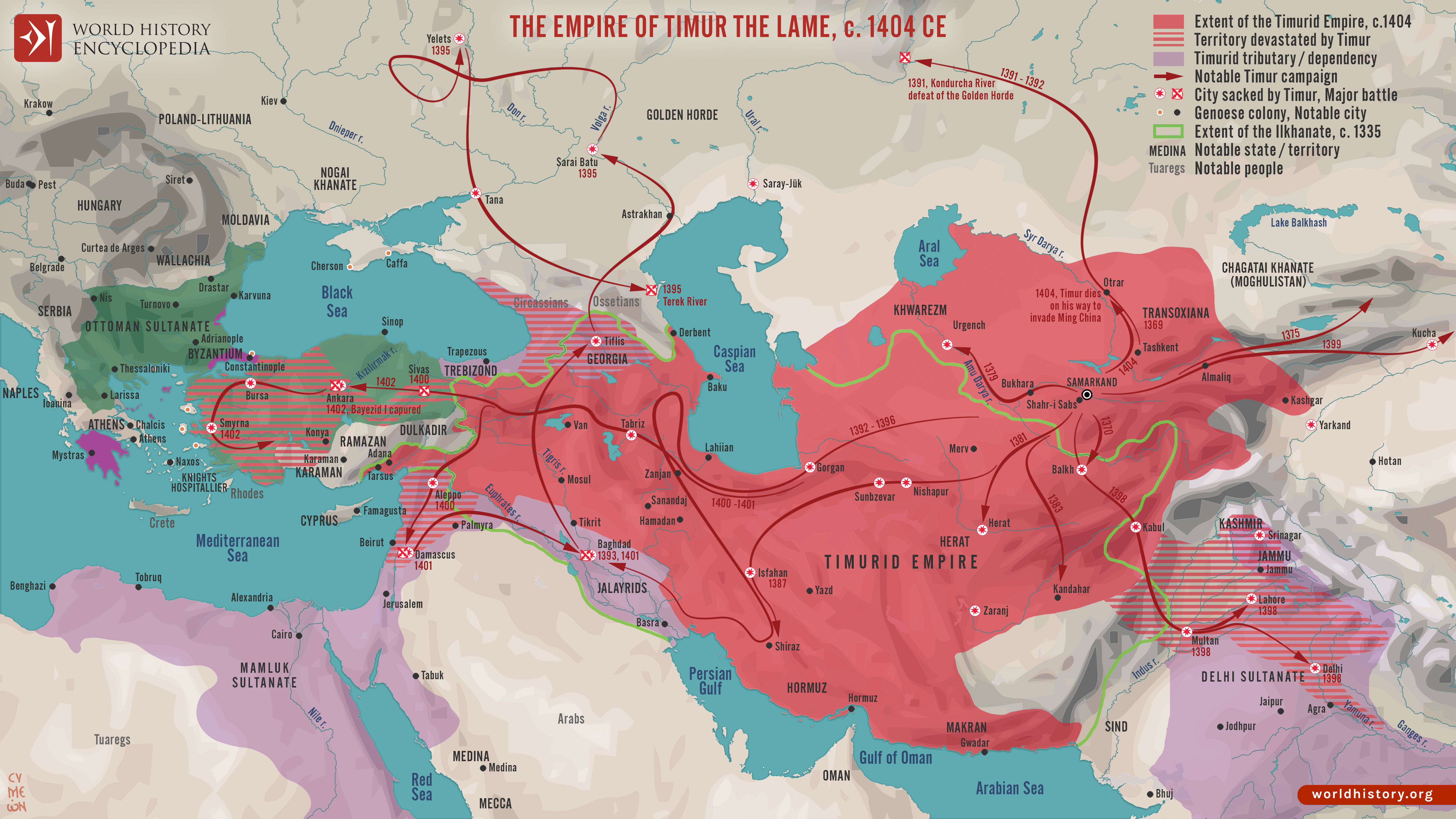
This map illustrates the rise and expansion of the Timurid [Empire](https://www.worldhistory.org/empire/) (1370–1405) under [Timur](https://www.worldhistory.org/Timur/) ([Tamerlane](https://www.worldhistory.org/Timur/)), a conqueror of Turco-[Mongol](https://www.worldhistory.org/Mongol_Empire/) descent whose military campaigns reshaped the political landscape of 14th-century Eurasia. Born in 1336 near Kesh (modern Shahrisabz, Uzbekistan), Timur rose to power in Transoxiana, uniting the fractured Chagatai domains under his rule. Combining Mongol military organization with Persian imperial traditions, he launched a series of devastating campaigns that brought much of Central Asia, [Persia](https://www.worldhistory.org/Persia/), [Mesopotamia](https://www.worldhistory.org/Mesopotamia/), and parts of Russia, [India](https://www.worldhistory.org/india/), and [Anatolia](https://www.worldhistory.org/Asia_Minor/) under his control. His victories over the Mamluks, Ottomans, Delhi Sultanate, and [Golden Horde](https://www.worldhistory.org/Golden_Horde/) made him the most feared ruler of his age, while his capital at Samarqand became a brilliant center of Islamic art and [architecture](https://www.worldhistory.org/disambiguation/architecture/).
Timur’s empire, however, was built more on [conquest](https://www.worldhistory.org/warfare/) than administration. His authority rested on personal charisma, alliances through marriage (earning him the title *Timūr Gurkānī, “son-in-[law](https://www.worldhistory.org/disambiguation/law/)”* of [Genghis Khan](https://www.worldhistory.org/Genghis_Khan/)’s line), and the loyalty of his armies rather than on durable governance. When he died in 1405, preparing for an invasion of Ming [China](https://www.worldhistory.org/china/), his realm quickly fragmented into rival Timurid successor states. Though short-lived, Timur’s empire left a lasting legacy in Central Asian [culture](https://www.worldhistory.org/disambiguation/culture/), urban development, and the diffusion of Persianate art and learning, foreshadowing the rise of later dynasties such as the Mughals and Safavids.
#### Editorial Review
This human-authored image has been reviewed by our editorial team before publication to ensure accuracy, reliability and adherence to academic standards in accordance with our [editorial policy](https://www.worldhistory.org/static/editorial-policy/).
## About the Author
Simeon is a freelance visual designer and history educator, passionate about the human stories that shape the past.
- [Linkedin Profile](https://www.linkedin.com/in/simeon-netchev/)
## Cite This Work
### APA
Netchev, S. (2023, August 07). Map of the Empire of Timur the Lame, c. 1404 CE. *World History Encyclopedia*.
### Chicago
Netchev, Simeon. "Map of the Empire of Timur the Lame, c. 1404 CE." *World History Encyclopedia*, August 07, 2023. .
### MLA
Netchev, Simeon. "Map of the Empire of Timur the Lame, c. 1404 CE." *World History Encyclopedia*, 07 Aug 2023, .
## License & Copyright
Submitted by [Simeon Netchev](https://www.worldhistory.org/user/simeonnetchev/ "User Page: Simeon Netchev"), published on 07 August 2023. The copyright holder has published this content under the following license: [Creative Commons Attribution-NonCommercial-NoDerivs](https://creativecommons.org/licenses/by-nc/4.0deed.en). This licence only allows others to download this content and share it with others as long as the author is credited, but they can't change the content in any way or use it commercially. When republishing on the web a hyperlink back to the original content source URL must be included. Please note that content linked from this page may have different licensing terms.