---
title: Western Classical Music, c. 1700-1950
author: Simeon Netchev
source: https://www.worldhistory.org/image/17445/western-classical-music-c-1700-1950/
format: machine-readable-alternate
license: Creative Commons Attribution-NonCommercial-NoDerivs (https://creativecommons.org/licenses/by-nc/4.0)
updated: 2026-01-04
---
# Western Classical Music, c. 1700-1950
_Authored by [Simeon Netchev](https://www.worldhistory.org/user/simeonnetchev/)_
## Image File
[](https://www.worldhistory.org/uploads/images/17445.png)
## Image Caption
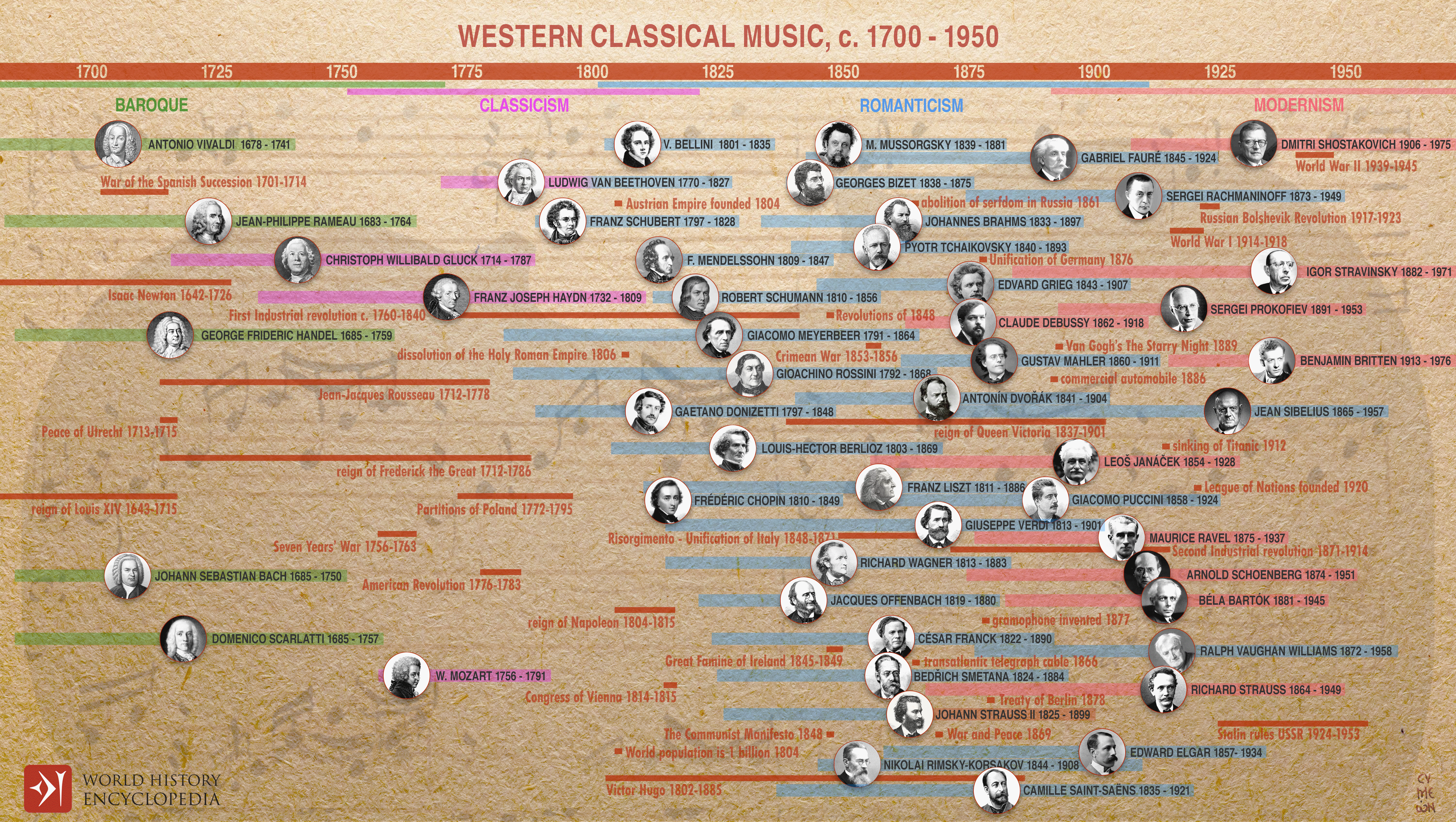
Between c. 1700 and 1950, Western classical [music](https://www.worldhistory.org/disambiguation/Music/) evolved alongside profound political, social, and technological change, moving through four broad stylistic phases: Baroque, Classicism, Romanticism, and Modernism. The Baroque era (c. 1700–1750) emphasized order, grandeur, and formal complexity, reflecting absolutist courts and religious institutions. Classicism (c. 1750–1825) emerged in the context of [the Enlightenment](https://www.worldhistory.org/The_Enlightenment/), favoring balance, clarity, and proportion, mirroring contemporary ideals of reason, civic order, and emerging bourgeois [culture](https://www.worldhistory.org/disambiguation/culture/) in [Europe](https://www.worldhistory.org/europe/) under monarchies such as those of Joseph II (reign 1765–1790) and [Napoleon Bonaparte](https://www.worldhistory.org/Napoleon_Bonaparte/) (reign 1804–1814).
During the Romantic period (c. 1825–1900), composers increasingly rejected restraint in favor of emotional expression, nationalism, and individual creativity, shaped by the political upheavals of the Revolutions of 1848 and the formation of modern nation-states. Music became a vehicle for personal identity and collective memory, expanding orchestras and exploring new harmonic language. By the early 20th century, Modernism (c. 1900–1950) responded to [industrialization](https://www.worldhistory.org/disambiguation/Industrialization/), world wars, and social dislocation, particularly World [War](https://www.worldhistory.org/disambiguation/War/) I (1914–1918) and World War II (1939–1945), by challenging tonal tradition and redefining the very language of music.
#### Editorial Review
This human-authored image has been reviewed by our editorial team before publication to ensure accuracy, reliability and adherence to academic standards in accordance with our [editorial policy](https://www.worldhistory.org/static/editorial-policy/).
## About the Author
Simeon is a freelance visual designer and history educator, passionate about the human stories that shape the past.
- [Linkedin Profile](https://www.linkedin.com/in/simeon-netchev/)
## Cite This Work
### APA
Netchev, S. (2023, May 19). Western Classical Music, c. 1700-1950. *World History Encyclopedia*.
### Chicago
Netchev, Simeon. "Western Classical Music, c. 1700-1950." *World History Encyclopedia*, May 19, 2023. .
### MLA
Netchev, Simeon. "Western Classical Music, c. 1700-1950." *World History Encyclopedia*, 19 May 2023, .
## License & Copyright
Submitted by [Simeon Netchev](https://www.worldhistory.org/user/simeonnetchev/ "User Page: Simeon Netchev"), published on 19 May 2023. The copyright holder has published this content under the following license: [Creative Commons Attribution-NonCommercial-NoDerivs](https://creativecommons.org/licenses/by-nc/4.0deed.en). This licence only allows others to download this content and share it with others as long as the author is credited, but they can't change the content in any way or use it commercially. When republishing on the web a hyperlink back to the original content source URL must be included. Please note that content linked from this page may have different licensing terms.