---
title: Map of the Rise of the Delhi Sultanate: The Mamluk Period: From Slave Commanders to Sultans
author: Simeon Netchev
source: https://www.worldhistory.org/image/17344/map-of-the-rise-of-the-delhi-sultanate-the-mamluk/
format: machine-readable-alternate
license: Creative Commons Attribution-NonCommercial-NoDerivs (https://creativecommons.org/licenses/by-nc/4.0)
updated: 2026-03-02
---
# Map of the Rise of the Delhi Sultanate: The Mamluk Period: From Slave Commanders to Sultans
_Authored by [Simeon Netchev](https://www.worldhistory.org/user/simeonnetchev/)_
## Image File
[](https://www.worldhistory.org/uploads/images/17344.png)
## Image Caption
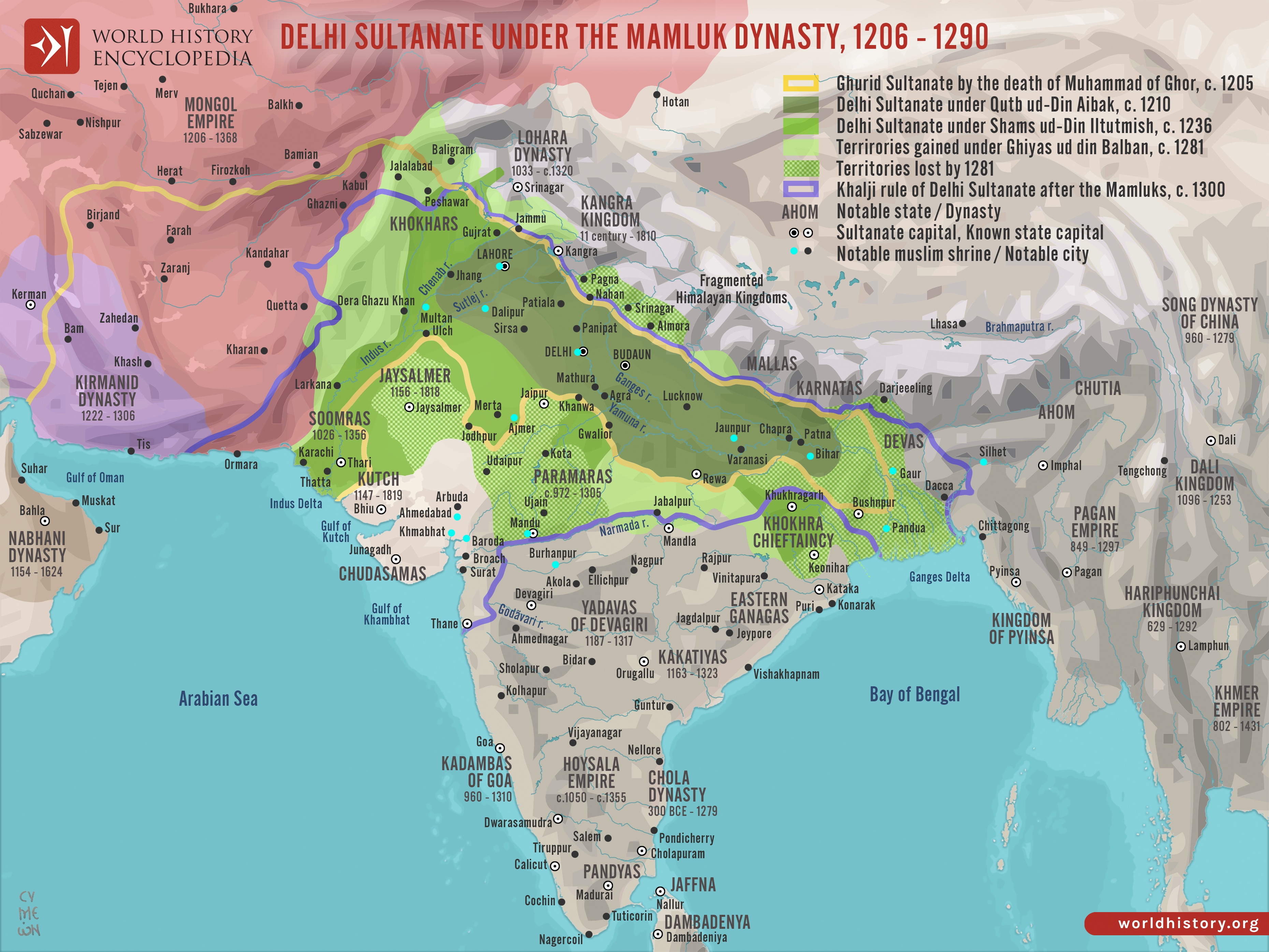
The Delhi Sultanate under the Mamluk (or “Slave”) Dynasty (1206–1290) marked the consolidation of centralized Muslim rule in northern [India](https://www.worldhistory.org/india/) following the fragmentation of the Ghurid [Empire](https://www.worldhistory.org/empire/). The term mamlūk (Arabic: “owned” or military slave) reflects the origins of its ruling elite, Turkic slave-soldiers who rose through military service. After the assassination of Muʿizz al-Din [Muhammad](https://www.worldhistory.org/disambiguation/Muhammad/) of Ghor (1206), political authority in North India passed to his former general Qutb al-Din Aibak (reign 1206–1210), who established an independent sultanate at Delhi. Although his reign was brief, it laid institutional foundations for a durable polity, linking military authority, iqṭāʿ revenue assignments, and emerging Indo-Islamic court [culture](https://www.worldhistory.org/disambiguation/culture/).
The sultanate was consolidated under Shams al-Din Iltutmish (reign 1211–1236), who secured recognition from the [Abbasid caliphate](https://www.worldhistory.org/Abbasid_Dynasty/) and stabilized control over the [Ganga](https://www.worldhistory.org/Ganges/)–Yamuna Doab and Bengal. Later, Ghiyas ud-Din Balban (reign 1266–1287) strengthened royal authority, reinforced frontier defenses against [Mongol](https://www.worldhistory.org/Mongol_Empire/) incursions, and curtailed aristocratic factionalism through a more centralized court ideology. Throughout the period, territorial control remained fluid, with recurring resistance from Rajput polities and regional powers, producing fluctuating borders and near-constant campaigning. The dynasty ended in 1290 when Jalal ud-Din Khalji (reign 1290–1296) overthrew the last Mamluk ruler, initiating the Khalji phase of the Delhi Sultanate.
#### Editorial Review
This human-authored image has been reviewed by our editorial team before publication to ensure accuracy, reliability and adherence to academic standards in accordance with our [editorial policy](https://www.worldhistory.org/static/editorial-policy/).
## About the Author
Simeon is a freelance visual designer and history educator, passionate about the human stories that shape the past.
- [Linkedin Profile](https://www.linkedin.com/in/simeon-netchev/)
## Cite This Work
### APA
Netchev, S. (2023, May 04). Map of the Rise of the Delhi Sultanate: The Mamluk Period: From Slave Commanders to Sultans. *World History Encyclopedia*.
### Chicago
Netchev, Simeon. "Map of the Rise of the Delhi Sultanate: The Mamluk Period: From Slave Commanders to Sultans." *World History Encyclopedia*, May 04, 2023. .
### MLA
Netchev, Simeon. "Map of the Rise of the Delhi Sultanate: The Mamluk Period: From Slave Commanders to Sultans." *World History Encyclopedia*, 04 May 2023, .
## License & Copyright
Submitted by [Simeon Netchev](https://www.worldhistory.org/user/simeonnetchev/ "User Page: Simeon Netchev"), published on 04 May 2023. The copyright holder has published this content under the following license: [Creative Commons Attribution-NonCommercial-NoDerivs](https://creativecommons.org/licenses/by-nc/4.0deed.en). This licence only allows others to download this content and share it with others as long as the author is credited, but they can't change the content in any way or use it commercially. When republishing on the web a hyperlink back to the original content source URL must be included. Please note that content linked from this page may have different licensing terms.