---
title: Map of the Rise of the Delhi Sultanate: Mamluk Dynasty: State Formation and Conquest in Medieval India, 1206–1290
author: Simeon Netchev
source: https://www.worldhistory.org/image/17344/map-of-the-rise-of-the-delhi-sultanate-mamluk-dyna/
format: machine-readable-alternate
license: Creative Commons Attribution-NonCommercial-NoDerivs (https://creativecommons.org/licenses/by-nc/4.0)
updated: 2026-10-26
---
# Map of the Rise of the Delhi Sultanate: Mamluk Dynasty: State Formation and Conquest in Medieval India, 1206–1290
_Authored by [Simeon Netchev](https://www.worldhistory.org/user/simeonnetchev/)_
## Image File
[](https://www.worldhistory.org/uploads/images/17344.png)
## Image Caption
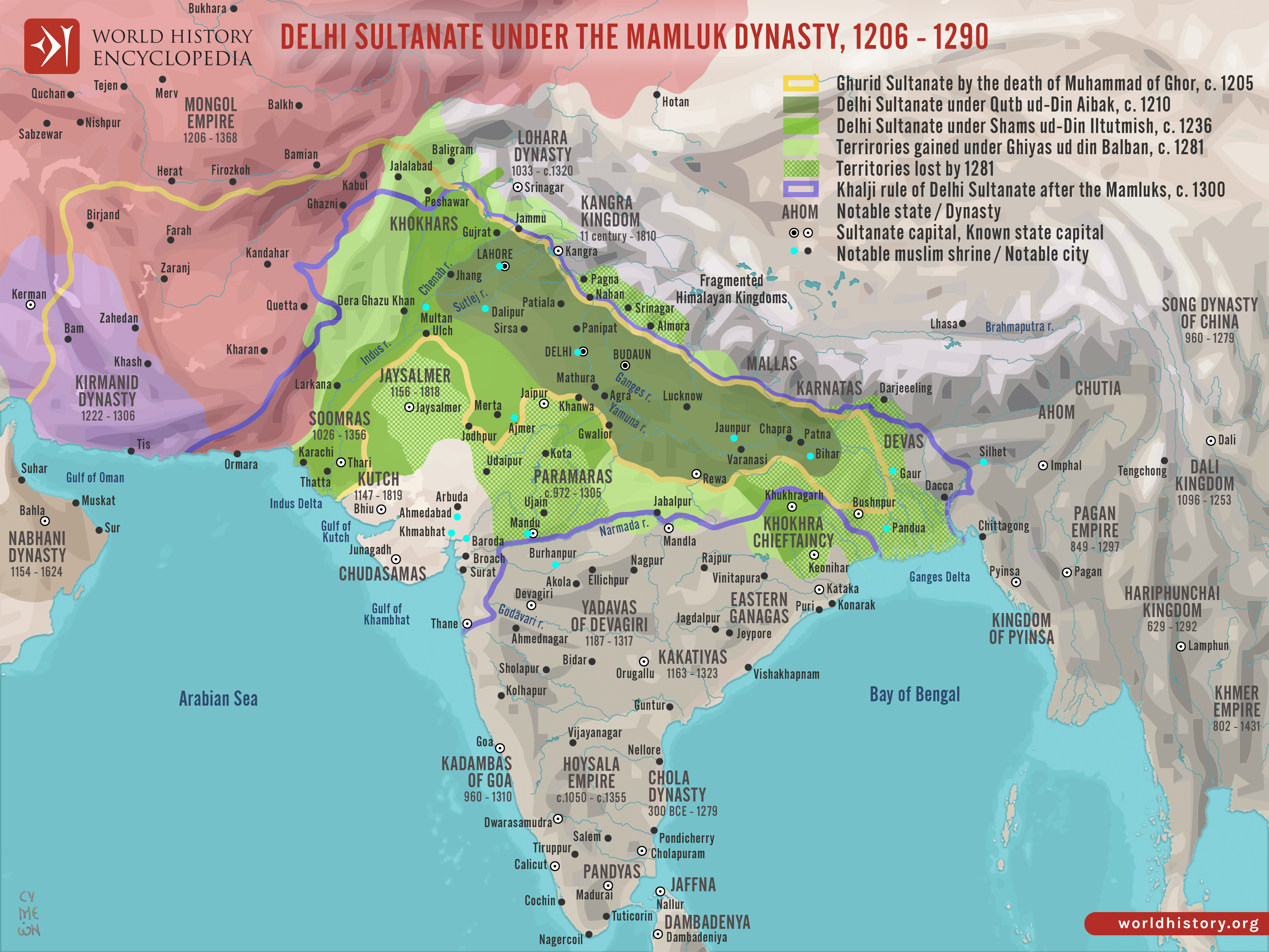
The Delhi Sultanate's Mamluk (or Slave) period (1206–1290) marked the emergence of a powerful Muslim-ruled state in northern [India](https://www.worldhistory.org/india/) following the breakup of the Ghurid [Empire](https://www.worldhistory.org/empire/). The term *mamlūk* (Arabic: "owned") refers to the military-slave origins of its early ruling elite. After [Muhammad](https://www.worldhistory.org/disambiguation/Muhammad/) of Ghor's assassination in 1206, his former commander Qutb ud-Din Aibak (reign 1206–1210) established independent rule. His successor, Shams ud-Din Iltutmish (reign 1211–1236), consolidated the sultanate around Delhi, strengthened the iqṭāʿ system of revenue assignments, and secured recognition from the [Abbasid caliphate](https://www.worldhistory.org/Abbasid_Dynasty/).
The sultanate's authority remained contested by Rajput polities, regional governors, and [Mongol](https://www.worldhistory.org/Mongol_Empire/) incursions along its northwestern frontier. Ghiyas ud-Din Balban (reign 1266–1287) reinforced royal authority, strengthened frontier defenses, and suppressed rebellions, notably in Bengal. Despite fluctuating territorial control, the Mamluks established durable military and administrative institutions that shaped medieval Indian governance and Indo-Islamic [culture](https://www.worldhistory.org/disambiguation/culture/). Their rule ended in 1290 when Jalal ud-Din Firuz Khalji founded a new ruling dynasty, continuing the Delhi Sultanate under the Khaljis.
#### Editorial Review
This human-authored image has been reviewed by our editorial team before publication to ensure accuracy, reliability and adherence to academic standards in accordance with our [editorial policy](https://www.worldhistory.org/static/editorial-policy/).
## About the Author
Simeon is a freelance visual designer and history educator, passionate about the human stories that shape the past.
- [Linkedin Profile](https://www.linkedin.com/in/simeon-netchev/)
## Cite This Work
### APA
Netchev, S. (2026, October 26). Map of the Rise of the Delhi Sultanate: Mamluk Dynasty: State Formation and Conquest in Medieval India, 1206–1290. *World History Encyclopedia*.
### Chicago
Netchev, Simeon. "Map of the Rise of the Delhi Sultanate: Mamluk Dynasty: State Formation and Conquest in Medieval India, 1206–1290." *World History Encyclopedia*, October 26, 2026. .
### MLA
Netchev, Simeon. "Map of the Rise of the Delhi Sultanate: Mamluk Dynasty: State Formation and Conquest in Medieval India, 1206–1290." *World History Encyclopedia*, 26 Oct 2026, .
## License & Copyright
Submitted by [Simeon Netchev](https://www.worldhistory.org/user/simeonnetchev/ "User Page: Simeon Netchev"), published on 26 October 2026. The copyright holder has published this content under the following license: [Creative Commons Attribution-NonCommercial-NoDerivs](https://creativecommons.org/licenses/by-nc/4.0deed.en). This licence only allows others to download this content and share it with others as long as the author is credited, but they can't change the content in any way or use it commercially. When republishing on the web a hyperlink back to the original content source URL must be included. Please note that content linked from this page may have different licensing terms.