---
title: Donkin Tin Can
author: Science Museum, London
source: https://www.worldhistory.org/image/17301/donkin-tin-can/
format: machine-readable-alternate
license: Creative Commons Attribution-NonCommercial-ShareAlike (https://creativecommons.org/licenses/by-nc-sa/4.0/)
updated: 2023-04-20
---
# Donkin Tin Can
_Authored by Science Museum, London_
## Image File
[](https://www.worldhistory.org/uploads/images/17301.png)
## Image Caption
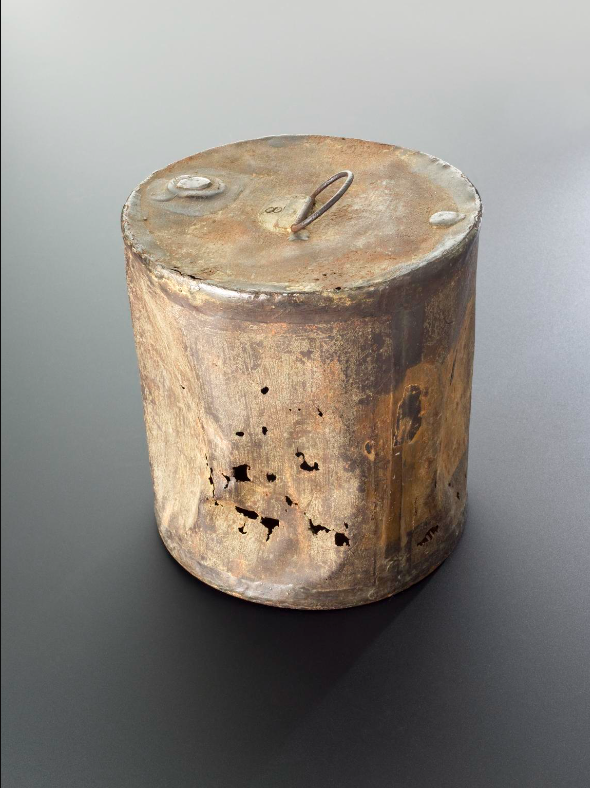
A Donkin tin can. The commercially viable tin can that preserved food was invented in 1811 by Bryan Donkin (1768-1855). Donkin built on the ideas of others to perfect a cheap and safe canning process. The idea was that soldiers, mariners, and explorers could take a food supply anywhere. Donkin ran his canning factory in London from 1813, the Donkin, Hall & Gamble Company. The cans were expensive and heavy – the lightest was 2 kilograms (4.4 lbs) – and needed to be opened using special tools, but they were used by both the military and polar explorers with success to preserve soup, meat, and vegetables.
[Science](https://www.worldhistory.org/science/) Museum, London.
## Cite This Work
### APA
London, S. M. (2023, April 18). Donkin Tin Can. *World History Encyclopedia*.
### Chicago
London, Science Museum,. "Donkin Tin Can." *World History Encyclopedia*, April 18, 2023. .
### MLA
London, Science Museum,. "Donkin Tin Can." *World History Encyclopedia*, 18 Apr 2023, .
## License & Copyright
[Original image](https://collection.sciencemuseumgroup.org.uk/objects/co8097425/tin-can-used-for-the-early-preservation-of-food-tin-can) by **Science Museum, London**. Submitted by [Mark Cartwright](https://www.worldhistory.org/user/markzcartwright/ "User Page: Mark Cartwright"), published on 18 April 2023. The copyright holder has published this content under the following license: [Creative Commons Attribution-NonCommercial-ShareAlike](https://creativecommons.org/licenses/by-nc-sa/4.0/deed.en). This license lets others remix, tweak, and build upon this content non-commercially, as long as they credit the author and license their new creations under the identical terms. When republishing on the web a hyperlink back to the original content source URL must be included. Please note that content linked from this page may have different licensing terms.