---
title: Map of Europe at the Peace of Westphalia, 1648: From the Thirty Years’ War to a New European Order
author: Simeon Netchev
source: https://www.worldhistory.org/image/17228/map-of-europe-at-the-peace-of-westphalia-1648/
format: machine-readable-alternate
license: Creative Commons Attribution-NonCommercial-NoDerivs (https://creativecommons.org/licenses/by-nc/4.0)
updated: 2026-03-18
---
# Map of Europe at the Peace of Westphalia, 1648: From the Thirty Years’ War to a New European Order
_Authored by [Simeon Netchev](https://www.worldhistory.org/user/simeonnetchev/)_
## Image File
[](https://www.worldhistory.org/uploads/images/17228.png)
## Image Caption
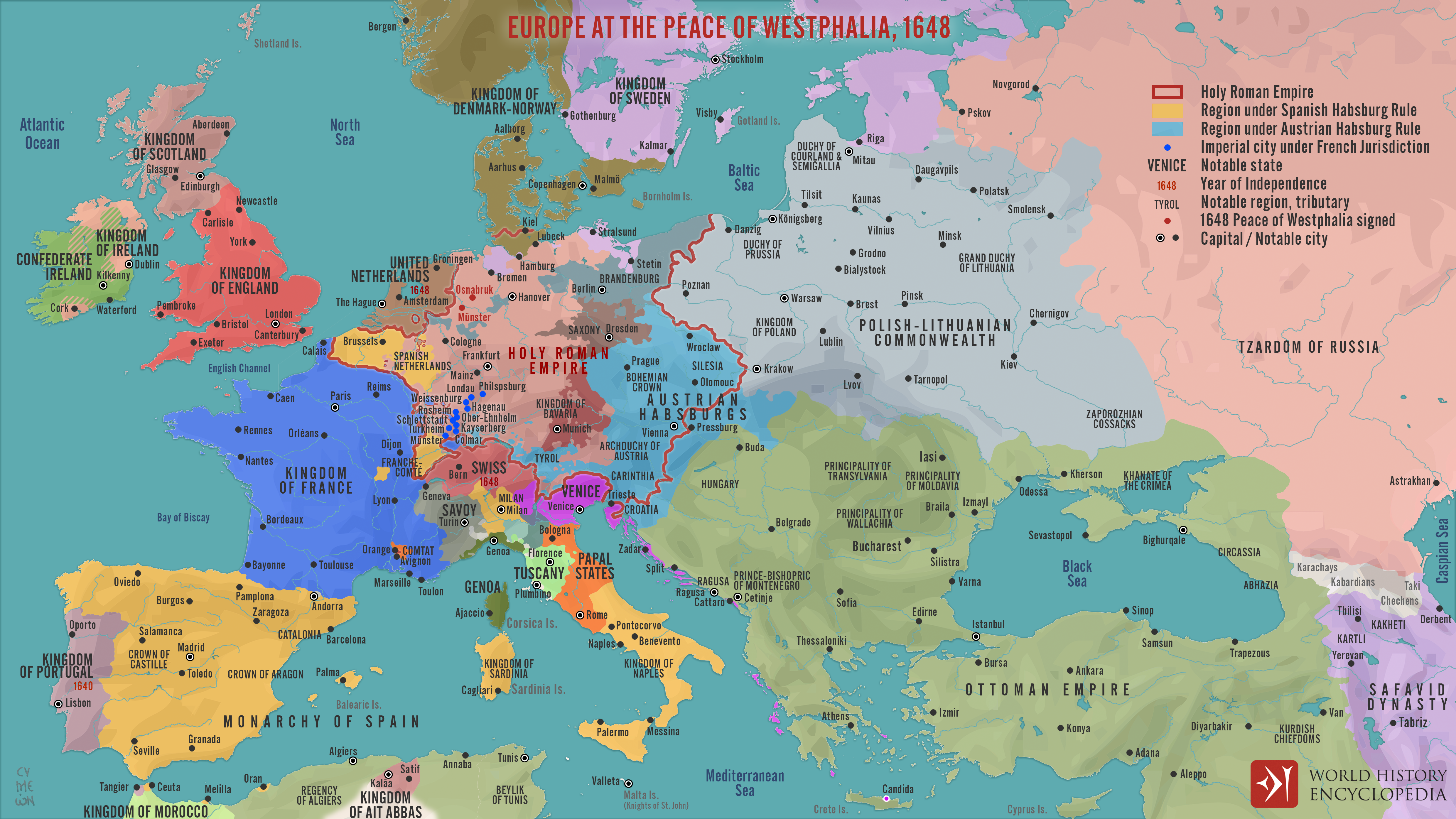
The [Peace of Westphalia](https://www.worldhistory.org/Peace_of_Westphalia/) (1648), concluded through treaties signed at Osnabrück and Münster (May-October 1648), marked the end of two major conflicts: the Thirty Years’ [War](https://www.worldhistory.org/disambiguation/War/) and the Eighty Years’ War. What began as a religious and dynastic struggle within the [Holy Roman Empire](https://www.worldhistory.org/Holy_Roman_Empire/) evolved into a wider contest involving major European powers. The settlement formally recognized the independence of the Dutch Republic from Spanish [Empire](https://www.worldhistory.org/empire/), and confirmed France and Sweden as key beneficiaries, shifting the balance of power away from Habsburg dominance.
Negotiated among more than one hundred delegations, the treaties restructured political authority within the empire by enhancing the autonomy of its constituent princes and [cities](https://www.worldhistory.org/city/), while limiting the universalist ambitions of the Habsburg emperors. The agreements reaffirmed and expanded earlier religious settlements, including recognition of Calvinism alongside Catholicism and Lutheranism, contributing to a more stable, though still contested, confessional order. Although not all European powers were directly represented, the Peace of Westphalia is often seen as a turning point in the development of interstate relations, reinforcing principles of territorial sovereignty, diplomatic negotiation, and legal equality among states that would shape European politics in the centuries that followed.
#### Editorial Review
This human-authored image has been reviewed by our editorial team before publication to ensure accuracy, reliability and adherence to academic standards in accordance with our [editorial policy](https://www.worldhistory.org/static/editorial-policy/).
## About the Author
Simeon is a freelance visual designer and history educator, passionate about the human stories that shape the past.
- [Linkedin Profile](https://www.linkedin.com/in/simeon-netchev/)
## Cite This Work
### APA
Netchev, S. (2026, March 18). Map of Europe at the Peace of Westphalia, 1648: From the Thirty Years’ War to a New European Order. *World History Encyclopedia*.
### Chicago
Netchev, Simeon. "Map of Europe at the Peace of Westphalia, 1648: From the Thirty Years’ War to a New European Order." *World History Encyclopedia*, March 18, 2026. .
### MLA
Netchev, Simeon. "Map of Europe at the Peace of Westphalia, 1648: From the Thirty Years’ War to a New European Order." *World History Encyclopedia*, 18 Mar 2026, .
## License & Copyright
Submitted by [Simeon Netchev](https://www.worldhistory.org/user/simeonnetchev/ "User Page: Simeon Netchev"), published on 18 March 2026. The copyright holder has published this content under the following license: [Creative Commons Attribution-NonCommercial-NoDerivs](https://creativecommons.org/licenses/by-nc/4.0deed.en). This licence only allows others to download this content and share it with others as long as the author is credited, but they can't change the content in any way or use it commercially. When republishing on the web a hyperlink back to the original content source URL must be included. Please note that content linked from this page may have different licensing terms.