---
title: The First Industrial Revolution, c. 1760 - 1840
author: Simeon Netchev
source: https://www.worldhistory.org/image/17099/the-first-industrial-revolution-c-1760---1840/
format: machine-readable-alternate
license: Creative Commons Attribution-NonCommercial-NoDerivs (https://creativecommons.org/licenses/by-nc/4.0)
updated: 2026-01-12
---
# The First Industrial Revolution, c. 1760 - 1840
_Authored by [Simeon Netchev](https://www.worldhistory.org/user/simeonnetchev/)_
## Image File
[](https://www.worldhistory.org/uploads/images/17099.png)
## Image Caption
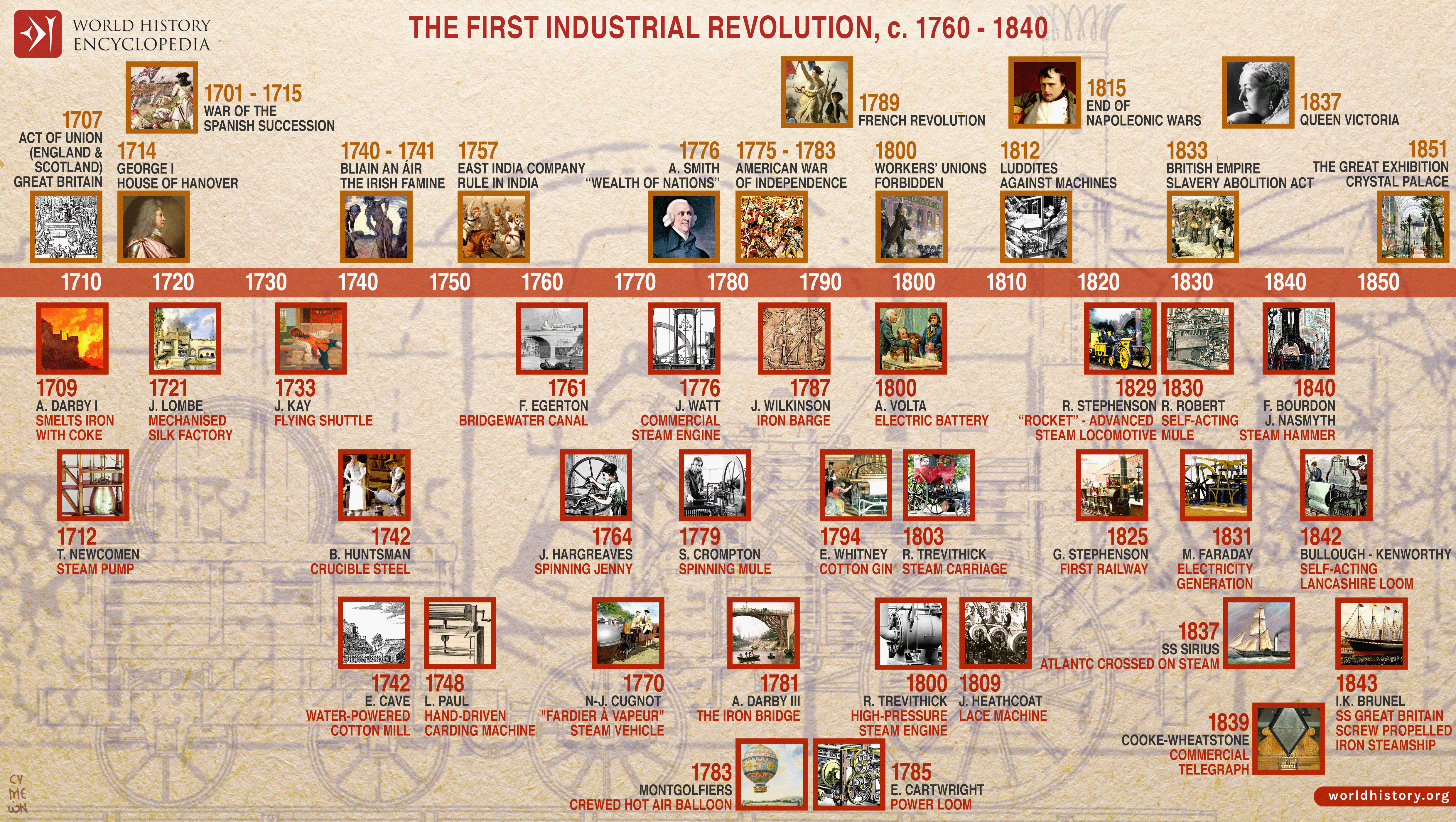
The First [Industrial Revolution](https://www.worldhistory.org/disambiguation/Industrial_Revolution/) refers to the profound economic and technological transformation that reshaped parts of [Europe](https://www.worldhistory.org/europe/) and North America between c. 1760 and 1840, first and most intensively in [Britain](https://www.worldhistory.org/disambiguation/Britain/) under monarchs such as George III (reign 1760–1820). The term Industrial Revolution was popularized in the 19th century by the historian Arnold Toynbee, building on earlier French usage, to describe the shift from agrarian, craft-based economies to systems centered on mechanized production, fossil energy, and wage labor. Driven by innovation in textiles, metallurgy, and steam power, production moved from homes and workshops into factories, accelerating output and transforming patterns of work, settlement, and wealth.
These technological changes triggered rapid [urbanization](https://www.worldhistory.org/urbanization/), altered class structures, and generated both unprecedented economic growth and severe social disruption. While early [industrialization](https://www.worldhistory.org/disambiguation/Industrialization/) brought productivity gains, it also produced harsh working conditions, environmental damage, and cyclical instability; by the late 1830s–1840s, economic downturns exposed the limits of early industrial systems. Yet innovations emerging toward the end of this phase, improved transport networks, advances in iron production, and early breakthroughs in communication technologies such as the electric telegraph, laid the foundations for later industrial phases.
#### Editorial Review
This human-authored image has been reviewed by our editorial team before publication to ensure accuracy, reliability and adherence to academic standards in accordance with our [editorial policy](https://www.worldhistory.org/static/editorial-policy/).
## About the Author
Simeon is a freelance visual designer and history educator, passionate about the human stories that shape the past.
- [Linkedin Profile](https://www.linkedin.com/in/simeon-netchev/)
## Cite This Work
### APA
Netchev, S. (2023, February 23). The First Industrial Revolution, c. 1760 - 1840. *World History Encyclopedia*.
### Chicago
Netchev, Simeon. "The First Industrial Revolution, c. 1760 - 1840." *World History Encyclopedia*, February 23, 2023. .
### MLA
Netchev, Simeon. "The First Industrial Revolution, c. 1760 - 1840." *World History Encyclopedia*, 23 Feb 2023, .
## License & Copyright
Submitted by [Simeon Netchev](https://www.worldhistory.org/user/simeonnetchev/ "User Page: Simeon Netchev"), published on 23 February 2023. The copyright holder has published this content under the following license: [Creative Commons Attribution-NonCommercial-NoDerivs](https://creativecommons.org/licenses/by-nc/4.0deed.en). This licence only allows others to download this content and share it with others as long as the author is credited, but they can't change the content in any way or use it commercially. When republishing on the web a hyperlink back to the original content source URL must be included. Please note that content linked from this page may have different licensing terms.