---
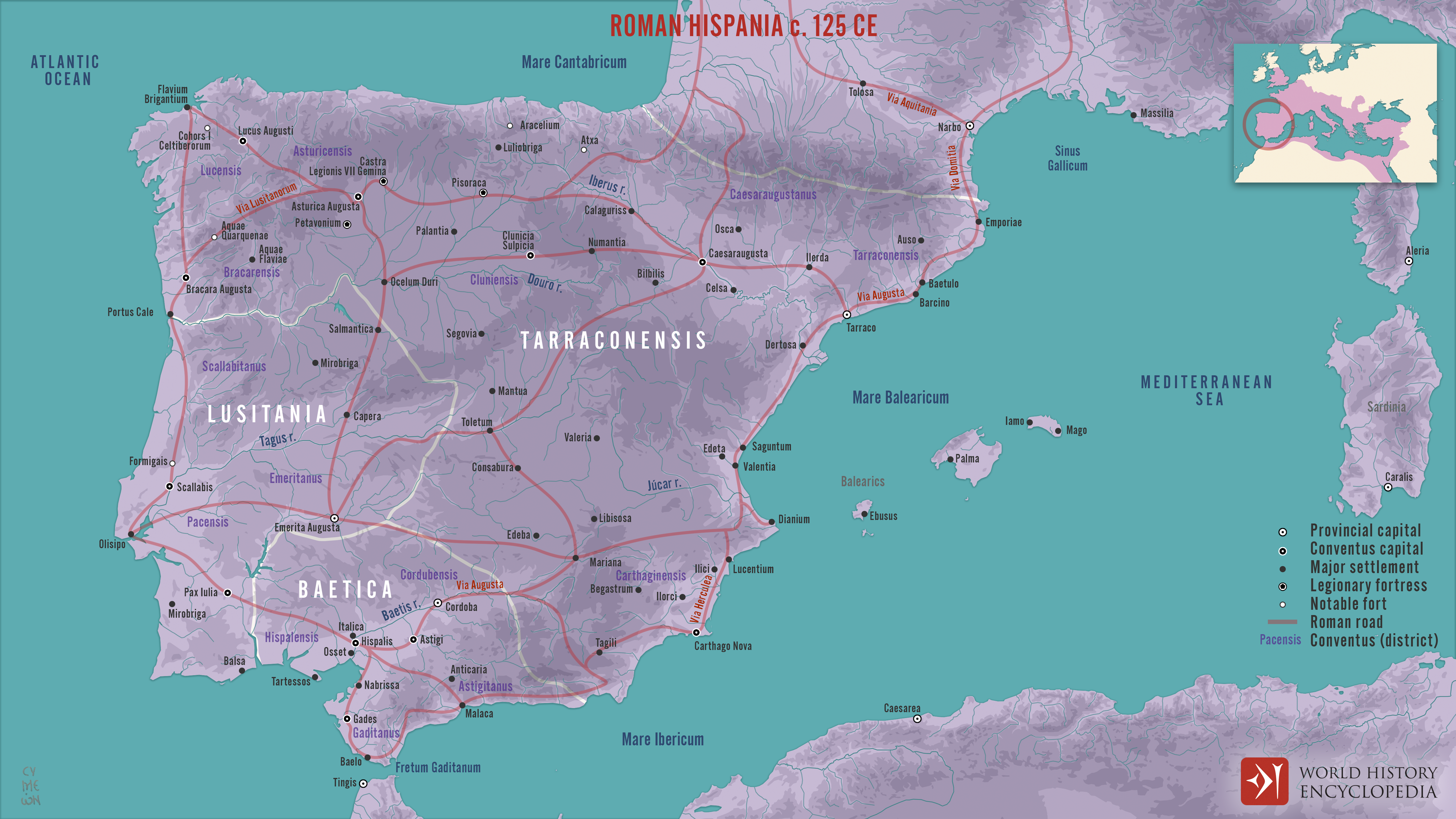
title: Map of Roman Hispania c. 125 CE
author: Simeon Netchev
source: https://www.worldhistory.org/image/16928/map-of-roman-hispania-c-125-ce/
format: machine-readable-alternate
license: Creative Commons Attribution-NonCommercial-NoDerivs (https://creativecommons.org/licenses/by-nc/4.0)
updated: 2025-10-03
---
# Map of Roman Hispania c. 125 CE
_Authored by [Simeon Netchev](https://www.worldhistory.org/user/simeonnetchev/)_
## Image File
[](https://www.worldhistory.org/uploads/images/16928.png)
## Image Caption
The [Roman](https://www.worldhistory.org/disambiguation/Roman/) provinces in Hispania (206 BCE–c. 474 CE) illustrate both the persistence of Roman expansion and the durability of imperial rule. The [conquest](https://www.worldhistory.org/warfare/) began in the [Second Punic War](https://www.worldhistory.org/Second_Punic_War/), when [Rome](https://www.worldhistory.org/Rome/) displaced [Carthage](https://www.worldhistory.org/carthage/) in 206 BCE, and unfolded over nearly two centuries as legions subdued Iberian and Celtiberian peoples. By the reign of [Augustus](https://www.worldhistory.org/augustus/) (27 BCE–14 CE), the peninsula was reorganized into formal provinces, with Hispania Tarraconensis, Baetica, and Lusitania forming the core. These regions supplied the [empire](https://www.worldhistory.org/empire/) with [silver](https://www.worldhistory.org/Silver/), [gold](https://www.worldhistory.org/gold/), olive oil, and grain, while also serving as a recruiting ground for Roman armies.
Over the following five centuries, Hispania became one of the most thoroughly Romanized areas of the West. [Cities](https://www.worldhistory.org/city/) like Emerita Augusta (Mérida), Italica, and Tarraco flourished with theaters, [aqueducts](https://www.worldhistory.org/aqueduct/), and forums, while Latin language, [Roman law](https://www.worldhistory.org/Roman_Law/), and [Christianity](https://www.worldhistory.org/christianity/) took deep root. Hispania produced notable emperors, including [Trajan](https://www.worldhistory.org/trajan/) (98–117 CE) and [Hadrian](https://www.worldhistory.org/hadrian/) (117–138 CE). Even as the Western Empire crumbled in the 5th century, northeastern Hispania remained under nominal Roman control until c. 474 CE, outlasting many other provinces and leaving a legacy of cultural and institutional continuity that shaped medieval [Iberia](https://www.worldhistory.org/disambiguation/iberia/).
#### Editorial Review
This human-authored image has been reviewed by our editorial team before publication to ensure accuracy, reliability and adherence to academic standards in accordance with our [editorial policy](https://www.worldhistory.org/static/editorial-policy/).
## About the Author
Simeon is a freelance visual designer and history educator, passionate about the human stories that shape the past.
- [Linkedin Profile](https://www.linkedin.com/in/simeon-netchev/)
## Cite This Work
### APA
Netchev, S. (2023, February 01). Map of Roman Hispania c. 125 CE. *World History Encyclopedia*.
### Chicago
Netchev, Simeon. "Map of Roman Hispania c. 125 CE." *World History Encyclopedia*, February 01, 2023. .
### MLA
Netchev, Simeon. "Map of Roman Hispania c. 125 CE." *World History Encyclopedia*, 01 Feb 2023, .
## License & Copyright
Submitted by [Simeon Netchev](https://www.worldhistory.org/user/simeonnetchev/ "User Page: Simeon Netchev"), published on 01 February 2023. The copyright holder has published this content under the following license: [Creative Commons Attribution-NonCommercial-NoDerivs](https://creativecommons.org/licenses/by-nc/4.0deed.en). This licence only allows others to download this content and share it with others as long as the author is credited, but they can't change the content in any way or use it commercially. When republishing on the web a hyperlink back to the original content source URL must be included. Please note that content linked from this page may have different licensing terms.