---
title: Greek Bireme on an Etruscan Water Jar
author: The Trustees of the British Museum
source: https://www.worldhistory.org/image/16458/greek-bireme-on-an-etruscan-water-jar/
format: machine-readable-alternate
license: Creative Commons Attribution-NonCommercial-ShareAlike (https://creativecommons.org/licenses/by-nc-sa/4.0/)
updated: 2022-10-06
---
# Greek Bireme on an Etruscan Water Jar
_Authored by The Trustees of the British Museum_
## Image File
[](https://www.worldhistory.org/uploads/images/16458.jpg)
## Image Caption
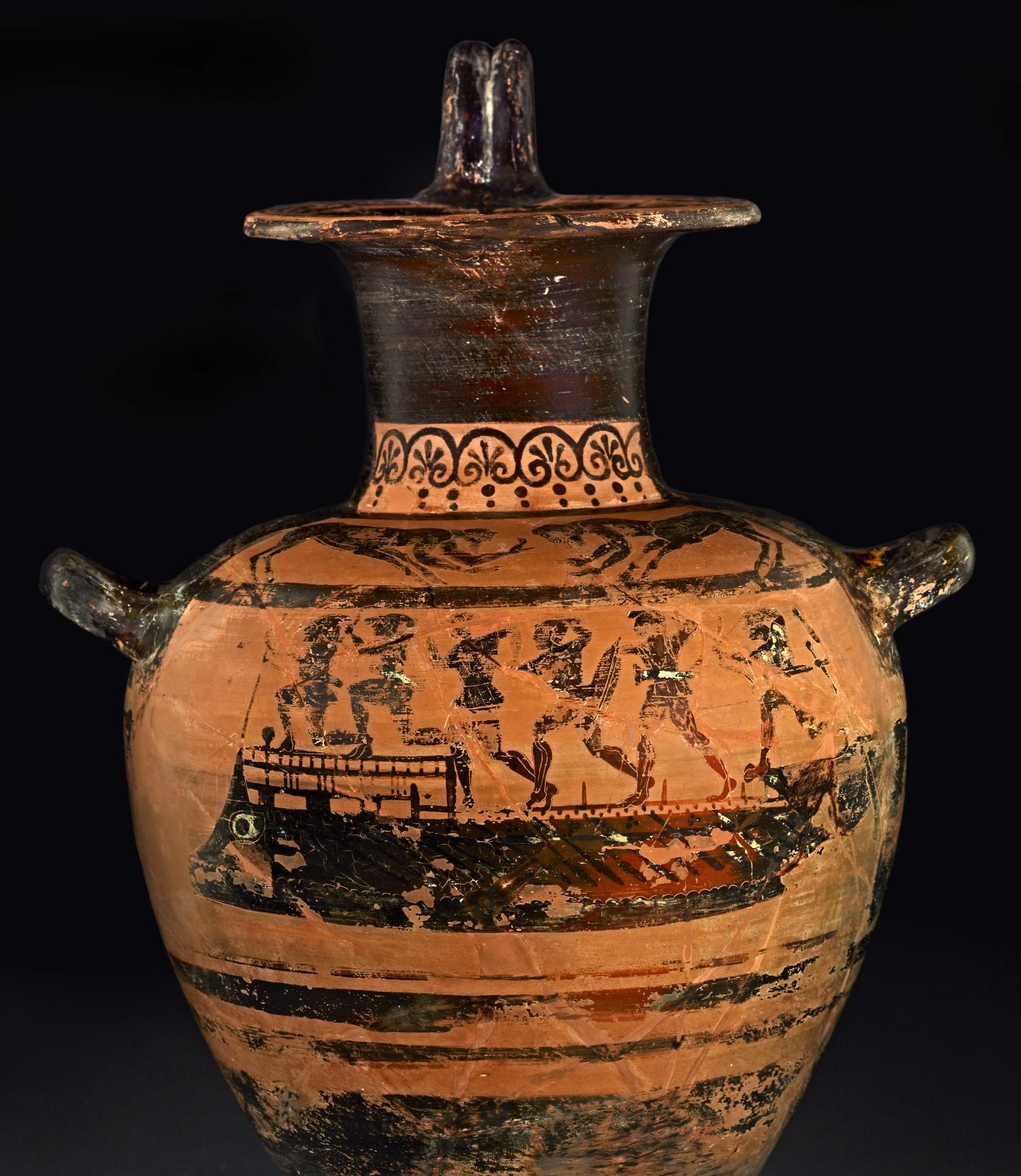
Black-figure hydria from [Vulci](https://www.worldhistory.org/Vulci/), [Etruria](https://www.worldhistory.org/Etruscan_Civilization/), attributed to the Micali Painter, c. 510-500 BCE.
The British Museum, London
This Italiote reproduction of the [Greek](https://www.worldhistory.org/disambiguation/greek/) naval invasion of [Troy](https://www.worldhistory.org/troy/) based on the *[Iliad](https://www.worldhistory.org/iliad/)* is shaped around a bireme (*diiris*), the Greek [Archaic](https://www.worldhistory.org/disambiguation/Archaic/) warship invented sometime prior to the 6th century BCE and continued to be in use way into the [Roman](https://www.worldhistory.org/disambiguation/Roman/) era. The typical bireme, developed from the earlier 30-meter long penteconter (fifty-oared), was at least 50 m longer but relatively narrower to increase the swiftness and speed and to make it difficult for enemy troops to jump on board in clusters. The elongated shape of the bireme made it distinctive from round-shaped cargo ships. As represented on this vase, each bireme was manned by hoplites and archers with the relative frequency of 4:1 or 5:1. Biremes were decorated by massive staring eyes near the stern and a zoomorphic ram, here a boar's head, crowning the bow to strike and sink enemy ships. In the first half of the 6th century BCE, a wider model of the bireme, *samaina*, was invented on the island of [Samos](https://www.worldhistory.org/samos/) under [Polycrates](https://www.worldhistory.org/Polycrates/) (r. 539-522 BCE). Unlike the battleship bireme that had rails and no decks, *samaina* ships lacked the rail and were covered up by a bow-to-stern deck. These features made them suitable for both [warfare](https://www.worldhistory.org/warfare/) and [trade](https://www.worldhistory.org/disambiguation/trade/) thanks to their covered-up and capacious hull.
## Bibliography
- [Giant Hellenistic Warships](http://www.hellenicaworld.com/Greece/Technology/en/GiantShips.html "Giant Hellenistic Warships"), accessed 29 Sep 2022.
- [Sea Vessel Samaina - Archaeology Wiki](https://www.archaeology.wiki/blog/issue/sea-vessel-samaina/ "Sea Vessel Samaina - Archaeology Wiki"), accessed 29 Sep 2022.
## Cite This Work
### APA
Museum, T. T. o. t. B. (2022, October 06). Greek Bireme on an Etruscan Water Jar. *World History Encyclopedia*.
### Chicago
Museum, The Trustees of the British. "Greek Bireme on an Etruscan Water Jar." *World History Encyclopedia*, October 06, 2022. .
### MLA
Museum, The Trustees of the British. "Greek Bireme on an Etruscan Water Jar." *World History Encyclopedia*, 06 Oct 2022, .
## License & Copyright
The British Museum has released this image under a Creative Commons Attribution-NonCommercial-ShareAlike 4.0 International ([CC BY-NC-SA 4.0](https://creativecommons.org/licenses/by-nc-sa/4.0/)) license. You can read more about the British Museum and Creative Commons [here](https://www.britishmuseum.org/about_this_site/terms_of_use/copyright_and_permissions.aspx). [Original image](https://www.britishmuseum.org/collection/object/G_1836-0224-228) by [**The Trustees of the British Museum**](https://www.britishmuseum.org/collection/object/G_1836-0224-228). Submitted by [Nathalie Choubineh](https://www.worldhistory.org/user/nathalie.choubineh/ "User Page: Nathalie Choubineh"), published on 06 October 2022. The copyright holder has published this content under the following license: [Creative Commons Attribution-NonCommercial-ShareAlike](https://creativecommons.org/licenses/by-nc-sa/4.0/deed.en). This license lets others remix, tweak, and build upon this content non-commercially, as long as they credit the author and license their new creations under the identical terms. When republishing on the web a hyperlink back to the original content source URL must be included. Please note that content linked from this page may have different licensing terms.