---
title: Map of the East India Company Trade, c.1800
author: Simeon Netchev
source: https://www.worldhistory.org/image/16446/map-of-the-east-india-company-trade-c1800/
format: machine-readable-alternate
license: Creative Commons Attribution-NonCommercial-NoDerivs (https://creativecommons.org/licenses/by-nc/4.0)
updated: 2025-12-20
---
# Map of the East India Company Trade, c.1800
_Authored by [Simeon Netchev](https://www.worldhistory.org/user/simeonnetchev/)_
## Image File
[](https://www.worldhistory.org/uploads/images/16446.png)
## Image Caption
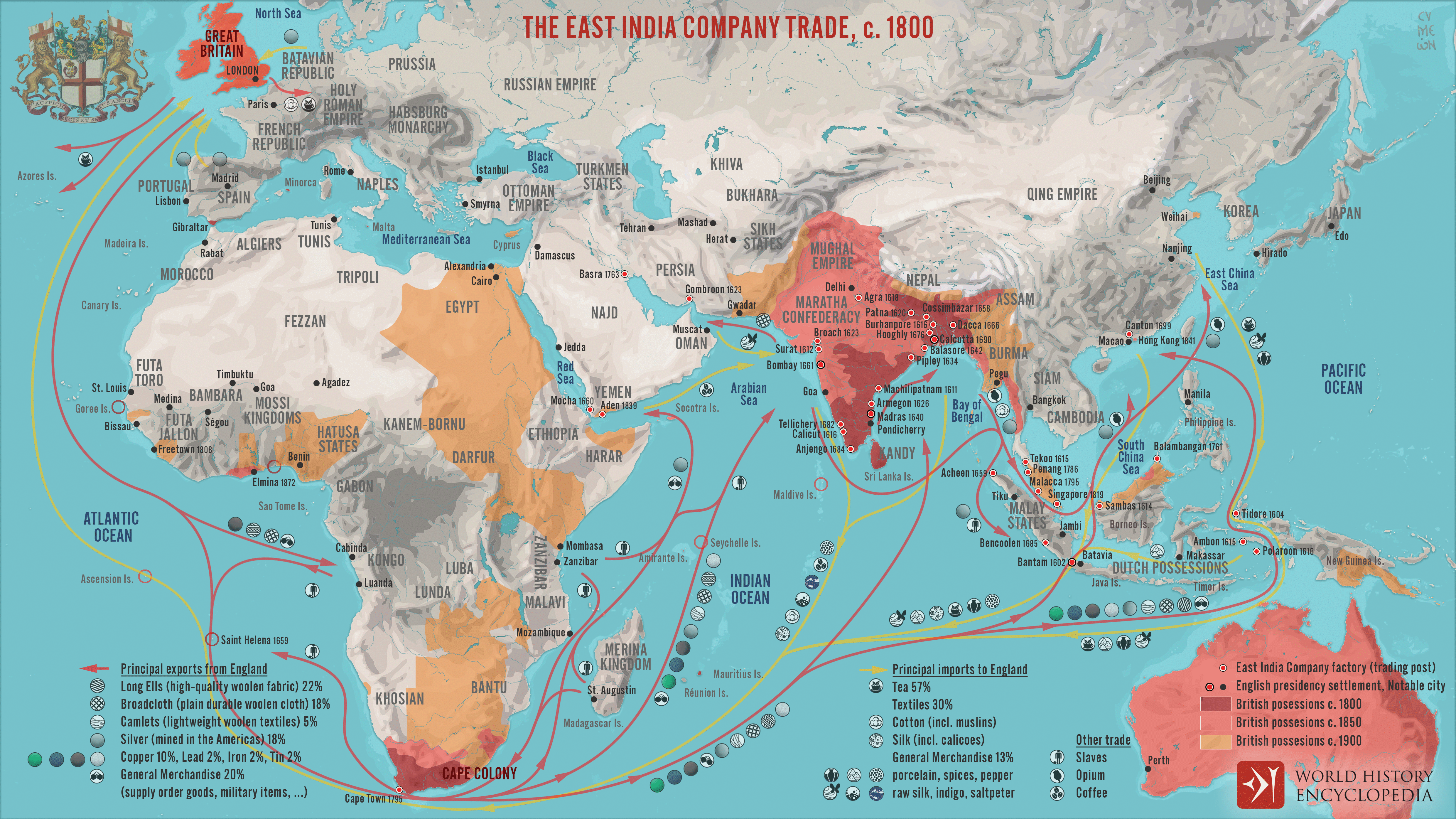
The English [East India Company](https://www.worldhistory.org/East_India_Company/) (EIC) was established by Royal Charter on 31 December 1600 under Queen Elizabeth I (reign 1558–1603), granting it a monopoly on English [trade](https://www.worldhistory.org/disambiguation/trade/) east of the Cape of Good Hope. Initially conceived as a commercial enterprise, the Company focused on high-value Asian goods, such as spices, textiles, tea, and later opium, traded across [India](https://www.worldhistory.org/india/), Southeast Asia, and [China](https://www.worldhistory.org/china/). By the early 17th century, the EIC had established a growing network of coastal trading posts (“factories”), embedding itself within existing Indian Ocean trade systems while competing with Portuguese and Dutch rivals. Its success reflected broader early modern trends: maritime expansion, mercantilism, and the integration of distant markets into a global [economy](https://www.worldhistory.org/disambiguation/economy/).
Over the 18th century, the Company evolved from a trading corporation into a powerful territorial and military force. By c. 1700, it was conducting dozens of annual voyages to Asia and maintaining its own shipyards, merchant fleet, and thousands of sailors. Following its military victories in India, especially after Plassey (1757), the EIC increasingly exercised political authority, culminating in a private army of roughly 260,000 men by 1803, larger than that of many European states. By c. 1800, the Company accounted for nearly half of [Britain](https://www.worldhistory.org/disambiguation/Britain/)’s global trade, illustrating how commercial capitalism, state support, and military power could merge into a single imperial system.
#### Editorial Review
This human-authored image has been reviewed by our editorial team before publication to ensure accuracy, reliability and adherence to academic standards in accordance with our [editorial policy](https://www.worldhistory.org/static/editorial-policy/).
## About the Author
Simeon is a freelance visual designer and history educator, passionate about the human stories that shape the past.
- [Linkedin Profile](https://www.linkedin.com/in/simeon-netchev/)
## Cite This Work
### APA
Netchev, S. (2025, December 20). Map of the East India Company Trade, c.1800. *World History Encyclopedia*.
### Chicago
Netchev, Simeon. "Map of the East India Company Trade, c.1800." *World History Encyclopedia*, December 20, 2025. .
### MLA
Netchev, Simeon. "Map of the East India Company Trade, c.1800." *World History Encyclopedia*, 20 Dec 2025, .
## License & Copyright
Submitted by [Simeon Netchev](https://www.worldhistory.org/user/simeonnetchev/ "User Page: Simeon Netchev"), published on 20 December 2025. The copyright holder has published this content under the following license: [Creative Commons Attribution-NonCommercial-NoDerivs](https://creativecommons.org/licenses/by-nc/4.0deed.en). This licence only allows others to download this content and share it with others as long as the author is credited, but they can't change the content in any way or use it commercially. When republishing on the web a hyperlink back to the original content source URL must be included. Please note that content linked from this page may have different licensing terms.