---
title: Map of the Median Hegemony, c. 600 BCE: Power, Influence & Transition in Western Asia after Assyria
author: Simeon Netchev
source: https://www.worldhistory.org/image/16317/map-of-the-median-hegemony-c-600-bce/
format: machine-readable-alternate
license: Creative Commons Attribution-NonCommercial-NoDerivs (https://creativecommons.org/licenses/by-nc/4.0)
updated: 2026-05-05
---
# Map of the Median Hegemony, c. 600 BCE: Power, Influence & Transition in Western Asia after Assyria
_Authored by [Simeon Netchev](https://www.worldhistory.org/user/simeonnetchev/)_
## Image File
[](https://www.worldhistory.org/uploads/images/16317.png)
## Image Caption
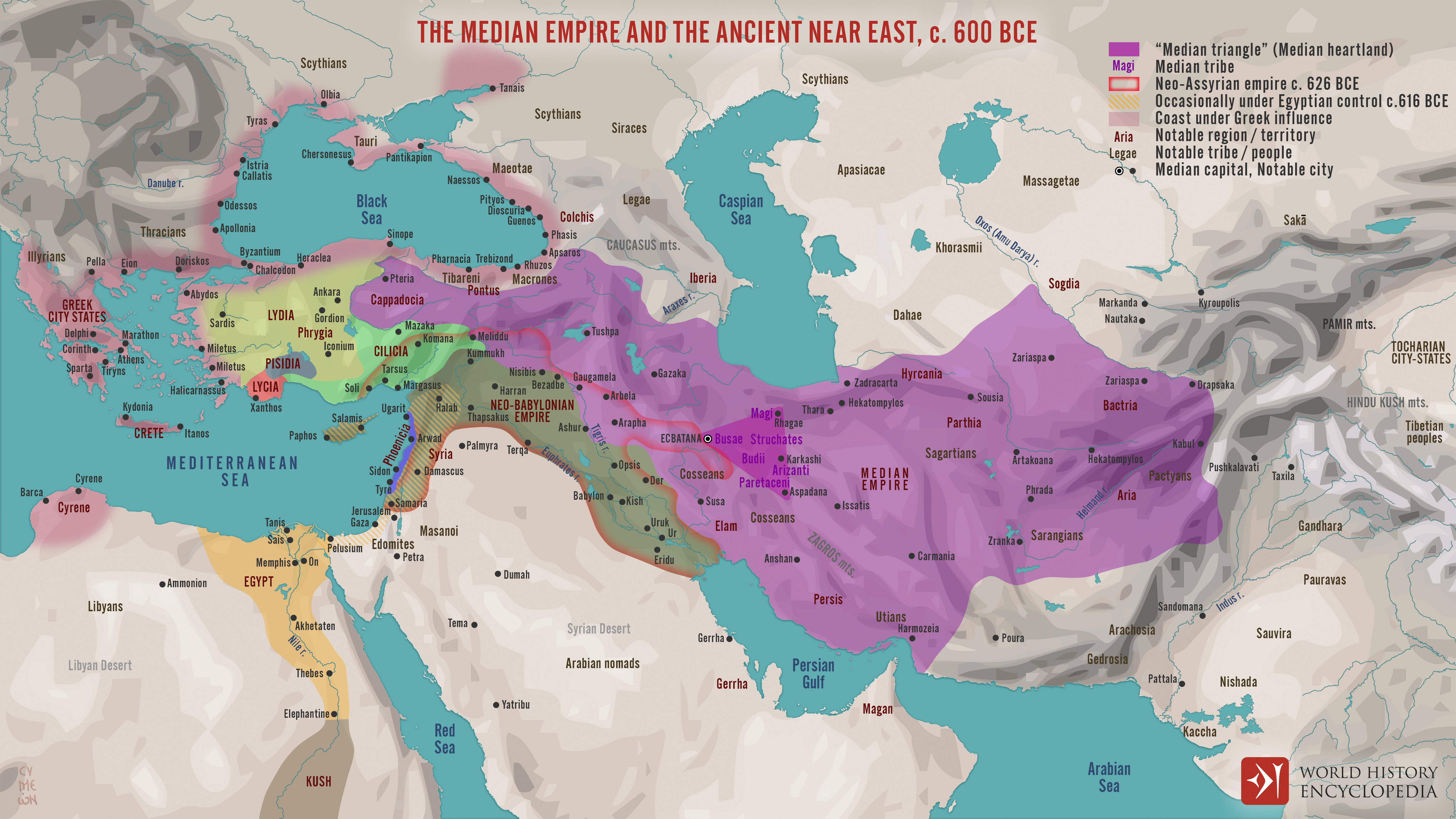
The Median hegemony (late 7th-early 6th century BCE) emerged in the aftermath of the [Bronze Age Collapse](https://www.worldhistory.org/Bronze_Age_Collapse/) (c. 1200-1150 BCE) and, more directly, the disintegration of the [Neo-Assyrian Empire](https://www.worldhistory.org/Neo-Assyrian_Empire/) (to 612/609 BCE). Under rulers such as Cyaxares (reign c. 625–585 BCE), Median power expanded across the Iranian plateau and into eastern [Anatolia](https://www.worldhistory.org/Asia_Minor/), contributing to the final defeat of [Assyria](https://www.worldhistory.org/assyria/) in alliance with the Neo-Babylonian king Nabopolassar (reign 626–605 BCE). In the west, [Lydia](https://www.worldhistory.org/lydia/) consolidated control under Alyattes (reign c. 619–560 BCE), while in [Mesopotamia](https://www.worldhistory.org/Mesopotamia/) the Neo-Babylonian [Empire](https://www.worldhistory.org/empire/) (626–539 BCE) dominated the [Fertile Crescent](https://www.worldhistory.org/Fertile_Crescent/) from the [Levant](https://www.worldhistory.org/levant/) to the Tigris and Euphrates.
Median authority, however, was not expressed through continuous territorial administration but through a shifting network of alliances, tribute relations, and regional influence. While Median power extended toward the Caucasus, the Caspian basin, and eastward into regions later known as [Parthia](https://www.worldhistory.org/disambiguation/Parthia/), [Aria](https://www.worldhistory.org/aria/), and [Bactria](https://www.worldhistory.org/Bactria/), these areas functioned as loosely connected zones rather than integrated provinces. Frontier regions, especially the steppe, highlands, and eastern corridors toward the Indus, remained fluid, inhabited by groups such as the [Scythians](https://www.worldhistory.org/Scythians/), Dahae, and other mobile societies whose autonomy limited the reach of centralized control.
#### Editorial Review
This human-authored image has been reviewed by our editorial team before publication to ensure accuracy, reliability and adherence to academic standards in accordance with our [editorial policy](https://www.worldhistory.org/static/editorial-policy/).
## About the Author
Simeon is a freelance visual designer and history educator, passionate about the human stories that shape the past.
- [Linkedin Profile](https://www.linkedin.com/in/simeon-netchev/)
## Cite This Work
### APA
Netchev, S. (2026, May 05). Map of the Median Hegemony, c. 600 BCE: Power, Influence & Transition in Western Asia after Assyria. *World History Encyclopedia*.
### Chicago
Netchev, Simeon. "Map of the Median Hegemony, c. 600 BCE: Power, Influence & Transition in Western Asia after Assyria." *World History Encyclopedia*, May 05, 2026. .
### MLA
Netchev, Simeon. "Map of the Median Hegemony, c. 600 BCE: Power, Influence & Transition in Western Asia after Assyria." *World History Encyclopedia*, 05 May 2026, .
## License & Copyright
Submitted by [Simeon Netchev](https://www.worldhistory.org/user/simeonnetchev/ "User Page: Simeon Netchev"), published on 05 May 2026. The copyright holder has published this content under the following license: [Creative Commons Attribution-NonCommercial-NoDerivs](https://creativecommons.org/licenses/by-nc/4.0deed.en). This licence only allows others to download this content and share it with others as long as the author is credited, but they can't change the content in any way or use it commercially. When republishing on the web a hyperlink back to the original content source URL must be included. Please note that content linked from this page may have different licensing terms.