---
title: Imperial Dynasties of China Visual Timeline
author: Simeon Netchev
source: https://www.worldhistory.org/image/16125/imperial-dynasties-of-china-visual-timeline/
format: machine-readable-alternate
license: Creative Commons Attribution-NonCommercial-NoDerivs (https://creativecommons.org/licenses/by-nc/4.0)
updated: 2026-02-10
---
# Imperial Dynasties of China Visual Timeline
_Authored by [Simeon Netchev](https://www.worldhistory.org/user/simeonnetchev/)_
## Image File
[](https://www.worldhistory.org/uploads/images/16125.png)
## Image Caption
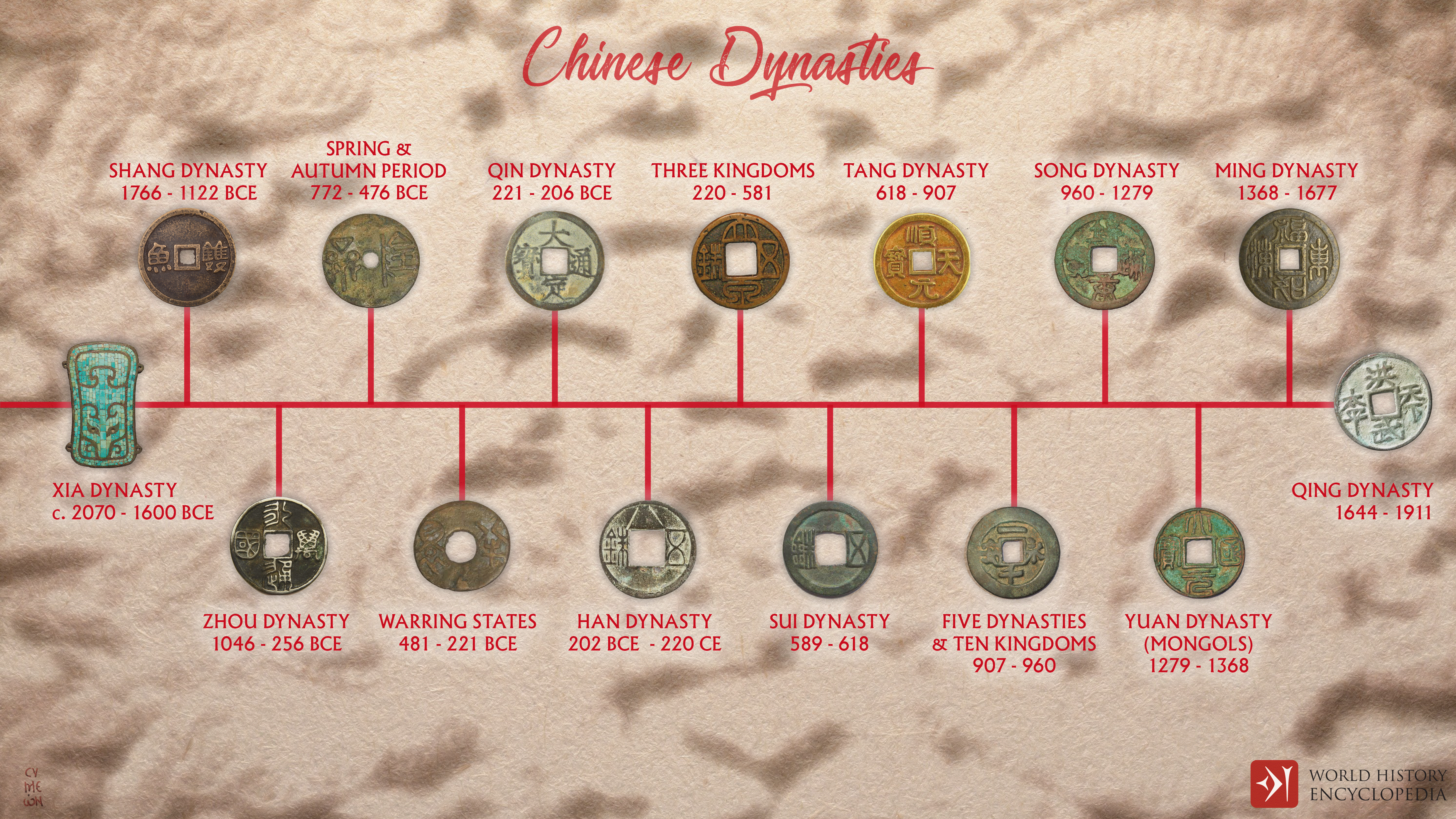
The history of Chinese imperial rule traditionally begins with the semi-legendary [Xia dynasty](https://www.worldhistory.org/Xia_Dynasty/) (traditionally dated c. 2070–1600 BCE) and unfolds through a succession of ruling houses that shaped one of the world’s most continuous state traditions. From the Shang (c. 1600–1046 BCE) and [Zhou](https://www.worldhistory.org/Zhou_Dynasty/) (c. 1046–256 BCE), which articulated the [Mandate of Heaven](https://www.worldhistory.org/Mandate_of_Heaven/) as a principle of dynastic legitimacy, to the Qin unification under [Qin Shi Huang](https://www.worldhistory.org/Shi_Huangdi/) (reign 221–210 BCE) and the consolidation of imperial institutions under the [Han](https://www.worldhistory.org/Han_Dynasty/) (206 BCE–220 CE), Chinese emperors governed vast territories through evolving administrative systems. Across periods of unity and fragmentation, imperial authority rested on bureaucratic governance, Confucian state ideology, and control over agrarian and commercial resources.
Foreign [conquest](https://www.worldhistory.org/warfare/) also became part of this dynastic cycle. The [Mongol](https://www.worldhistory.org/Mongol_Empire/)-led [Yuan dynasty](https://www.worldhistory.org/Yuan_Dynasty/) under [Kublai Khan](https://www.worldhistory.org/Kublai_Khan/) (reign 1260–1294; Yuan rule 1271–1368) integrated [China](https://www.worldhistory.org/china/) into a wider Eurasian [empire](https://www.worldhistory.org/empire/), while the Manchu Qing dynasty (1644–1912) expanded imperial frontiers to their greatest territorial extent under emperors such as Kangxi (reign 1661–1722) and Qianlong (reign 1735–1796). Yet the same structural pressures, fiscal strain, internal rebellion, and external challenge, that had toppled earlier dynasties resurfaced in the 19th century. The abdication of the Xuantong Emperor (Puyi, reign 1908–1912) marked the end of over two millennia of imperial governance. Across these transitions, the Chinese dynastic model demonstrated both remarkable continuity and repeated reinvention, linking political legitimacy to moral authority, territorial control, and administrative adaptability.
#### Editorial Review
This human-authored image has been reviewed by our editorial team before publication to ensure accuracy, reliability and adherence to academic standards in accordance with our [editorial policy](https://www.worldhistory.org/static/editorial-policy/).
## About the Author
Simeon is a freelance visual designer and history educator, passionate about the human stories that shape the past.
- [Linkedin Profile](https://www.linkedin.com/in/simeon-netchev/)
## Cite This Work
### APA
Netchev, S. (2022, July 11). Imperial Dynasties of China Visual Timeline. *World History Encyclopedia*.
### Chicago
Netchev, Simeon. "Imperial Dynasties of China Visual Timeline." *World History Encyclopedia*, July 11, 2022. .
### MLA
Netchev, Simeon. "Imperial Dynasties of China Visual Timeline." *World History Encyclopedia*, 11 Jul 2022, .
## License & Copyright
Submitted by [Simeon Netchev](https://www.worldhistory.org/user/simeonnetchev/ "User Page: Simeon Netchev"), published on 11 July 2022. The copyright holder has published this content under the following license: [Creative Commons Attribution-NonCommercial-NoDerivs](https://creativecommons.org/licenses/by-nc/4.0deed.en). This licence only allows others to download this content and share it with others as long as the author is credited, but they can't change the content in any way or use it commercially. When republishing on the web a hyperlink back to the original content source URL must be included. Please note that content linked from this page may have different licensing terms.