---
title: Map of the Early Christian Pilgrimage (4th-5th Century)
author: Simeon Netchev
source: https://www.worldhistory.org/image/16025/map-of-the-early-christian-pilgrimage-4th-5th-cent/
format: machine-readable-alternate
license: Creative Commons Attribution-NonCommercial-NoDerivs (https://creativecommons.org/licenses/by-nc/4.0)
updated: 2025-10-09
---
# Map of the Early Christian Pilgrimage (4th-5th Century)
_Authored by [Simeon Netchev](https://www.worldhistory.org/user/simeonnetchev/)_
## Image File
[](https://www.worldhistory.org/uploads/images/16025.png)
## Image Caption
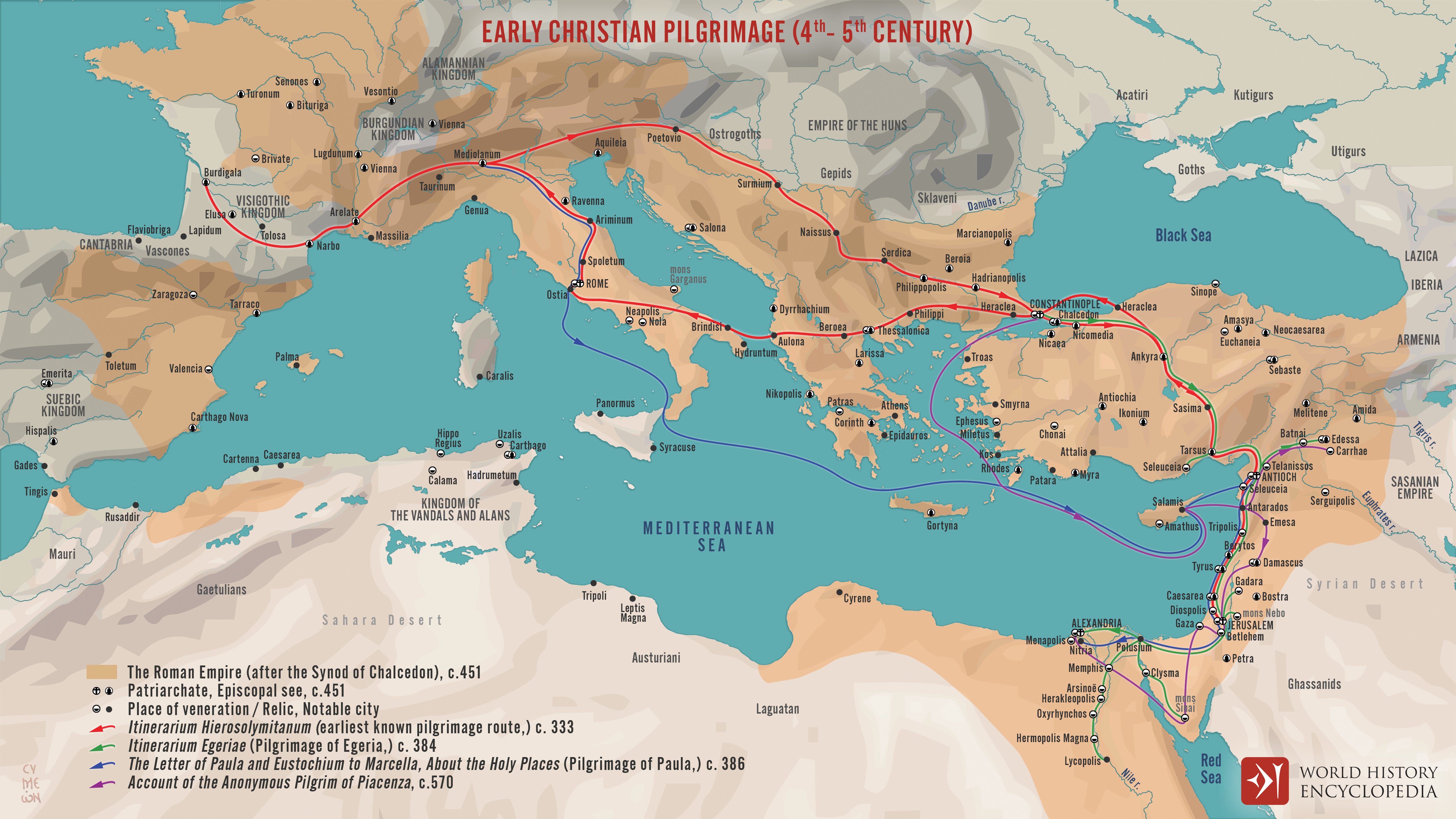
The rise of Christian pilgrimage begins after the conversion of Emperor [Constantine](https://www.worldhistory.org/disambiguation/Constantine/) (reign 306–337 CE) and the legalization of [Christianity](https://www.worldhistory.org/christianity/) in the Edict of Milan (313 CE). The word pilgrim comes from the Latin *peregrinus* meaning “stranger” or “one on a journey,” reflecting both physical travel and spiritual quest. From the 4th century onward, journeys to holy places became an integral part of Christian practice. The emergence of the idea of a “Holy Land” gave the faith a tangible dimension, linking belief to geography and reinforcing the new role of [Jerusalem](https://www.worldhistory.org/jerusalem/) and other sacred sites in the Christian imagination.
Christian pilgrimage built on older [Roman](https://www.worldhistory.org/disambiguation/Roman/) and [Greek](https://www.worldhistory.org/disambiguation/greek/) traditions of sacred places but expanded through the cult of saints and martyrs. Relics were seen as vessels of divine presence, drawing believers to shrines and creating a new sacred landscape stretching from Jerusalem to the edges of Christendom. These journeys required time, resources, and resilience, exposing pilgrims to physical danger and moral trial. Yet they flourished across late antiquity and the Middle Ages, becoming central acts of devotion, shaping Christian identity, and connecting local communities to a wider spiritual world.
#### Editorial Review
This human-authored image has been reviewed by our editorial team before publication to ensure accuracy, reliability and adherence to academic standards in accordance with our [editorial policy](https://www.worldhistory.org/static/editorial-policy/).
## About the Author
Simeon is a freelance visual designer and history educator, passionate about the human stories that shape the past.
- [Linkedin Profile](https://www.linkedin.com/in/simeon-netchev/)
## Cite This Work
### APA
Netchev, S. (2022, June 15). Map of the Early Christian Pilgrimage (4th-5th Century). *World History Encyclopedia*.
### Chicago
Netchev, Simeon. "Map of the Early Christian Pilgrimage (4th-5th Century)." *World History Encyclopedia*, June 15, 2022. .
### MLA
Netchev, Simeon. "Map of the Early Christian Pilgrimage (4th-5th Century)." *World History Encyclopedia*, 15 Jun 2022, .
## License & Copyright
Submitted by [Simeon Netchev](https://www.worldhistory.org/user/simeonnetchev/ "User Page: Simeon Netchev"), published on 15 June 2022. The copyright holder has published this content under the following license: [Creative Commons Attribution-NonCommercial-NoDerivs](https://creativecommons.org/licenses/by-nc/4.0deed.en). This licence only allows others to download this content and share it with others as long as the author is credited, but they can't change the content in any way or use it commercially. When republishing on the web a hyperlink back to the original content source URL must be included. Please note that content linked from this page may have different licensing terms.