---
title: Erfurt Cathedral
author: Irina-Maria Manea
source: https://www.worldhistory.org/image/15694/erfurt-cathedral/
format: machine-readable-alternate
license: Creative Commons Attribution-NonCommercial-ShareAlike (https://creativecommons.org/licenses/by-nc-sa/4.0/)
updated: 1970-01-01
---
# Erfurt Cathedral
_Authored by [Irina-Maria Manea](https://www.worldhistory.org/user/irinamaria.manea/)_
## Image File
[](https://www.worldhistory.org/uploads/images/15694.jpg)
## Image Caption
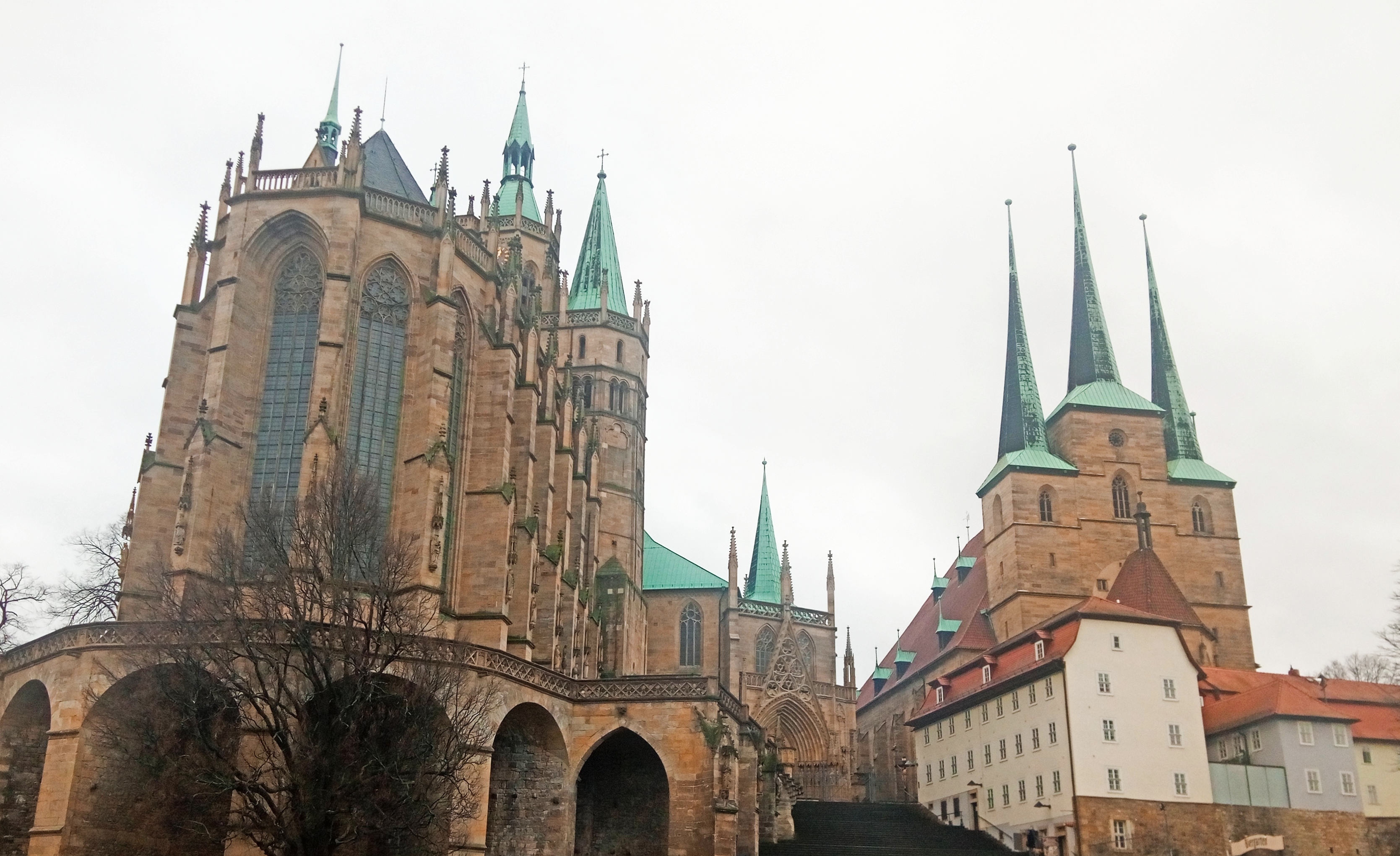
Erfurt (Thuringia, Thüringen) today has one of the most outstanding examples of [medieval church](https://www.worldhistory.org/Medieval_Church/) [architecture](https://www.worldhistory.org/disambiguation/architecture/) in Germany with the cathedral and the neighbouring Severikirche. It was [Boniface](https://www.worldhistory.org/Saint_Boniface/) who first founded a diocese in 742 at the place called „Erphesfurt", for which he soon had a first church built on the Domberg - the predecessor of today's cathedral.
For the year 1153, the chronicles report the collapse of a church, which was followed a year later by the start of construction for a late Romanesque basilica. However, it is neither certain that the church initiated by Boniface actually stood until 1153, nor that the building actually collapsed. It is more likely that the responsible archbishop of Mainz had a new church built.
The construction of the new church progressed quickly - also because during the work two tombs were found, identified as the remains of the bishops and Boniface‘s companions Adolar and Eoban. This find led to numerous donations and thus contributed to the financing of the construction. The church was consecrated on June 20, 1182, although the construction work had not yet been completed. This is documented by reports about the completion of the two towers (1201 and 1237) and a renewed consecration on October 5, 1253.
As in other cathedral and collegiate churches, the need to make the church and especially the choir larger and brighter grew in Erfurt during the Gothic period that began soon after, especially since there was soon not enough space for all the cathedral canons. Their number had risen to more than 100 people as a result of several foundations. As early as the 1280s, work began on adding a larger choir with a polygonal finish to the church.
But soon the expanded space was not enough. Therefore, in the 14th century, a significantly expanded choir was created and extensive building work was also carried out. Among other things, the triangular portal on the northern arm of the transept was built as the main entrance around 1330. It shows the twelve apostles and the cycle of the wise and foolish virgins, flanked by the ecclesia and synagogue. In 1349 the foundation stone was laid for the High Choir, which was consecrated in 1370.
The 15th century then brought major structural changes. The reason for this in 1452 was concern that the nave was about to collapse. It was therefore demolished three years later and work began on building a new late Gothic hall church. The church was usable again as early as 1465.
For more than 400 years, hardly any structural changes were made to the church. Instead, external influences caused destruction. During the Napoleonic Wars, the dome hill was also converted into a fortress and the cathedral was misused by French troops as a horse stable.
Unlike many other places of worship, the Erfurt Cathedral was spared from direct bomb hits during the Second World [War](https://www.worldhistory.org/disambiguation/War/).
#### Editorial Review
This human-authored image has been reviewed by our editorial team before publication to ensure accuracy, reliability and adherence to academic standards in accordance with our [editorial policy](https://www.worldhistory.org/static/editorial-policy/).
## About the Author
A curious and open mind, fascinated by the past. Historian with a keen interest in Norse myth and the Viking Age, as well as history teacher and language instructor. Originally from Bucharest, Romania, now residing in Hesse, Germany.
- [Facebook Profile](https://www.facebook.com/irinaskuld)
- [Linkedin Profile](https://www.linkedin.com/in/irinamariamanea/)
## Cite This Work
### APA
Manea, I. (2022, April 21). Erfurt Cathedral. *World History Encyclopedia*.
### Chicago
Manea, Irina-Maria. "Erfurt Cathedral." *World History Encyclopedia*, April 21, 2022. .
### MLA
Manea, Irina-Maria. "Erfurt Cathedral." *World History Encyclopedia*, 21 Apr 2022, .
## License & Copyright
Submitted by [Irina-Maria Manea](https://www.worldhistory.org/user/irinamaria.manea/ "User Page: Irina-Maria Manea"), published on 21 April 2022. The copyright holder has published this content under the following license: [Creative Commons Attribution-NonCommercial-ShareAlike](https://creativecommons.org/licenses/by-nc-sa/4.0/deed.en). This license lets others remix, tweak, and build upon this content non-commercially, as long as they credit the author and license their new creations under the identical terms. When republishing on the web a hyperlink back to the original content source URL must be included. Please note that content linked from this page may have different licensing terms.