---
title: Nuremberg Castle
author: Irina-Maria Manea
source: https://www.worldhistory.org/image/15693/nuremberg-castle/
format: machine-readable-alternate
license: Creative Commons Attribution-NonCommercial-ShareAlike (https://creativecommons.org/licenses/by-nc-sa/4.0/)
updated: 1970-01-01
---
# Nuremberg Castle
_Authored by [Irina-Maria Manea](https://www.worldhistory.org/user/irinamaria.manea/)_
## Image File
[](https://www.worldhistory.org/uploads/images/15693.jpg)
## Image Caption
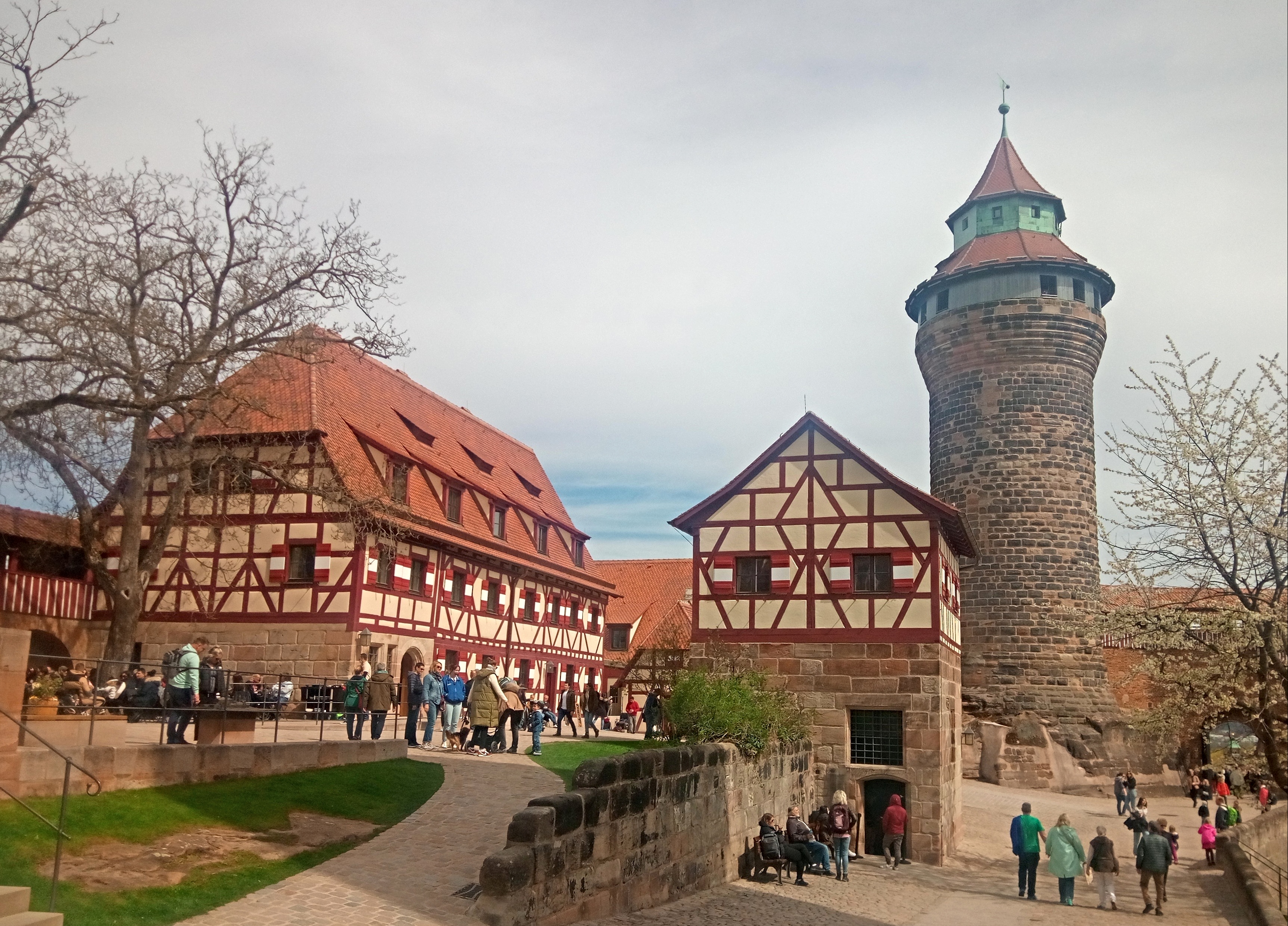
The Imperial Castle is Nuremberg's landmark, a symbol for the power and importance of the [Holy Roman Empire](https://www.worldhistory.org/Holy_Roman_Empire/).
Nuremberg (Nürnberg), first documented as a royal estate in 1050, was an important base for the domestic power politics during the time of the Salian and Staufer (Hohenstaufen) kings and emperors. The castle and the town formed a preferred place of residence for the travelling rulers, who held court days and imperial assemblies here.
The Staufer built an extensive [palace](https://www.worldhistory.org/disambiguation/palace/) complex on the castle rock which still characterizes the appearance of the imperial castle today. They appointed a burgrave who resided in the front area of the complex, and in 1191 the office of burgrave passed to the Counts of Zollern.
Thanks to the close connection to the kingdom and the location at the crossroads of vital commercial paths, Nuremberg quickly developed into an important centre of [trade](https://www.worldhistory.org/disambiguation/trade/) and export as well as a financial centre. The letter of Emperor Friedrich II from 1219 favoured the civil autonomy of the municipality at the expense of the burgrave's rights. The development of the independent imperial [city](https://www.worldhistory.org/city/) was consolidated with the end of the Staufer dynasty in 1254.
The town finally emerged victorious from the bitter disputes with the Zoller burgraves, who acquired extensive territories in Franconia. In 1422, Emperor Sigismund gave it responsibility for the castle for the good of the king and emperor. After an attack on the castle, the city finally acquired the remains from burgrave Friedrich VI. Since that time, the entire castle complex has been owned by the city.
In the late Middle Ages, Nuremberg was considered the most distinguished town of the [empire](https://www.worldhistory.org/empire/). It was the scene of numerous imperial assemblies, and from 1356 the "Golden Bull" of Emperor Charles IV stipulated that every newly elected ruler must hold his first court day in Nuremberg.
Most emperors stayed here several times: Ludwig IV the Bavarian 74 times, Charles IV 52 times. However, the castle lost its importance. The town hall, completed in 1340, replaced it as a conference venue, and from the time of Ludwig the Bavarian, the emperors preferred the living comfort of the [patrician](https://www.worldhistory.org/Patrician/) houses. In 1423, Sigismund also gave the city the imperial insignia, a sign of special trust. The Habsburg Frederick III. and his son Maximilian I. were the last emperors to reside in the castle and town for a longer period of time.
The acceptance of the [Reformation](https://www.worldhistory.org/disambiguation/Reformation/) in 1524 led to estrangement between the Protestant city and the Catholic emperors. After the [Thirty Years' War](https://www.worldhistory.org/Thirty_Years'_War/), the Reichstag was finally moved to Regensburg in 1663. After the dissolution of the Holy [Roman Empire](https://www.worldhistory.org/Roman_Empire/) in 1806 and the incorporation of Nuremberg into the Kingdom of Bavaria, the castle found new interest as a monument of German history. From 1833, King Ludwig I had it redesigned by the architect Carl [Alexander](https://www.worldhistory.org/disambiguation/Alexander/) von Heideloff in order to be able to live there as sovereign.
In 1866, the Hohenzollern seized the imperial castle: Ludwig II had to grant King Wilhelm I of Prussia joint use of the castle after the defeat in the [war](https://www.worldhistory.org/disambiguation/War/) of 1866. Emperor Wilhelm II lived in the castle several times and called himself the "Burgrave of Nuremberg".
#### Editorial Review
This human-authored image has been reviewed by our editorial team before publication to ensure accuracy, reliability and adherence to academic standards in accordance with our [editorial policy](https://www.worldhistory.org/static/editorial-policy/).
## About the Author
A curious and open mind, fascinated by the past. Historian with a keen interest in Norse myth and the Viking Age, as well as history teacher and language instructor. Originally from Bucharest, Romania, now residing in Hesse, Germany.
- [Facebook Profile](https://www.facebook.com/irinaskuld)
- [Linkedin Profile](https://www.linkedin.com/in/irinamariamanea/)
## Cite This Work
### APA
Manea, I. (2022, April 24). Nuremberg Castle. *World History Encyclopedia*.
### Chicago
Manea, Irina-Maria. "Nuremberg Castle." *World History Encyclopedia*, April 24, 2022. .
### MLA
Manea, Irina-Maria. "Nuremberg Castle." *World History Encyclopedia*, 24 Apr 2022, .
## License & Copyright
Submitted by [Irina-Maria Manea](https://www.worldhistory.org/user/irinamaria.manea/ "User Page: Irina-Maria Manea"), published on 24 April 2022. The copyright holder has published this content under the following license: [Creative Commons Attribution-NonCommercial-ShareAlike](https://creativecommons.org/licenses/by-nc-sa/4.0/deed.en). This license lets others remix, tweak, and build upon this content non-commercially, as long as they credit the author and license their new creations under the identical terms. When republishing on the web a hyperlink back to the original content source URL must be included. Please note that content linked from this page may have different licensing terms.