---
title: Prehistoric Monument Stonehenge, c. 3000-1600 BCE: Ceremonial Landscape on Salisbury Plain
author: Simeon Netchev
source: https://www.worldhistory.org/image/15691/prehistoric-monument-stonehenge-c-3000-1600-bce/
format: machine-readable-alternate
license: Creative Commons Attribution-NonCommercial-NoDerivs (https://creativecommons.org/licenses/by-nc/4.0)
updated: 2026-03-20
---
# Prehistoric Monument Stonehenge, c. 3000-1600 BCE: Ceremonial Landscape on Salisbury Plain
_Authored by [Simeon Netchev](https://www.worldhistory.org/user/simeonnetchev/)_
## Image File
[](https://www.worldhistory.org/uploads/images/15691.png)
## Image Caption
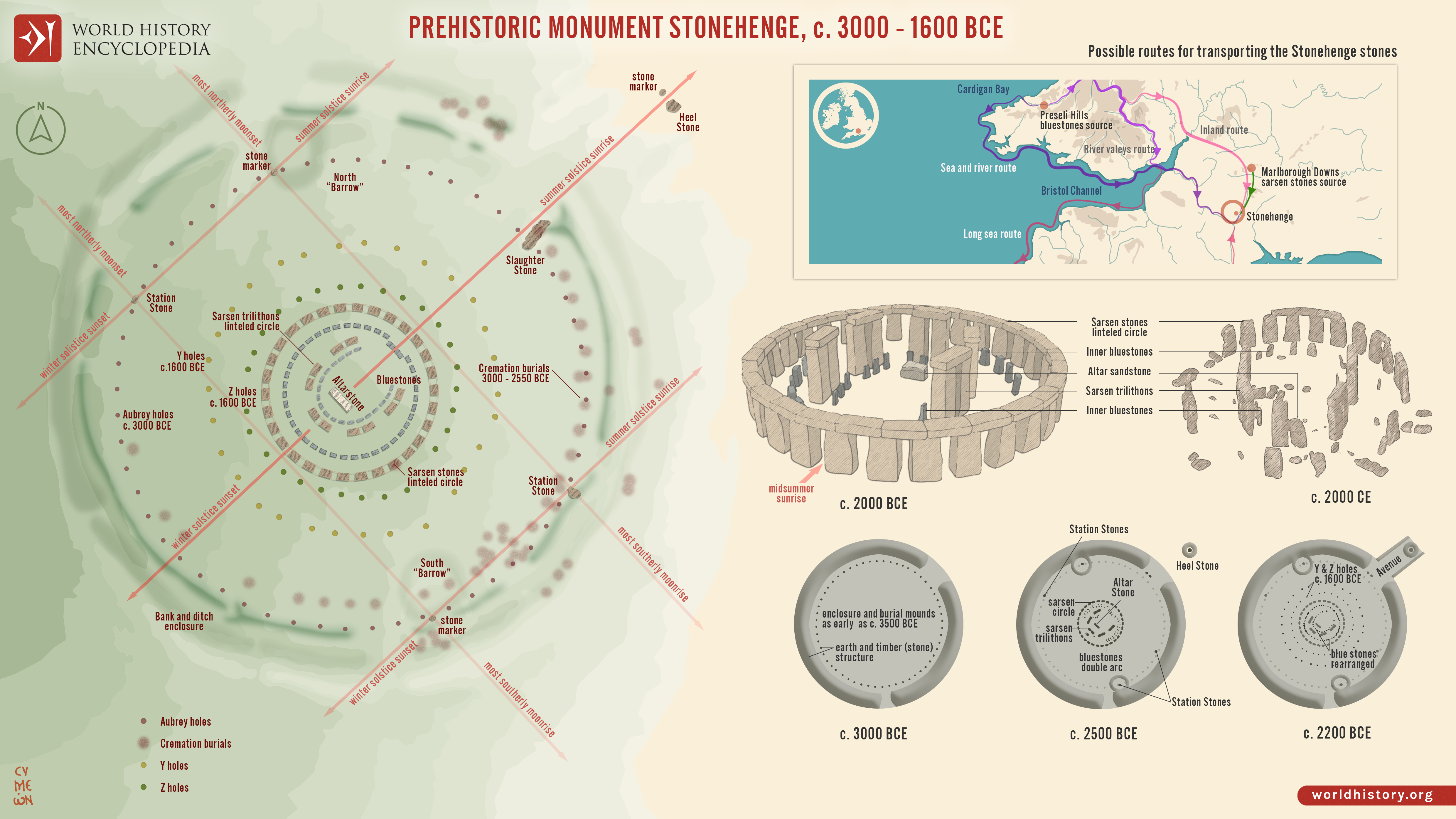
[Stonehenge](https://www.worldhistory.org/stonehenge/), located on Salisbury Plain in Wiltshire, [England](https://www.worldhistory.org/disambiguation/england/), is one of the most important monumental complexes of prehistoric northwestern [Europe](https://www.worldhistory.org/europe/). Constructed in multiple phases between c. 3000 and 1600 BCE, it spans the Late [Neolithic](https://www.worldhistory.org/Neolithic/) and early [Bronze Age](https://www.worldhistory.org/disambiguation/Bronze_Age/), reflecting long-term changes in ritual practice, social organization, and technical ability. The earliest phase consisted of a circular earthwork enclosure with a surrounding ditch and bank, followed by timber settings and later the erection of bluestones and large sarsen megaliths. These successive building stages suggest that Stonehenge was not a single-purpose structure but a monument repeatedly reinterpreted by different communities over many centuries. Its orientation toward the solstitial axis indicates a close relationship between ceremonial life and the seasonal cycles of the sun, although it is more cautious to describe it as a ritual monument with astronomical alignments than as an “observatory” in the modern sense.
Since the 17th century, antiquarians such as John Aubrey (1626–1697) and William Stukeley (1687–1765) helped initiate sustained scholarly interest in the site, while modern [archaeology](https://www.worldhistory.org/Archaeology/) has placed Stonehenge within a wider ceremonial landscape that includes Durrington Walls and Avebury. Excavation, radiocarbon dating, and isotopic analysis have revealed links to [burial](https://www.worldhistory.org/burial/) practices, feasting, long-distance transport of stone, and regional networks of memory and belief. Rather than supporting a single definitive interpretation, current scholarship views Stonehenge as a multifunctional ceremonial and funerary complex whose significance changed over time.
#### Editorial Review
This human-authored image has been reviewed by our editorial team before publication to ensure accuracy, reliability and adherence to academic standards in accordance with our [editorial policy](https://www.worldhistory.org/static/editorial-policy/).
## About the Author
Simeon is a freelance visual designer and history educator, passionate about the human stories that shape the past.
- [Linkedin Profile](https://www.linkedin.com/in/simeon-netchev/)
## Cite This Work
### APA
Netchev, S. (2022, April 24). Prehistoric Monument Stonehenge, c. 3000-1600 BCE: Ceremonial Landscape on Salisbury Plain. *World History Encyclopedia*.
### Chicago
Netchev, Simeon. "Prehistoric Monument Stonehenge, c. 3000-1600 BCE: Ceremonial Landscape on Salisbury Plain." *World History Encyclopedia*, April 24, 2022. .
### MLA
Netchev, Simeon. "Prehistoric Monument Stonehenge, c. 3000-1600 BCE: Ceremonial Landscape on Salisbury Plain." *World History Encyclopedia*, 24 Apr 2022, .
## License & Copyright
Submitted by [Simeon Netchev](https://www.worldhistory.org/user/simeonnetchev/ "User Page: Simeon Netchev"), published on 24 April 2022. The copyright holder has published this content under the following license: [Creative Commons Attribution-NonCommercial-NoDerivs](https://creativecommons.org/licenses/by-nc/4.0deed.en). This licence only allows others to download this content and share it with others as long as the author is credited, but they can't change the content in any way or use it commercially. When republishing on the web a hyperlink back to the original content source URL must be included. Please note that content linked from this page may have different licensing terms.