---
title: Viking Dragon Plaque
author: MichaelMaggs
source: https://www.worldhistory.org/image/15628/viking-dragon-plaque/
format: machine-readable-alternate
license: Creative Commons Attribution-NonCommercial-ShareAlike (https://creativecommons.org/licenses/by-nc-sa/4.0/)
updated: 1970-01-01
---
# Viking Dragon Plaque
_Authored by MichaelMaggs_
## Image File
[](https://www.worldhistory.org/uploads/images/15628.jpg)
## Image Caption
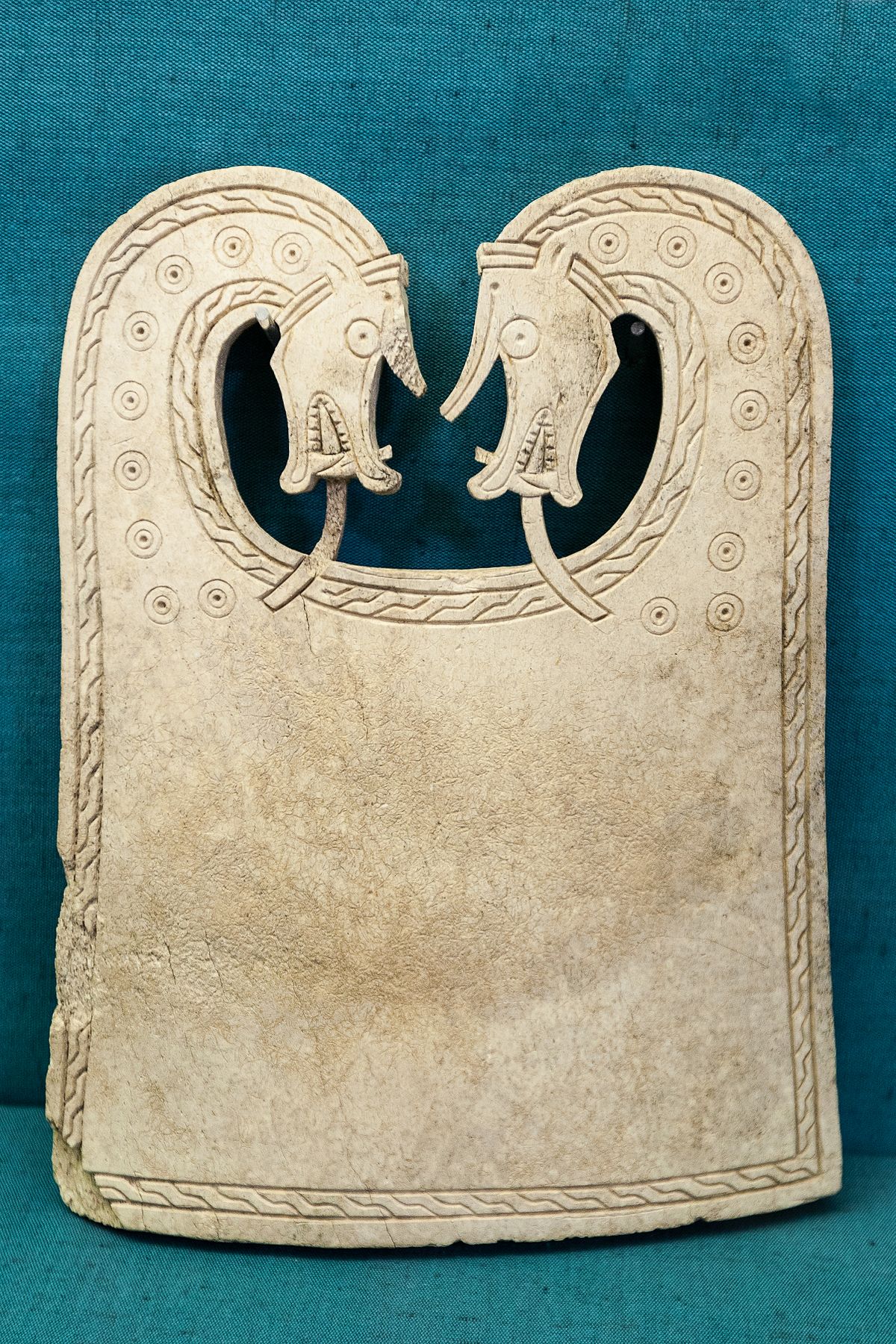
Plaque from a late 9th- or early 10th-century [burial](https://www.worldhistory.org/burial/) at Scar, Sanday in the Orkney Islands, [Scotland](https://www.worldhistory.org/disambiguation/Scotland/).
Orkney Museum.
The plaque, carved from one piece of whalebone into the shape of two dragons facing each other, was found in a [Viking](https://www.worldhistory.org/Vikings/) burial, which was partly uncovered by coastal erosion on the coast near the farm of Scar, and was excavated in 1991. This was a boat burial; the boat was built in Norway and transported to Orkney on a larger boat. At the centre, lay the remains of a woman in her seventies with the whalebone plaque and other [grave](https://www.worldhistory.org/burial/) goods including brooches, spindle whorls, an iron sickle, and shears. Similar plaques have been found in other rich [women](https://www.worldhistory.org/disambiguation/women/)'s graves, mostly in northern Norway. Lying next to the woman were the remains of a child of about ten years of age. At the western end of the boat lay the skeleton of a man in his thirties, with a sword, arrows, a bone and antler comb, and whalebone gaming pieces.
The function of these whalebone plaques is uncertain. One possibility is that they were used like ironing boards for smoothing folds and seams in linen clothing, with the aid of a smoother, rounded on the top with a flat base. Another opinion is that plaques and smoothers were used in the manufacture of textiles. Or they could have been serving platters for food at high-status feasts. They may have also had a symbolic function. Whalebone was a prized material, obtained through risky hunting operations or if whales became stranded or washed ashore.
## Cite This Work
### APA
MichaelMaggs. (2022, April 11). Viking Dragon Plaque. *World History Encyclopedia*.
### Chicago
MichaelMaggs. "Viking Dragon Plaque." *World History Encyclopedia*, April 11, 2022. .
### MLA
MichaelMaggs. "Viking Dragon Plaque." *World History Encyclopedia*, 11 Apr 2022, .
## License & Copyright
[Original image](https://commons.wikimedia.org/wiki/File:Scar_Plaque,_Scar_Viking_boat_burial,_Sanday,_Orkney.jpg?uselang=de) by [**MichaelMaggs**](https://commons.wikimedia.org/wiki/File:Scar_Plaque,_Scar_Viking_boat_burial,_Sanday,_Orkney.jpg?uselang=de). Submitted by [Irina-Maria Manea](https://www.worldhistory.org/user/irinamaria.manea/ "User Page: Irina-Maria Manea"), published on 11 April 2022. The copyright holder has published this content under the following license: [Creative Commons Attribution-NonCommercial-ShareAlike](https://creativecommons.org/licenses/by-nc-sa/4.0/deed.en). This license lets others remix, tweak, and build upon this content non-commercially, as long as they credit the author and license their new creations under the identical terms. When republishing on the web a hyperlink back to the original content source URL must be included. Please note that content linked from this page may have different licensing terms.