---
title: The Feudal Society in Medieval Europe: Power in Medieval Europe: Lords, Land & the Church
author: Simeon Netchev
source: https://www.worldhistory.org/image/15424/the-feudal-society-in-medieval-europe/
format: machine-readable-alternate
license: Creative Commons Attribution-NonCommercial-NoDerivs (https://creativecommons.org/licenses/by-nc/4.0)
updated: 2026-03-10
---
# The Feudal Society in Medieval Europe: Power in Medieval Europe: Lords, Land & the Church
_Authored by [Simeon Netchev](https://www.worldhistory.org/user/simeonnetchev/)_
## Image File
[](https://www.worldhistory.org/uploads/images/15424.png)
## Image Caption
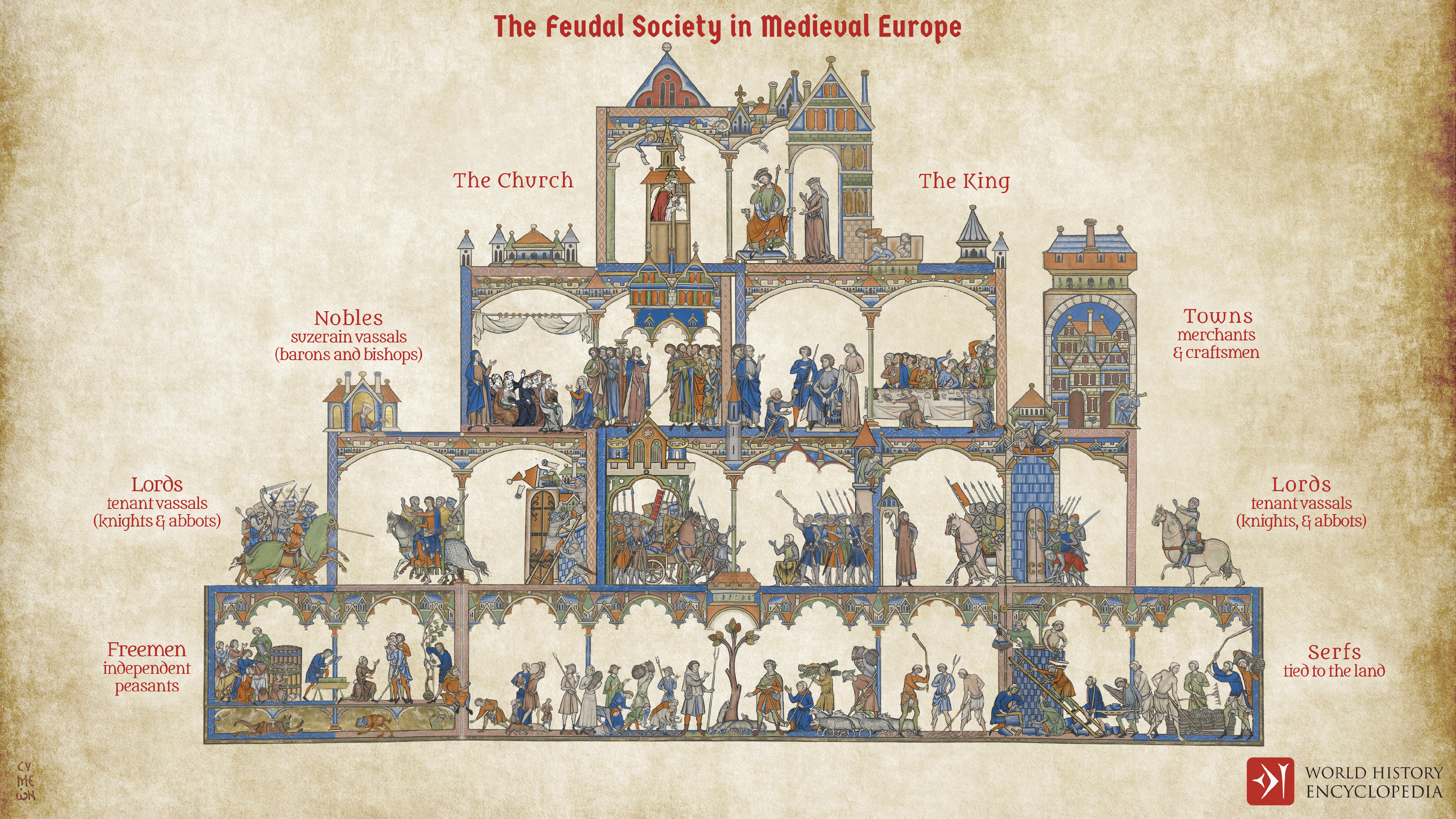
The social structure of medieval Western [Europe](https://www.worldhistory.org/europe/) (c. 10th–13th centuries) is often described through the framework of feudal relationships and landholding systems that linked rulers, nobles, and rural communities. In this model, political authority radiated from monarchs, such as [William the Conqueror](https://www.worldhistory.org/William_the_Conqueror/) (reign 1066–1087) or [Philip II](https://www.worldhistory.org/disambiguation/Philip_II/) of France (reign 1180–1223), who granted lands known as fiefs to nobles and vassals in exchange for loyalty and military service. These layered obligations formed networks of lordship that structured governance and defense across much of Latin Christendom. At the same time, the institutional Church constituted a parallel and powerful authority: bishops and abbots controlled extensive estates, exercised jurisdiction over ecclesiastical courts, and played central roles in both spiritual and political life.
Below the aristocratic elite stood the majority of the population, rural cultivators whose status varied from free [peasants](https://www.worldhistory.org/disambiguation/Peasants/) to serfs bound to manorial landholdings. While serfdom tied many communities to obligations of labor, rent, and service, the medieval countryside also included independent farmers and tenant cultivators whose conditions differed regionally. From the 11th century onward, the revival of [trade](https://www.worldhistory.org/disambiguation/trade/) and urban growth introduced an additional social element: townspeople, merchants, and craftsmen organized through guilds and municipal institutions. This expanding urban sector gradually reshaped economic life within a society still dominated by agrarian production.
#### Editorial Review
This human-authored image has been reviewed by our editorial team before publication to ensure accuracy, reliability and adherence to academic standards in accordance with our [editorial policy](https://www.worldhistory.org/static/editorial-policy/).
## About the Author
Simeon is a freelance visual designer and history educator, passionate about the human stories that shape the past.
- [Linkedin Profile](https://www.linkedin.com/in/simeon-netchev/)
## Cite This Work
### APA
Netchev, S. (2022, March 16). The Feudal Society in Medieval Europe: Power in Medieval Europe: Lords, Land & the Church. *World History Encyclopedia*.
### Chicago
Netchev, Simeon. "The Feudal Society in Medieval Europe: Power in Medieval Europe: Lords, Land & the Church." *World History Encyclopedia*, March 16, 2022. .
### MLA
Netchev, Simeon. "The Feudal Society in Medieval Europe: Power in Medieval Europe: Lords, Land & the Church." *World History Encyclopedia*, 16 Mar 2022, .
## License & Copyright
Submitted by [Simeon Netchev](https://www.worldhistory.org/user/simeonnetchev/ "User Page: Simeon Netchev"), published on 16 March 2022. The copyright holder has published this content under the following license: [Creative Commons Attribution-NonCommercial-NoDerivs](https://creativecommons.org/licenses/by-nc/4.0deed.en). This licence only allows others to download this content and share it with others as long as the author is credited, but they can't change the content in any way or use it commercially. When republishing on the web a hyperlink back to the original content source URL must be included. Please note that content linked from this page may have different licensing terms.