---
title: Map of the Third Dynasty of Ur: Sumerian Temples, Tablets, and the Birth of Legal Tradition in Ancient Mesopotamia
author: Simeon Netchev
source: https://www.worldhistory.org/image/15308/map-of-the-third-dynasty-of-ur/
format: machine-readable-alternate
license: Creative Commons Attribution-NonCommercial-NoDerivs (https://creativecommons.org/licenses/by-nc/4.0)
updated: 2025-06-06
---
# Map of the Third Dynasty of Ur: Sumerian Temples, Tablets, and the Birth of Legal Tradition in Ancient Mesopotamia
_Authored by [Simeon Netchev](https://www.worldhistory.org/user/simeonnetchev/)_
## Image File
[](https://www.worldhistory.org/uploads/images/15308.png)
## Image Caption
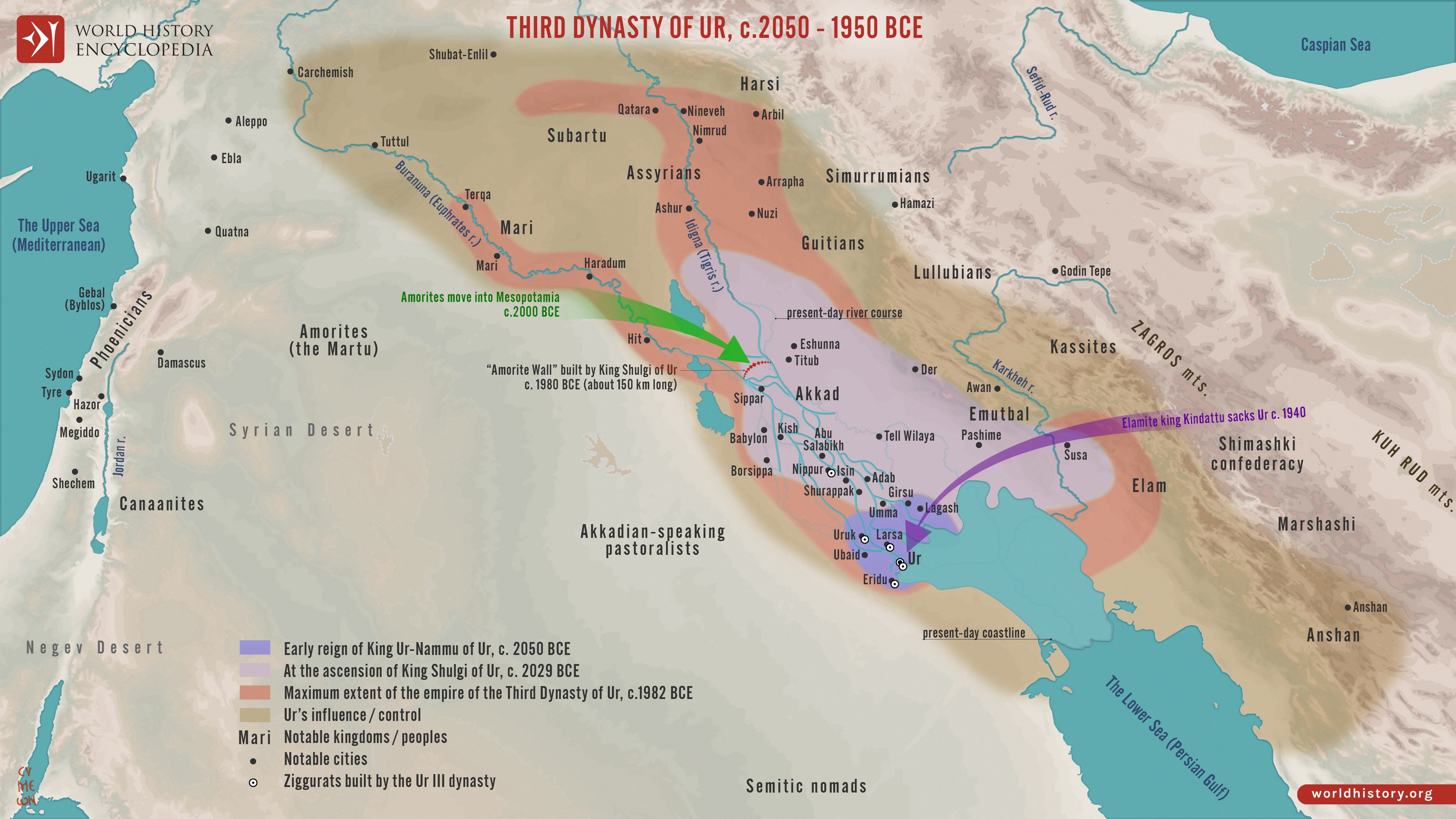
This map illustrates the rise of the [Sumerian](https://www.worldhistory.org/Sumerians/) [city-state](https://www.worldhistory.org/Polis/) of [Ur](https://www.worldhistory.org/ur/) following the collapse of the [Akkadian Empire](https://www.worldhistory.org/akkad/) (reign: circa 2334 - 2154 BCE). In the aftermath of political fragmentation and regional instability, Ur emerged as a leading center of power in southern [Mesopotamia](https://www.worldhistory.org/Mesopotamia/). This period, often referred to as the Sumerian Renaissance, marked a revival of Sumerian cultural identity, political organization, and literary production.
Under Ur-Namma (reign: circa 2112 - 2095 BCE), founder of the Third Dynasty of Ur (circa 2050 - 1950 BCE), and his successor Shulgi (reign: circa 2094 - 2047 BCE), the Ur III state unified much of Mesopotamia under a centralized bureaucracy. They introduced standardized administrative systems, promoted large-scale [temple](https://www.worldhistory.org/temple/) construction, and supported artistic and intellectual achievements. Ur-Namma’s [law](https://www.worldhistory.org/disambiguation/law/) code (circa 2100–2050 BCE)—one of the oldest known—reflected early efforts at codified justice. This era marks the final chapter of native Sumerian rule before Mesopotamia entered a new phase of Semitic political dominance.
#### Editorial Review
This human-authored image has been reviewed by our editorial team before publication to ensure accuracy, reliability and adherence to academic standards in accordance with our [editorial policy](https://www.worldhistory.org/static/editorial-policy/).
## About the Author
Simeon is a freelance visual designer and history educator, passionate about the human stories that shape the past.
- [Linkedin Profile](https://www.linkedin.com/in/simeon-netchev/)
## Cite This Work
### APA
Netchev, S. (2022, March 03). Map of the Third Dynasty of Ur: Sumerian Temples, Tablets, and the Birth of Legal Tradition in Ancient Mesopotamia. *World History Encyclopedia*.
### Chicago
Netchev, Simeon. "Map of the Third Dynasty of Ur: Sumerian Temples, Tablets, and the Birth of Legal Tradition in Ancient Mesopotamia." *World History Encyclopedia*, March 03, 2022. .
### MLA
Netchev, Simeon. "Map of the Third Dynasty of Ur: Sumerian Temples, Tablets, and the Birth of Legal Tradition in Ancient Mesopotamia." *World History Encyclopedia*, 03 Mar 2022, .
## License & Copyright
Submitted by [Simeon Netchev](https://www.worldhistory.org/user/simeonnetchev/ "User Page: Simeon Netchev"), published on 03 March 2022. The copyright holder has published this content under the following license: [Creative Commons Attribution-NonCommercial-NoDerivs](https://creativecommons.org/licenses/by-nc/4.0deed.en). This licence only allows others to download this content and share it with others as long as the author is credited, but they can't change the content in any way or use it commercially. When republishing on the web a hyperlink back to the original content source URL must be included. Please note that content linked from this page may have different licensing terms.