---
title: Map of the Sumerian Civilization: Where Cities Began
author: Simeon Netchev
source: https://www.worldhistory.org/image/15299/map-of-the-sumerian-civilization/
format: machine-readable-alternate
license: Creative Commons Attribution-NonCommercial-NoDerivs (https://creativecommons.org/licenses/by-nc/4.0)
updated: 2026-03-10
---
# Map of the Sumerian Civilization: Where Cities Began
_Authored by [Simeon Netchev](https://www.worldhistory.org/user/simeonnetchev/)_
## Image File
[](https://www.worldhistory.org/uploads/images/15299.png)
## Image Caption
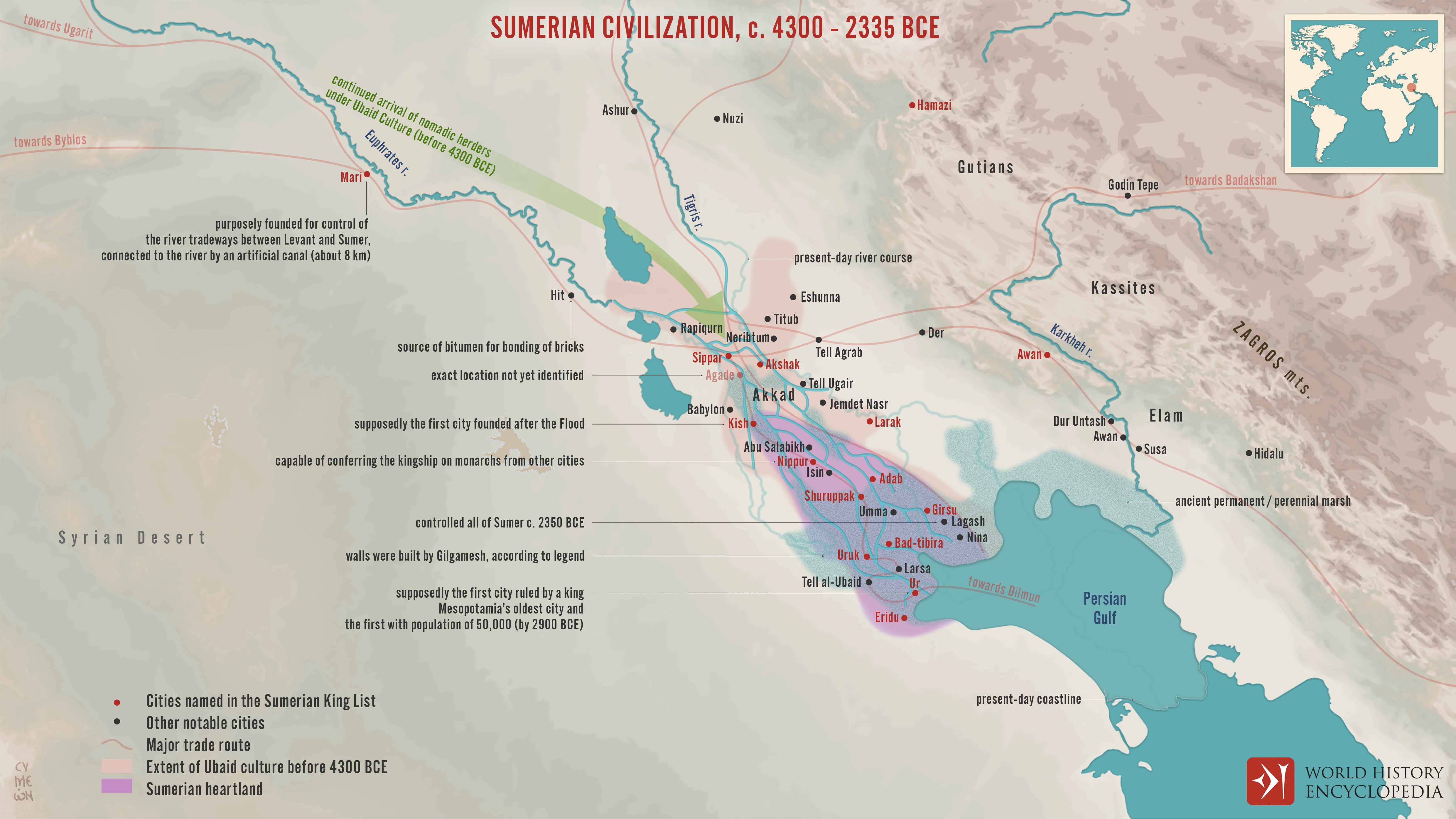
The rise of [Sumerian](https://www.worldhistory.org/Sumerians/) [civilization](https://www.worldhistory.org/civilization/) in southern [Mesopotamia](https://www.worldhistory.org/Mesopotamia/) (c. 6000–2300 BCE) represents one of the earliest transformations from agrarian village life to urban state formation. Located between the Tigris and Euphrates Rivers, this alluvial plain required large-scale irrigation management, fostering collective organization and administrative innovation. By the fourth millennium BCE ([Uruk](https://www.worldhistory.org/uruk/) Period, c. 4000–3100 BCE), urban centers emerged that integrated agricultural surplus, long-distance [trade](https://www.worldhistory.org/disambiguation/trade/), [temple](https://www.worldhistory.org/temple/) authority, and early bureaucratic systems. The region later known as Mesopotamia, home in subsequent centuries to [Akkad](https://www.worldhistory.org/akkad/) and [Babylonia](https://www.worldhistory.org/babylon/), thus became a laboratory for early statecraft, shaped by environmental adaptation and socio-political competition.
Independent [city](https://www.worldhistory.org/city/)-states such as [Ur](https://www.worldhistory.org/ur/), Uruk, Lagash, and [Eridu](https://www.worldhistory.org/eridu/) developed distinct political structures under rulers often titled ensi or lugal ([Early Dynastic](https://www.worldhistory.org/disambiguation/Early_Dynastic/) Period, c. 2900–2334 BCE). Monumental temple complexes (ziggurats), the development of [cuneiform](https://www.worldhistory.org/cuneiform/) [writing](https://www.worldhistory.org/writing/) (c. 3200 BCE), and advances in mathematics and [law](https://www.worldhistory.org/disambiguation/law/) reflected increasingly sophisticated administrative needs. Although rivalry and [warfare](https://www.worldhistory.org/warfare/) were frequent, shared religious traditions and linguistic [culture](https://www.worldhistory.org/disambiguation/culture/) fostered a broader Sumerian identity. Even after the rise of the [Akkadian Empire](https://www.worldhistory.org/akkad/) under [Sargon of Akkad](https://www.worldhistory.org/Sargon_of_Akkad/) (reign c. 2334–2279 BCE), Sumerian cultural models endured, shaping Mesopotamian political and intellectual life for centuries.
#### Editorial Review
This human-authored image has been reviewed by our editorial team before publication to ensure accuracy, reliability and adherence to academic standards in accordance with our [editorial policy](https://www.worldhistory.org/static/editorial-policy/).
## About the Author
Simeon is a freelance visual designer and history educator, passionate about the human stories that shape the past.
- [Linkedin Profile](https://www.linkedin.com/in/simeon-netchev/)
## Cite This Work
### APA
Netchev, S. (2026, February 27). Map of the Sumerian Civilization: Where Cities Began. *World History Encyclopedia*.
### Chicago
Netchev, Simeon. "Map of the Sumerian Civilization: Where Cities Began." *World History Encyclopedia*, February 27, 2026. .
### MLA
Netchev, Simeon. "Map of the Sumerian Civilization: Where Cities Began." *World History Encyclopedia*, 27 Feb 2026, .
## License & Copyright
Submitted by [Simeon Netchev](https://www.worldhistory.org/user/simeonnetchev/ "User Page: Simeon Netchev"), published on 27 February 2026. The copyright holder has published this content under the following license: [Creative Commons Attribution-NonCommercial-NoDerivs](https://creativecommons.org/licenses/by-nc/4.0deed.en). This licence only allows others to download this content and share it with others as long as the author is credited, but they can't change the content in any way or use it commercially. When republishing on the web a hyperlink back to the original content source URL must be included. Please note that content linked from this page may have different licensing terms.