---
title: The Helm of Awe
author: Anonymous
source: https://www.worldhistory.org/image/15191/the-helm-of-awe/
format: machine-readable-alternate
updated: 1970-01-01
---
# The Helm of Awe
_Authored by Anonymous_
## Image File
[](https://www.worldhistory.org/uploads/images/15191.jpg)
## Image Caption
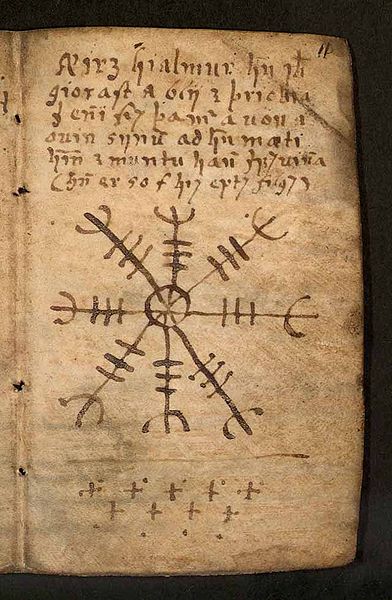
The Helm of Awe (Icelandic: *Ægishjálmur*), a magical symbol (stave) recorded in an Icelandic manuscript in the 1600s.
The term is attested in the Old Norse poem *Fáfnismál* (1200s) in the context of the fight between the hero Sigurd and the dragon Fáfnir, when before the final blow, the dragon mentions bearing an *øgishjalm* (the helmet of the frightener or, if spelled with æ, the helmet of one oft he Norse gods called Ægir) while sitting on his treasure, believing to have insurmountable power. However, today the term is rather known as a symbol from a much later manuscript (Lbs 143 8vo, *Landsbókasafn Íslands*, National Library of Iceland), which has attached to it some kind of spell: it must be made of lead and imprinted on the forehead, to fend off one's enemies. This may be connected to the etymology of the word.
Similar symbols have been found, for example, in a book of Icelandic 'dark magic' (*svartkonstbok* in Swedish) kept at the Historiska Museet. There we are advised to draw such a symbol between our eyes in order to quiet someone's anger, and then utter a prayer demanding that everyone is as pleased with us as Mary was with her son on the victory rock (unclear reference). Either way, the spell ends with the sign of the cross. The book contains many spells on how to bewitch [women](https://www.worldhistory.org/disambiguation/women/), instil fear in others, protect yourself, and even kill with the help of such magic staves resulting from different amalgamations of Latin letters and [runes](https://www.worldhistory.org/runes/). Other manuscripts share the idea of a sign on your forehead, together with ritual washing, drawing with your left hand or saying the Lord's prayer and the spell against powerful men.
It should not surprise us though that this kind of magical staves spread throughout [Europe](https://www.worldhistory.org/europe/), as they resemble very complicated models of crosses and witness the great mixture of Pagan and Christian beliefs and supernatural practices. It was not unusual to summon both Christ and [Odin](https://www.worldhistory.org/odin/), the saints and [Thor](https://www.worldhistory.org/Thor/) at the same time. Unfortunately, it is impossible to say how Norse the *Ægishjálmur* is, or whether what the dragon meant was that he also had it 'tattooed' on his forehead or that initially it referred to a magical helmet. The picture itself is from post-Pagan times.
## Cite This Work
### APA
Anonymous. (2022, January 27). The Helm of Awe. *World History Encyclopedia*.
### Chicago
Anonymous. "The Helm of Awe." *World History Encyclopedia*, January 27, 2022. .
### MLA
Anonymous. "The Helm of Awe." *World History Encyclopedia*, 27 Jan 2022, .
## License & Copyright
[Original image](https://de.wikipedia.org/wiki/Datei:%C3%86gishj%C3%A1lmur.jpg) by **Anonymous**. Submitted by [Irina-Maria Manea](https://www.worldhistory.org/user/irinamaria.manea/ "User Page: Irina-Maria Manea"), published on 27 January 2022. The copyright holder has published this content under the following license: [Public Domain](http://en.wikipedia.org/wiki/Public_domain). This item is in the public domain, and can be used, copied, and modified without any restrictions. Please note that content linked from this page may have different licensing terms.