---
title: Map of the Ancient Near East after Hammurabi, c. 1700 BCE: Kingdoms, Cities & Shifting Power in the Bronze Age
author: Simeon Netchev
source: https://www.worldhistory.org/image/15146/map-of-the-ancient-near-east-after-hammurabi-c-170/
format: machine-readable-alternate
license: Creative Commons Attribution-NonCommercial-NoDerivs (https://creativecommons.org/licenses/by-nc/4.0)
updated: 2026-09-14
---
# Map of the Ancient Near East after Hammurabi, c. 1700 BCE: Kingdoms, Cities & Shifting Power in the Bronze Age
_Authored by [Simeon Netchev](https://www.worldhistory.org/user/simeonnetchev/)_
## Image File
[](https://www.worldhistory.org/uploads/images/15146.png)
## Image Caption
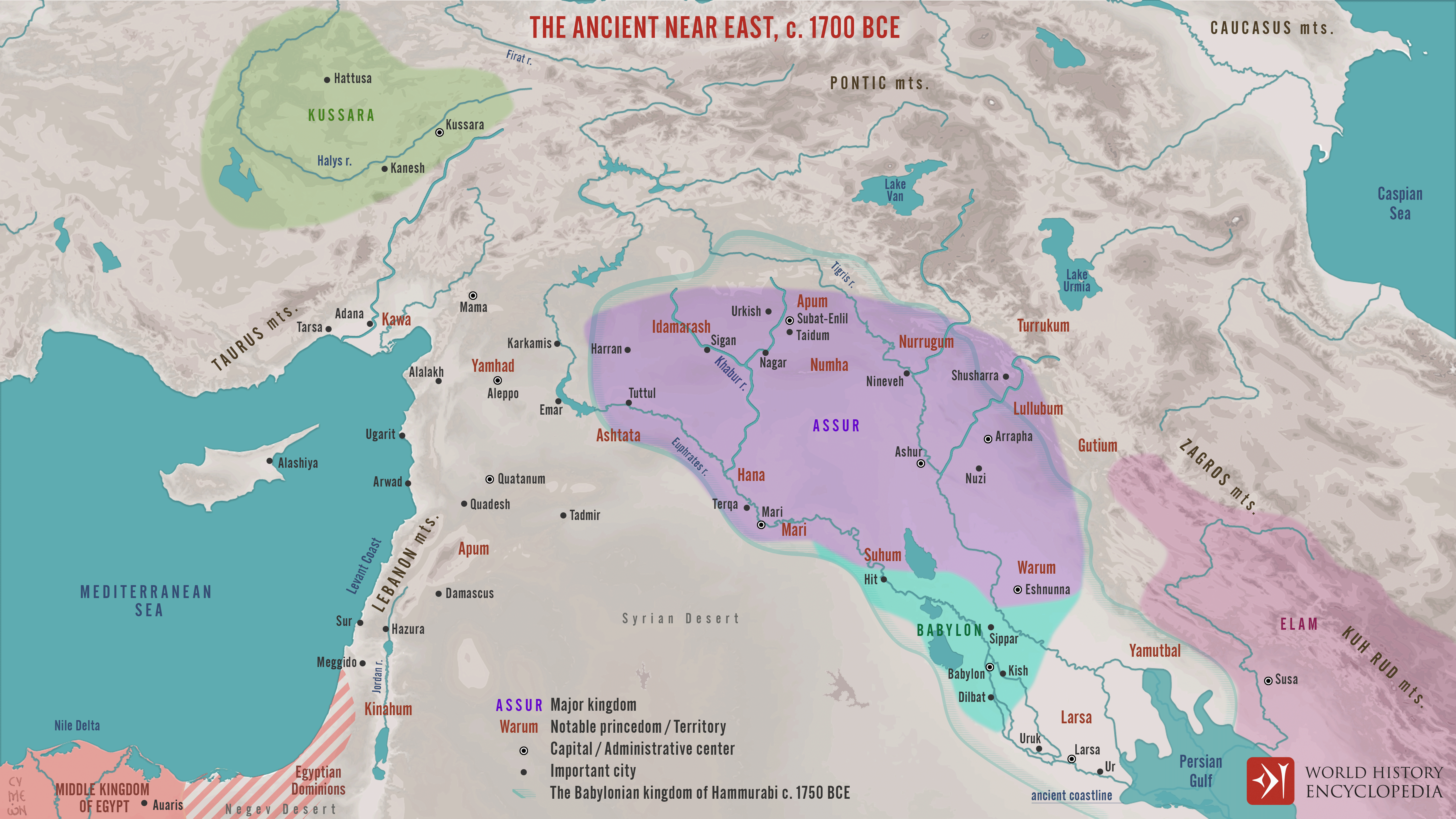
By c. 1700 BCE, the political landscape of the Ancient [Near East](https://www.worldhistory.org/Near_East/) had been reshaped by the rapid rise and fragmentation of two unusually large territorial states. Shamshi-Adad I created a realm stretching across much of Upper [Mesopotamia](https://www.worldhistory.org/Mesopotamia/), linking centers such as [Assur](https://www.worldhistory.org/assur/), Šubat-[Enlil](https://www.worldhistory.org/Enlil/), Ekallatum, and [Mari](https://www.worldhistory.org/mari/), but it fragmented soon after his [death](https://www.worldhistory.org/disambiguation/Death/) around 1776 BCE. A generation later, [Hammurabi](https://www.worldhistory.org/hammurabi/) of [Babylon](https://www.worldhistory.org/babylon/) defeated major rivals including Larsa and Eshnunna and conquered Mari, extending Babylonian authority across much of Mesopotamia by c. 1750 BCE. This expansion also proved difficult to sustain, and by c. 1700 BCE Babylon faced renewed regional competition, including the emergence of the Sealand Dynasty in southern Mesopotamia.
The period demonstrates the importance of state formation, imperial expansion, political fragmentation, and continuity and change in the ancient Near East. Political control didn't resemble the fixed administrative borders of modern states: authority could depend on control of [cities](https://www.worldhistory.org/city/), agricultural lands, [trade](https://www.worldhistory.org/disambiguation/trade/) routes, tributary relationships, military dominance, and shifting alliances. The survival or resurgence of powers such as Assur, Hana, Yamhad, Qatna, and [Elam](https://www.worldhistory.org/elam/), alongside regional peoples and mobile groups, illustrates both the ambitions and the limitations of early territorial states and provides a useful case study in how political power was created, negotiated, and lost.
#### Editorial Review
This human-authored image has been reviewed by our editorial team before publication to ensure accuracy, reliability and adherence to academic standards in accordance with our [editorial policy](https://www.worldhistory.org/static/editorial-policy/).
## About the Author
Simeon is a freelance visual designer and history educator, passionate about the human stories that shape the past.
- [Linkedin Profile](https://www.linkedin.com/in/simeon-netchev/)
## Cite This Work
### APA
Netchev, S. (2026, September 14). Map of the Ancient Near East after Hammurabi, c. 1700 BCE: Kingdoms, Cities & Shifting Power in the Bronze Age. *World History Encyclopedia*.
### Chicago
Netchev, Simeon. "Map of the Ancient Near East after Hammurabi, c. 1700 BCE: Kingdoms, Cities & Shifting Power in the Bronze Age." *World History Encyclopedia*, September 14, 2026. .
### MLA
Netchev, Simeon. "Map of the Ancient Near East after Hammurabi, c. 1700 BCE: Kingdoms, Cities & Shifting Power in the Bronze Age." *World History Encyclopedia*, 14 Sep 2026, .
## License & Copyright
Submitted by [Simeon Netchev](https://www.worldhistory.org/user/simeonnetchev/ "User Page: Simeon Netchev"), published on 14 September 2026. The copyright holder has published this content under the following license: [Creative Commons Attribution-NonCommercial-NoDerivs](https://creativecommons.org/licenses/by-nc/4.0deed.en). This licence only allows others to download this content and share it with others as long as the author is credited, but they can't change the content in any way or use it commercially. When republishing on the web a hyperlink back to the original content source URL must be included. Please note that content linked from this page may have different licensing terms.