---
title: Vespucci and the Map That Named America: Waldseemüller’s 1507 Map and the Invention of the New World
author: Simeon Netchev
source: https://www.worldhistory.org/image/14710/vespucci-and-the-map-that-named-america/
format: machine-readable-alternate
license: Creative Commons Attribution-NonCommercial-NoDerivs (https://creativecommons.org/licenses/by-nc/4.0)
updated: 2026-06-29
---
# Vespucci and the Map That Named America: Waldseemüller’s 1507 Map and the Invention of the New World
_Authored by [Simeon Netchev](https://www.worldhistory.org/user/simeonnetchev/)_
## Image File
[](https://www.worldhistory.org/uploads/images/14710.png)
## Image Caption
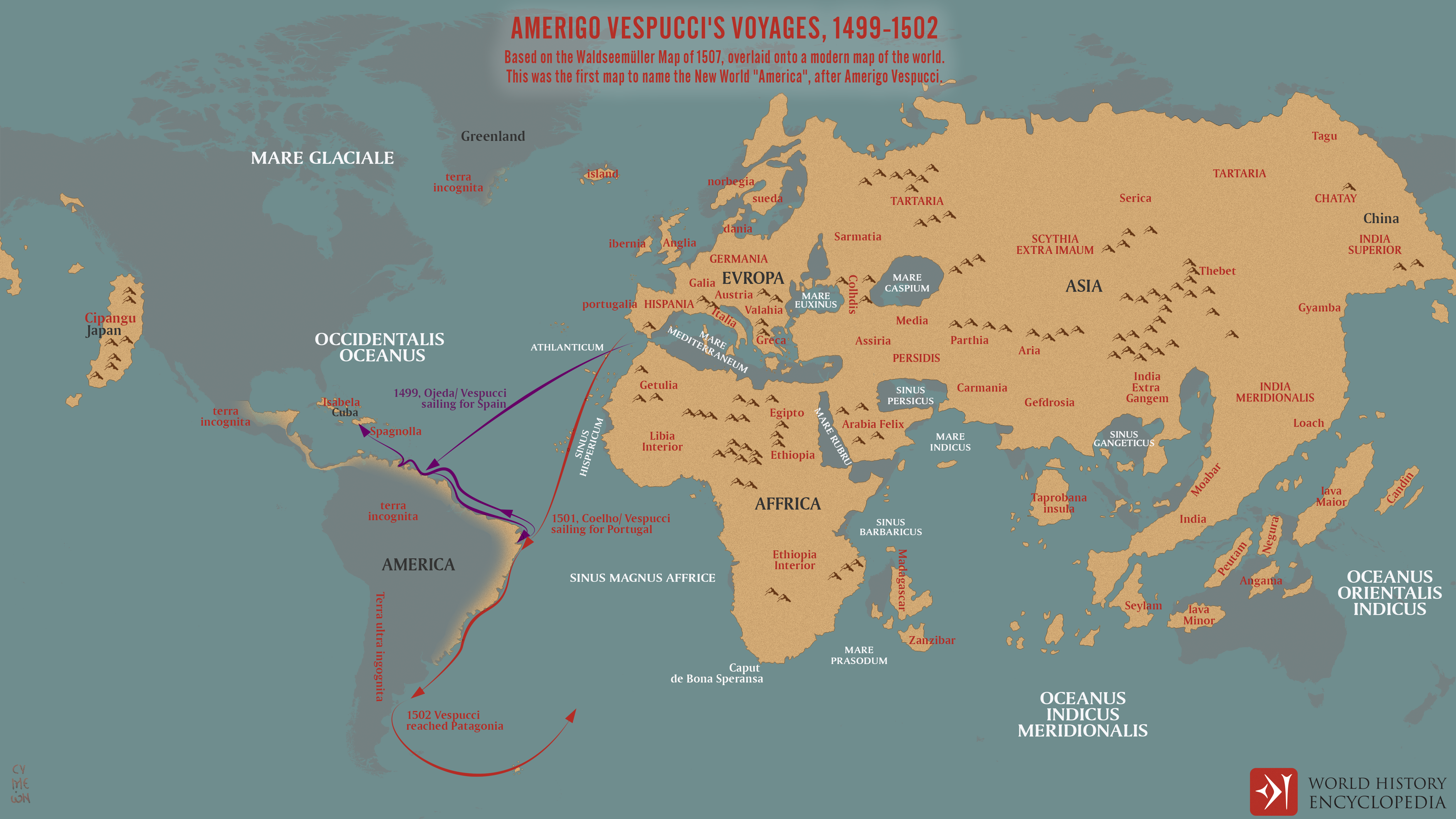
The naming of America was not the result of a single voyage or discovery, but of a chain of Atlantic expeditions, printed letters, and Renaissance mapmaking. [Christopher Columbus](https://www.worldhistory.org/Christopher_Columbus/) (1451–1506) reached the Caribbean in 1492 while seeking a westward route to Asia and continued to understand the lands he encountered within an “Indies” framework. Amerigo Vespucci (1454–1512), a Florentine merchant and navigator, became associated with later Spanish and Portuguese voyages to the South American coast, especially the better-attested expeditions of 1499–1500 and 1501–1502. His role was important, but often exaggerated: he did not command the main expeditions shown here, and some voyages later attributed to him, especially the alleged 1497–1498 voyage, remain historically uncertain.
Vespucci’s wider significance came through texts as much as travel. Printed letters attributed to him, including *Mundus Novus* and the *Soderini Letter*, helped popularize the idea that the western lands were not simply Asia but a Mundus Novus, a “New World.” In 1507, Martin Waldseemüller (c. 1470–1520) and Matthias Ringmann (1482–1511), working at Saint-Dié in Lorraine, used Vespucci-linked geography in a new world map and applied the name America to South America from the Latinized “Americus Vespuccius.” Waldseemüller later stepped back from the name, but print had already done its quiet damage: the label entered European cartography and eventually came to define two continents.
#### Editorial Review
This human-authored image has been reviewed by our editorial team before publication to ensure accuracy, reliability and adherence to academic standards in accordance with our [editorial policy](https://www.worldhistory.org/static/editorial-policy/).
## About the Author
Simeon is a freelance visual designer and history educator, passionate about the human stories that shape the past.
- [Linkedin Profile](https://www.linkedin.com/in/simeon-netchev/)
## Cite This Work
### APA
Netchev, S. (2026, June 29). Vespucci and the Map That Named America: Waldseemüller’s 1507 Map and the Invention of the New World. *World History Encyclopedia*.
### Chicago
Netchev, Simeon. "Vespucci and the Map That Named America: Waldseemüller’s 1507 Map and the Invention of the New World." *World History Encyclopedia*, June 29, 2026. .
### MLA
Netchev, Simeon. "Vespucci and the Map That Named America: Waldseemüller’s 1507 Map and the Invention of the New World." *World History Encyclopedia*, 29 Jun 2026, .
## License & Copyright
Submitted by [Simeon Netchev](https://www.worldhistory.org/user/simeonnetchev/ "User Page: Simeon Netchev"), published on 29 June 2026. The copyright holder has published this content under the following license: [Creative Commons Attribution-NonCommercial-NoDerivs](https://creativecommons.org/licenses/by-nc/4.0deed.en). This licence only allows others to download this content and share it with others as long as the author is credited, but they can't change the content in any way or use it commercially. When republishing on the web a hyperlink back to the original content source URL must be included. Please note that content linked from this page may have different licensing terms.