---
title: Map of the Silk Roads of Eurasia, c. 780–800: Trade Routes, Empires, and Cultural Exchange
author: Simeon Netchev
source: https://www.worldhistory.org/image/146/map-of-the-silk-roads-of-eurasia-c-780-800/
format: machine-readable-alternate
license: Creative Commons Attribution-NonCommercial-NoDerivs (https://creativecommons.org/licenses/by-nc/4.0)
updated: 2026-11-13
---
# Map of the Silk Roads of Eurasia, c. 780–800: Trade Routes, Empires, and Cultural Exchange
_Authored by [Simeon Netchev](https://www.worldhistory.org/user/simeonnetchev/)_
## Image File
[](https://www.worldhistory.org/uploads/images/146.png)
## Image Caption
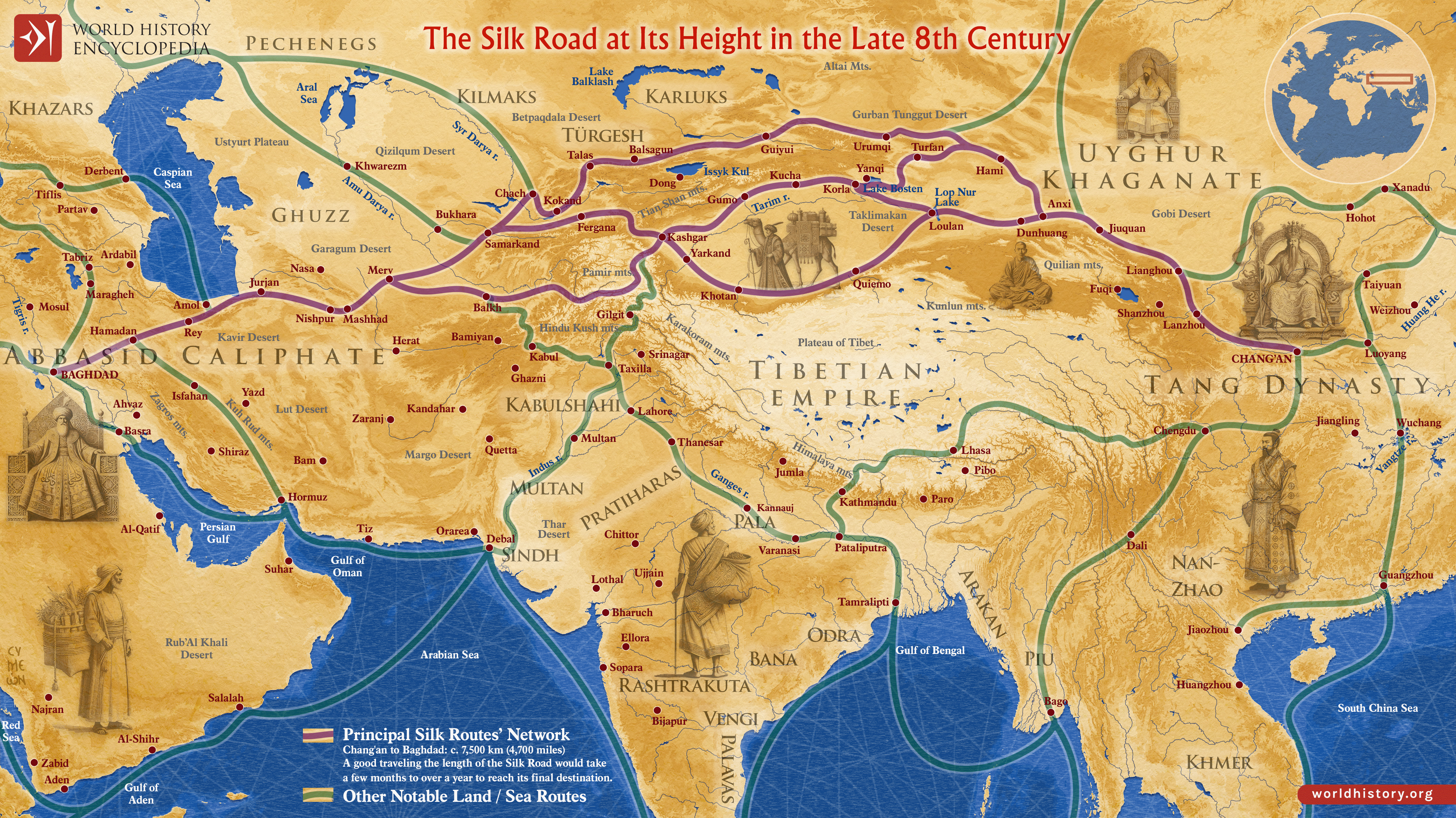
In the late 8th century, the [Silk](https://www.worldhistory.org/Silk/) Roads formed an interconnected network of overland caravan routes and maritime connections linking East Asia, Central Asia, [India](https://www.worldhistory.org/india/), the Islamic world, and parts of [Europe](https://www.worldhistory.org/europe/). Coined in 1877 by German geographer Ferdinand von Richthofen, the term describes not a single road but shifting corridors of [trade](https://www.worldhistory.org/disambiguation/trade/), diplomacy, and cultural exchange. [Cities](https://www.worldhistory.org/city/) such as Samarkand, Bukhara, Kashgar, Merv, and Baghdad served as commercial centres where successive merchants exchanged silk, horses, precious metals, and other commodities, while travellers transmitted religious beliefs, artistic traditions, and technologies across Eurasia.
By c. 780–800, political upheavals were reshaping these networks. The An Lushan Rebellion (755–763) had weakened the [Tang Dynasty](https://www.worldhistory.org/Tang_Dynasty/) (618–907), while the Tibetan [Empire](https://www.worldhistory.org/empire/) expanded into strategic Central Asian corridors and the Uyghur Khaganate (744–840) facilitated exchanges between [China](https://www.worldhistory.org/china/) and the Inner Asian steppe. To the west, the [Abbasid Caliphate](https://www.worldhistory.org/Abbasid_Dynasty/) (750–1258), ruling from Baghdad, connected markets across the Islamic world. Sogdian and other merchants sustained commerce across shifting political frontiers, while Indian Ocean routes linked [Arabia](https://www.worldhistory.org/Arabia/), India, Southeast Asia, and southern China. Despite imperial rivalry and regional instability, these networks continued to foster economic interdependence and the transmission of [Buddhism](https://www.worldhistory.org/buddhism/), [Islam](https://www.worldhistory.org/islam/), and other cultural traditions.
#### Editorial Review
This human-authored image has been reviewed by our editorial team before publication to ensure accuracy, reliability and adherence to academic standards in accordance with our [editorial policy](https://www.worldhistory.org/static/editorial-policy/).
## About the Author
Simeon is a freelance visual designer and history educator, passionate about the human stories that shape the past.
- [Linkedin Profile](https://www.linkedin.com/in/simeon-netchev/)
## Cite This Work
### APA
Netchev, S. (2026, November 13). Map of the Silk Roads of Eurasia, c. 780–800: Trade Routes, Empires, and Cultural Exchange. *World History Encyclopedia*.
### Chicago
Netchev, Simeon. "Map of the Silk Roads of Eurasia, c. 780–800: Trade Routes, Empires, and Cultural Exchange." *World History Encyclopedia*, November 13, 2026. .
### MLA
Netchev, Simeon. "Map of the Silk Roads of Eurasia, c. 780–800: Trade Routes, Empires, and Cultural Exchange." *World History Encyclopedia*, 13 Nov 2026, .
## License & Copyright
Submitted by [Simeon Netchev](https://www.worldhistory.org/user/simeonnetchev/ "User Page: Simeon Netchev"), published on 13 November 2026. The copyright holder has published this content under the following license: [Creative Commons Attribution-NonCommercial-NoDerivs](https://creativecommons.org/licenses/by-nc/4.0deed.en). This licence only allows others to download this content and share it with others as long as the author is credited, but they can't change the content in any way or use it commercially. When republishing on the web a hyperlink back to the original content source URL must be included. Please note that content linked from this page may have different licensing terms.