---
title: Map of India in the Vedic Age, 1500 BCE-500 BCE: Indo-Aryan Cultures in Northern India
author: Simeon Netchev
source: https://www.worldhistory.org/image/14540/map-of-india-in-the-vedic-age-1500-bce-500-bce/
format: machine-readable-alternate
license: Creative Commons Attribution-NonCommercial-NoDerivs (https://creativecommons.org/licenses/by-nc/4.0)
updated: 2026-04-20
---
# Map of India in the Vedic Age, 1500 BCE-500 BCE: Indo-Aryan Cultures in Northern India
_Authored by [Simeon Netchev](https://www.worldhistory.org/user/simeonnetchev/)_
## Image File
[](https://www.worldhistory.org/uploads/images/14540.png)
## Image Caption
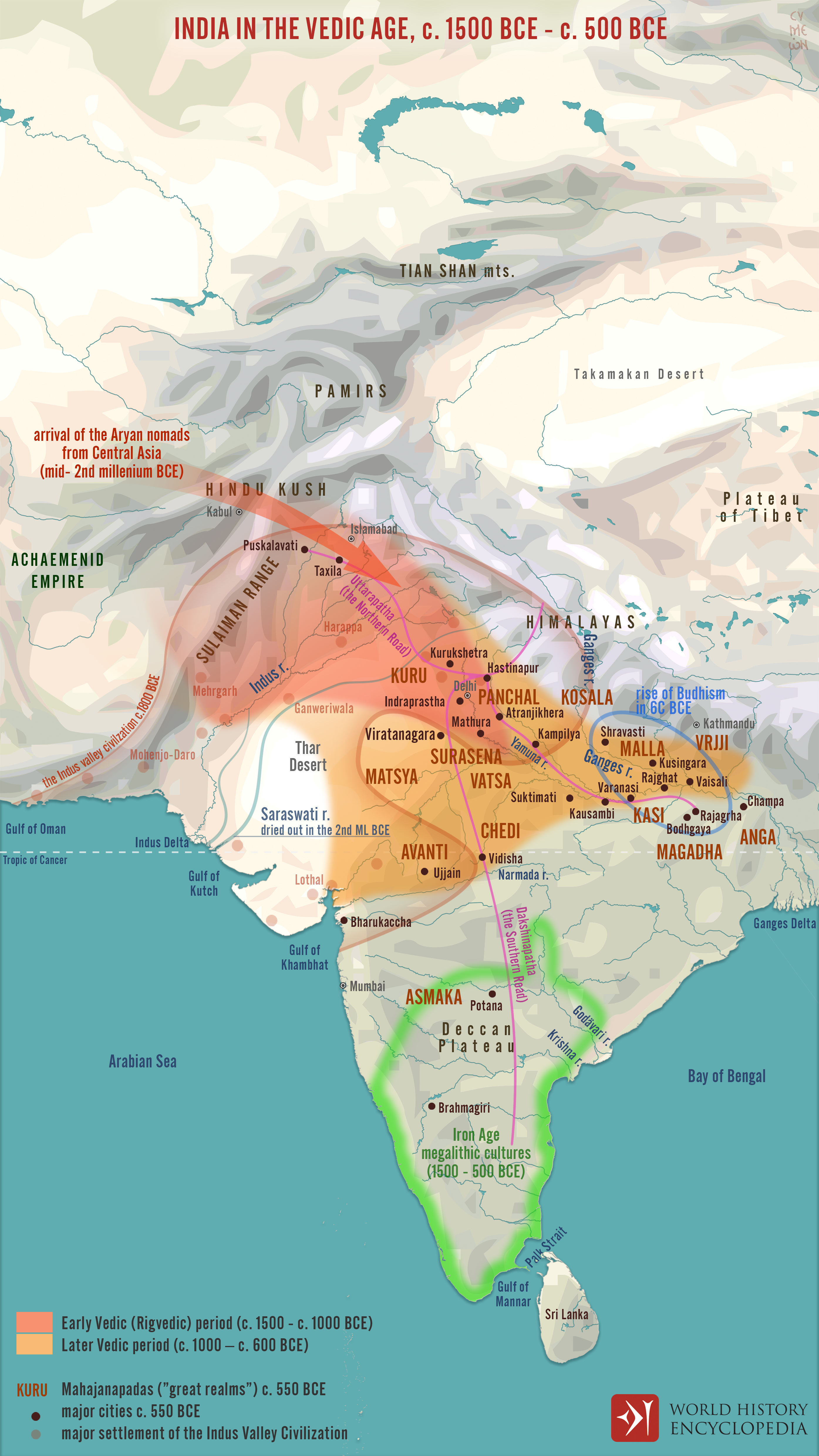
The Vedic Age (c. 1500-500 BCE) marks a formative period in the history of the northern Indian subcontinent, bridging the decline of the [Indus Valley Civilization](https://www.worldhistory.org/Indus_Valley_Civilization/) (c. 1300 BCE) and the emergence of early states in the Gangetic plain. During this time, Indo-[Aryan](https://www.worldhistory.org/Aryan/)–speaking pastoral groups migrated and settled across northwestern and northern [India](https://www.worldhistory.org/india/), interacting with existing populations and gradually transforming the cultural landscape. The period is named after the Vedic corpus, a body of orally transmitted texts composed in early [Sanskrit](https://www.worldhistory.org/Sanskrit/), which provide key insight into social organization, ritual practices, and early political structures. Rather than a unified state, the region was characterized by semi-nomadic clans and tribal polities, where authority rested with chieftains (rajas) and assemblies.
Over time, these societies underwent significant economic and political change, including the expansion of [agriculture](https://www.worldhistory.org/disambiguation/Agriculture/), the use of iron technology in the later phase, and the gradual movement eastward into the Indo-Gangetic plain. This process contributed to increasing social stratification, reflected in the development of the varna system, and to the emergence of more complex territorial polities. By c. 500 BCE, this transformation culminated in the rise of the *Mahajanapadas* (“Great Realms”), marking a transition toward [urbanization](https://www.worldhistory.org/urbanization/), state formation, and new intellectual traditions.
#### Editorial Review
This human-authored image has been reviewed by our editorial team before publication to ensure accuracy, reliability and adherence to academic standards in accordance with our [editorial policy](https://www.worldhistory.org/static/editorial-policy/).
## About the Author
Simeon is a freelance visual designer and history educator, passionate about the human stories that shape the past.
- [Linkedin Profile](https://www.linkedin.com/in/simeon-netchev/)
## Cite This Work
### APA
Netchev, S. (2026, April 20). Map of India in the Vedic Age, 1500 BCE-500 BCE: Indo-Aryan Cultures in Northern India. *World History Encyclopedia*.
### Chicago
Netchev, Simeon. "Map of India in the Vedic Age, 1500 BCE-500 BCE: Indo-Aryan Cultures in Northern India." *World History Encyclopedia*, April 20, 2026. .
### MLA
Netchev, Simeon. "Map of India in the Vedic Age, 1500 BCE-500 BCE: Indo-Aryan Cultures in Northern India." *World History Encyclopedia*, 20 Apr 2026, .
## License & Copyright
Submitted by [Simeon Netchev](https://www.worldhistory.org/user/simeonnetchev/ "User Page: Simeon Netchev"), published on 20 April 2026. The copyright holder has published this content under the following license: [Creative Commons Attribution-NonCommercial-NoDerivs](https://creativecommons.org/licenses/by-nc/4.0deed.en). This licence only allows others to download this content and share it with others as long as the author is credited, but they can't change the content in any way or use it commercially. When republishing on the web a hyperlink back to the original content source URL must be included. Please note that content linked from this page may have different licensing terms.