---
title: Processional Dancer Bringing Cake Offerings
author: The Ure Museum of Greek Archaeology
source: https://www.worldhistory.org/image/14460/processional-dancer-bringing-cake-offerings/
format: machine-readable-alternate
updated: 1970-01-01
---
# Processional Dancer Bringing Cake Offerings
_Authored by The Ure Museum of Greek Archaeology_
## Image File
[](https://www.worldhistory.org/uploads/images/14460.jpg)
## Image Caption
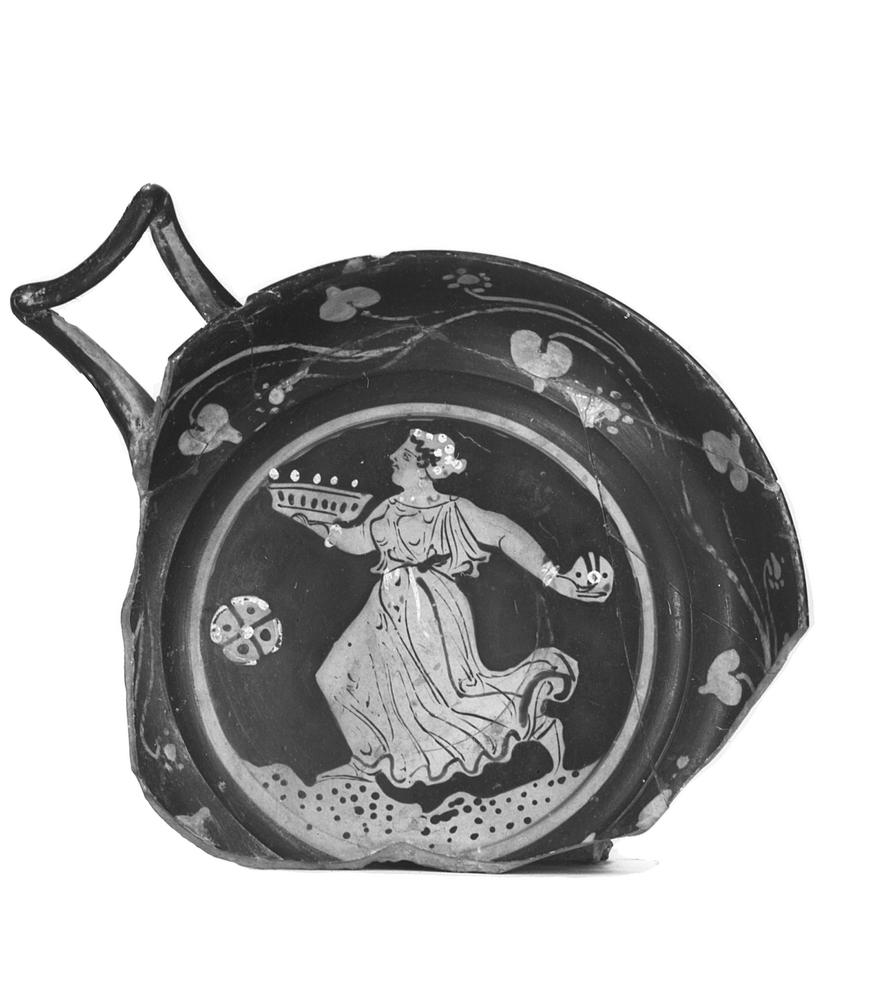
Apulian stemless cup (fragment) depicting a processional dancer bringing cake offerings, c. 350-325 BCE.
The Ure Museum of [Greek](https://www.worldhistory.org/disambiguation/greek/) [Archaeology](https://www.worldhistory.org/Archaeology/), Reading. acc. no. 22.3.24
In ancient [Greece](https://www.worldhistory.org/greece/), bringing offerings to gods and goddesses, or deified heroes, and/or ancestors was a key part of cultic rituals. Sacred offerings, overall, were divided into three main groups of burnt (or blood) sacrifices (sacrificial animals), unburnt sacrifices (boughs, grains, pieces of bread, and cakes), and libations (wine or water to pour down). The female worshipper depicted in the tondo of this cup is striding rhythmically in a processional dance while carrying two sorts of cake offerings. She has a large bowl containing an *amphiphon* cheesecake topped with little torches on her left hand (to the viewer) and a *kokkora*, a small cheese-doughnut shaped like pomegranate seed and usually decorated with fruits and nuts, here with a fig in its central depression and two (wal)nuts on sides, suggesting a whole row of nuts all around the central fig. The *amphiphon* was consecrated to [Artemis](https://www.worldhistory.org/artemis/) as the moon goddess in her nocturnal worship as the light-giving deity. The *kokkora* symbolised [Persephone](https://www.worldhistory.org/persephone/), the spring goddess, and her coming back from the underworld which prompted the rebirth of the whole nature. The painting, therefore, corresponds with the Mounichia, the spring festival of Artemis in the Athenian month Mounichion (April/May) which took place in her sanctuary on the top of the Mounichia hill near [Athens](https://www.worldhistory.org/Athens/).
## External Links
- [Ure Museum](https://uremuseum.org/cgi-bin/ure/uredb.cgi?rec=22.3.24)
## Cite This Work
### APA
Archaeology, T. U. M. o. G. (2021, August 20). Processional Dancer Bringing Cake Offerings. *World History Encyclopedia*.
### Chicago
Archaeology, The Ure Museum of Greek. "Processional Dancer Bringing Cake Offerings." *World History Encyclopedia*, August 20, 2021. .
### MLA
Archaeology, The Ure Museum of Greek. "Processional Dancer Bringing Cake Offerings." *World History Encyclopedia*, 20 Aug 2021, .
## License & Copyright
[Original image](https://uremuseum.org/cgi-bin/ure/uredb.cgi?rec=22.3.24) by **The Ure Museum of Greek Archaeology**. Submitted by [Nathalie Choubineh](https://www.worldhistory.org/user/nathalie.choubineh/ "User Page: Nathalie Choubineh"), published on 20 August 2021. The copyright holder has published this content under the following license: [Copyright](http://en.wikipedia.org/wiki/Copyright). You cannot use, copy, distribute, or modify this item without explicit permission from the author. Please note that content linked from this page may have different licensing terms.