---
title: Map of the Hallstatt Culture - Early Iron Age Europe: Salt, Iron, Trade and the Rise of Regional Elites
author: Simeon Netchev
source: https://www.worldhistory.org/image/14457/map-of-the-hallstatt-culture---early-iron-age-euro/
format: machine-readable-alternate
license: Creative Commons Attribution-NonCommercial-NoDerivs (https://creativecommons.org/licenses/by-nc/4.0)
updated: 2026-10-26
---
# Map of the Hallstatt Culture - Early Iron Age Europe: Salt, Iron, Trade and the Rise of Regional Elites
_Authored by [Simeon Netchev](https://www.worldhistory.org/user/simeonnetchev/)_
## Image File
[](https://www.worldhistory.org/uploads/images/14457.png)
## Image Caption
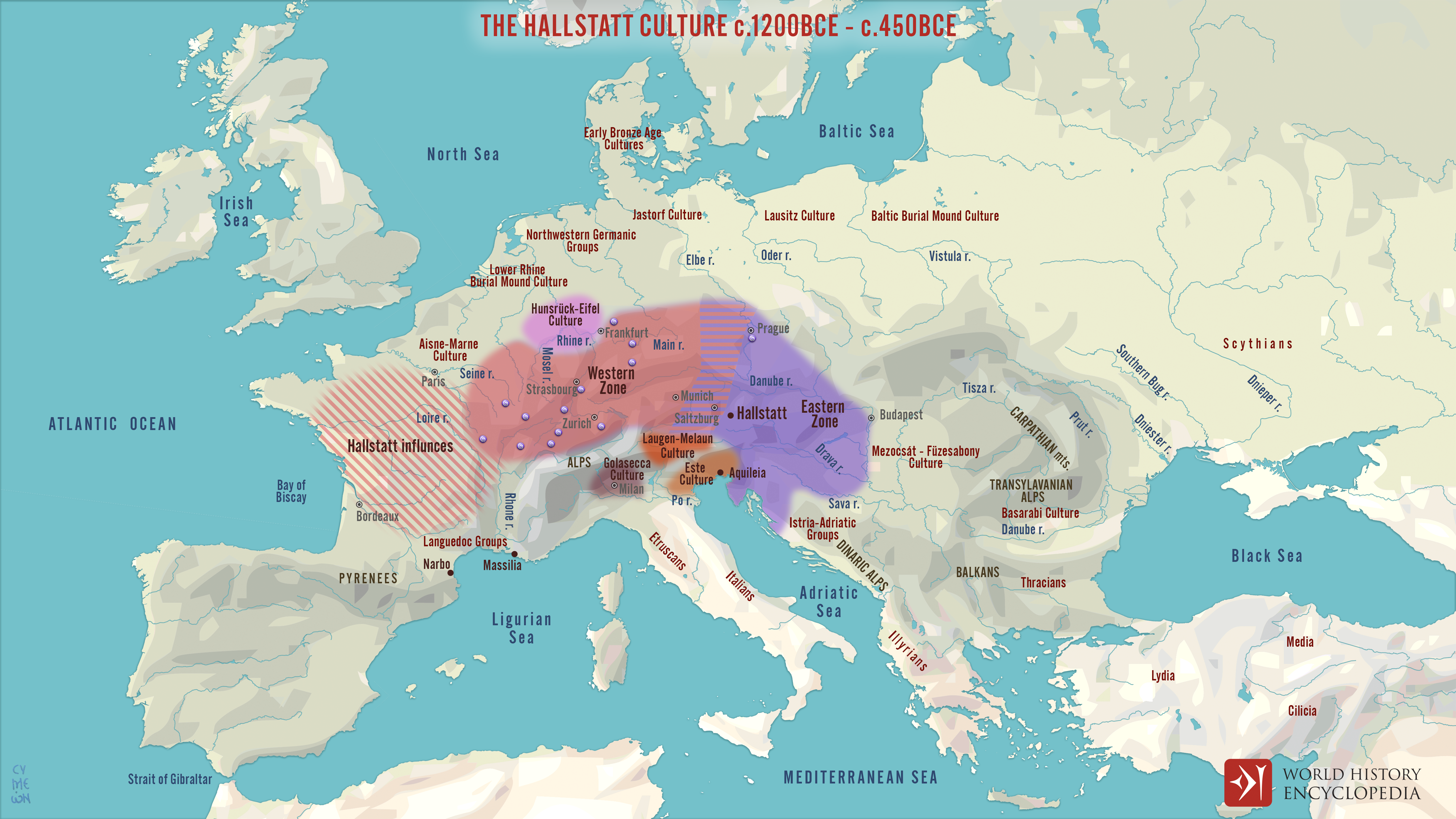
The [Hallstatt culture](https://www.worldhistory.org/Hallstatt_Culture/) flourished across Central [Europe](https://www.worldhistory.org/europe/) during the Early [Iron Age](https://www.worldhistory.org/disambiguation/Iron_Age/) (c. 800-450 BCE), emerging from earlier Late [Bronze Age](https://www.worldhistory.org/disambiguation/Bronze_Age/) traditions. Named after the extensive cemetery and prehistoric salt mines at [Hallstatt](https://www.worldhistory.org/Hallstatt_Culture/) in present-day Austria, it is often associated with the formative stages of [Celtic](https://www.worldhistory.org/celt/) societies, although shared archaeological traditions do not necessarily indicate a single people or language. Ironworking, salt extraction, [agriculture](https://www.worldhistory.org/disambiguation/Agriculture/), fortified settlements, and elaborate burials reveal increasingly complex communities, regional specialization, and the emergence of powerful elites.
[Trade](https://www.worldhistory.org/disambiguation/trade/) and cultural exchange connected Hallstatt communities with northern Europe and the [Mediterranean](https://www.worldhistory.org/disambiguation/mediterranean/) through river networks and Alpine crossings. Salt, metals, crafted goods, and Mediterranean imports circulated through networks involving [Greek](https://www.worldhistory.org/disambiguation/greek/) and [Etruscan](https://www.worldhistory.org/Etruscan_Civilization/) societies, supporting wealthy regional centers such as Heuneburg and Mont Lassois–Vix. The Western and Eastern Hallstatt zones developed distinctive material traditions rather than forming a unified political entity. By the fifth century BCE, changing economic networks and social structures accompanied the emergence of the [La Tène culture](https://www.worldhistory.org/La_Tene_Culture/), reflecting the continuing transformation of Early Iron Age Europe.
#### Editorial Review
This human-authored image has been reviewed by our editorial team before publication to ensure accuracy, reliability and adherence to academic standards in accordance with our [editorial policy](https://www.worldhistory.org/static/editorial-policy/).
## About the Author
Simeon is a freelance visual designer and history educator, passionate about the human stories that shape the past.
- [Linkedin Profile](https://www.linkedin.com/in/simeon-netchev/)
## Cite This Work
### APA
Netchev, S. (2026, October 26). Map of the Hallstatt Culture - Early Iron Age Europe: Salt, Iron, Trade and the Rise of Regional Elites. *World History Encyclopedia*.
### Chicago
Netchev, Simeon. "Map of the Hallstatt Culture - Early Iron Age Europe: Salt, Iron, Trade and the Rise of Regional Elites." *World History Encyclopedia*, October 26, 2026. .
### MLA
Netchev, Simeon. "Map of the Hallstatt Culture - Early Iron Age Europe: Salt, Iron, Trade and the Rise of Regional Elites." *World History Encyclopedia*, 26 Oct 2026, .
## License & Copyright
Submitted by [Simeon Netchev](https://www.worldhistory.org/user/simeonnetchev/ "User Page: Simeon Netchev"), published on 26 October 2026. The copyright holder has published this content under the following license: [Creative Commons Attribution-NonCommercial-NoDerivs](https://creativecommons.org/licenses/by-nc/4.0deed.en). This licence only allows others to download this content and share it with others as long as the author is credited, but they can't change the content in any way or use it commercially. When republishing on the web a hyperlink back to the original content source URL must be included. Please note that content linked from this page may have different licensing terms.