---
title: Map of the Urnfield Culture c. 1300 BCE
author: Simeon Netchev
source: https://www.worldhistory.org/image/14456/map-of-the-urnfield-culture-c-1300-bce/
format: machine-readable-alternate
license: Creative Commons Attribution-NonCommercial-NoDerivs (https://creativecommons.org/licenses/by-nc/4.0)
updated: 2025-09-17
---
# Map of the Urnfield Culture c. 1300 BCE
_Authored by [Simeon Netchev](https://www.worldhistory.org/user/simeonnetchev/)_
## Image File
[](https://www.worldhistory.org/uploads/images/14456.png)
## Image Caption
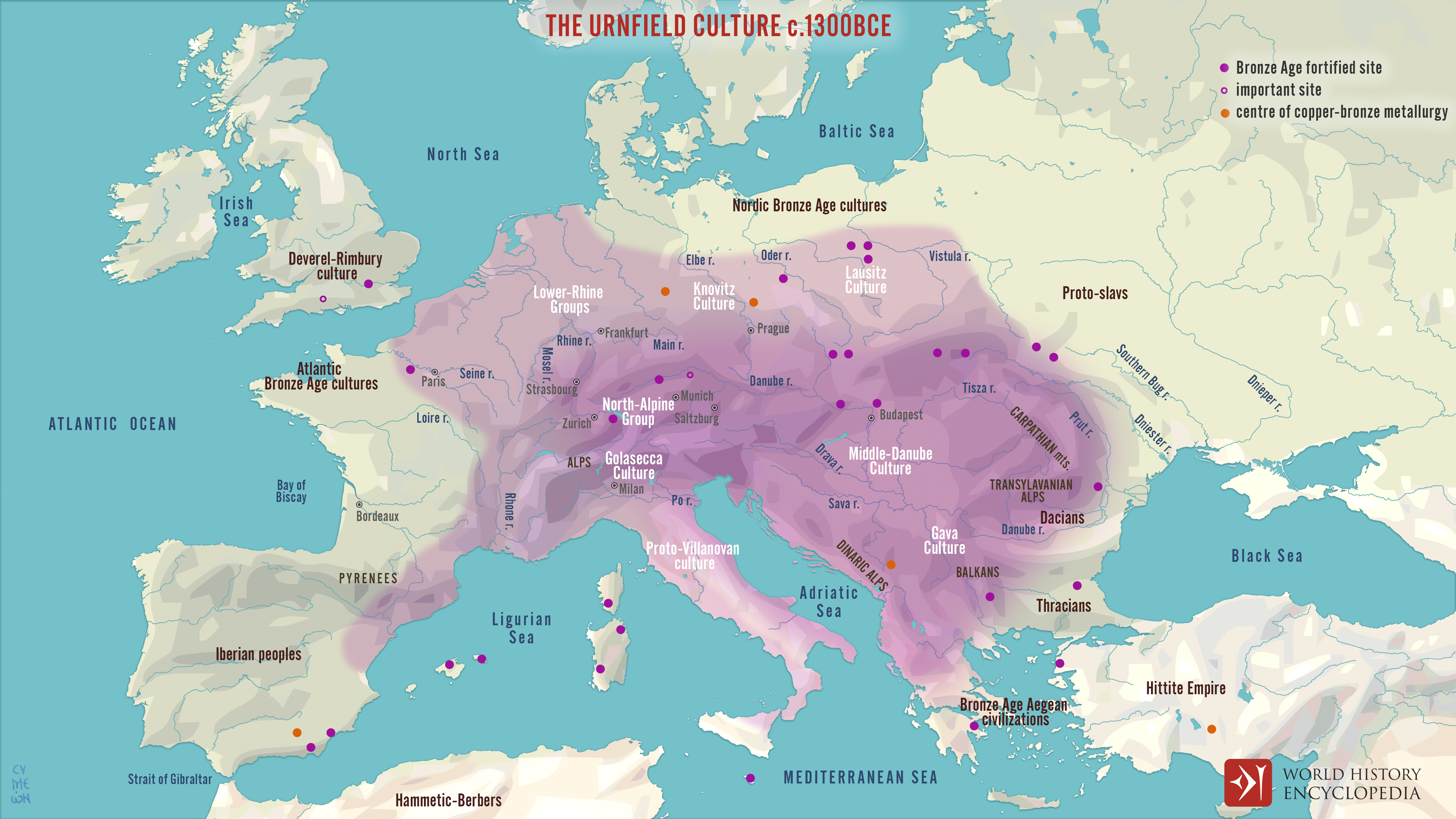
This map illustrates the spread of the Urnfield [culture](https://www.worldhistory.org/disambiguation/culture/) in [Europe](https://www.worldhistory.org/europe/) by around 1300 BCE, a late [Bronze Age](https://www.worldhistory.org/disambiguation/Bronze_Age/) archaeological horizon named for the practice of cremating the dead and placing their ashes in urns buried in fields. Lasting from roughly c. 1300-750 BCE, the Urnfield culture marked a transformative period in European prehistory and is widely regarded as one of the root cultures of the later [Celts](https://www.worldhistory.org/celt/).
The Urnfield tradition emerged in central Europe, especially in the upper Danube and Rhine regions, before expanding across much of continental Europe, from Hungary and Austria through southern Germany, France, and northern [Italy](https://www.worldhistory.org/italy/). Its spread coincided with advances in [bronze](https://www.worldhistory.org/disambiguation/bronze/) metallurgy, fortified settlements, and long-distance [trade](https://www.worldhistory.org/disambiguation/trade/) networks, linking Europe with the [Mediterranean](https://www.worldhistory.org/disambiguation/mediterranean/) and the [Near East](https://www.worldhistory.org/Near_East/). The characteristic funerary rite of urn cremation replaced earlier tumulus (mound) burials, reflecting broader social and religious shifts. While not a “state” culture, the Urnfield horizon represents a shared set of practices and material culture that laid the groundwork for the [Hallstatt culture](https://www.worldhistory.org/Hallstatt_Culture/) (c. 800-450 BCE) and, ultimately, the rise of the Celts as a distinct cultural group in the [Iron Age](https://www.worldhistory.org/disambiguation/Iron_Age/).
#### Editorial Review
This human-authored image has been reviewed by our editorial team before publication to ensure accuracy, reliability and adherence to academic standards in accordance with our [editorial policy](https://www.worldhistory.org/static/editorial-policy/).
## About the Author
Simeon is a freelance visual designer and history educator, passionate about the human stories that shape the past.
- [Linkedin Profile](https://www.linkedin.com/in/simeon-netchev/)
## Cite This Work
### APA
Netchev, S. (2021, August 23). Map of the Urnfield Culture c. 1300 BCE. *World History Encyclopedia*.
### Chicago
Netchev, Simeon. "Map of the Urnfield Culture c. 1300 BCE." *World History Encyclopedia*, August 23, 2021. .
### MLA
Netchev, Simeon. "Map of the Urnfield Culture c. 1300 BCE." *World History Encyclopedia*, 23 Aug 2021, .
## License & Copyright
Submitted by [Simeon Netchev](https://www.worldhistory.org/user/simeonnetchev/ "User Page: Simeon Netchev"), published on 23 August 2021. The copyright holder has published this content under the following license: [Creative Commons Attribution-NonCommercial-NoDerivs](https://creativecommons.org/licenses/by-nc/4.0deed.en). This licence only allows others to download this content and share it with others as long as the author is credited, but they can't change the content in any way or use it commercially. When republishing on the web a hyperlink back to the original content source URL must be included. Please note that content linked from this page may have different licensing terms.