---
title: Scarabs of Hatshepsut
author: Nicole Lesar
source: https://www.worldhistory.org/image/14370/scarabs-of-hatshepsut/
format: machine-readable-alternate
license: Creative Commons Attribution-NonCommercial-ShareAlike (https://creativecommons.org/licenses/by-nc-sa/4.0/)
updated: 2024-07-19
---
# Scarabs of Hatshepsut
_Authored by [Nicole Lesar](https://www.worldhistory.org/user/nicole.dy8/)_
## Image File
[](https://www.worldhistory.org/uploads/images/14370.jpg)
## Image Caption
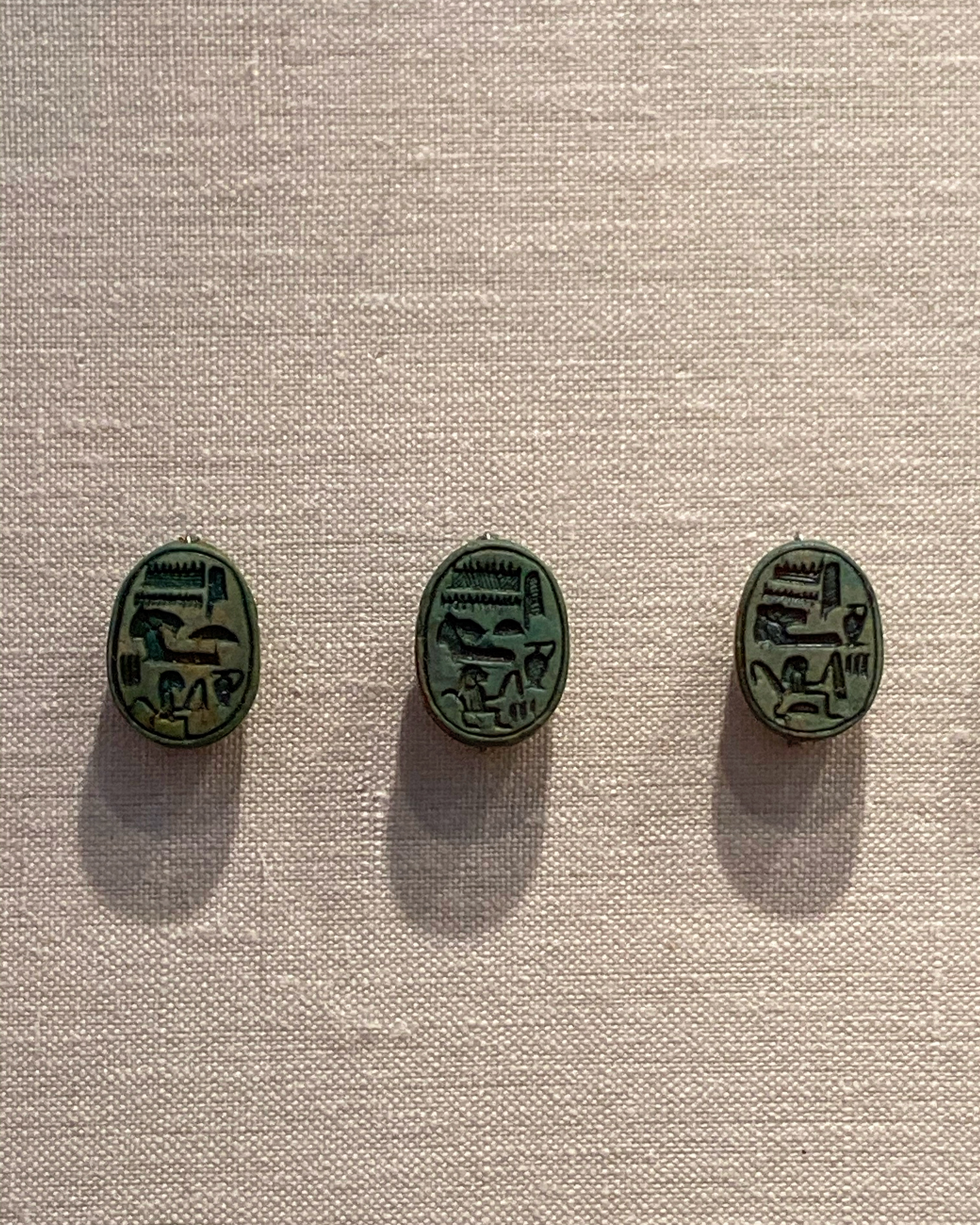
Scarabs of [Hatshepsut](https://www.worldhistory.org/hatshepsut/) (r. 1479-1458 BCE), 18th Dynasty, [New Kingdom of Egypt](https://www.worldhistory.org/New_Kingdom_of_Egypt/).
Metropolitan Museum of Art, New York.
The Metropolitan Museum of Art was an integral part of the excavations of Hatshepsut's [temple](https://www.worldhistory.org/temple/) at Deir al-Bahri. During the 1926-1927 dig season, 299 scarab amulets and stamp seals were discovered near the eastern [wall](https://www.worldhistory.org/wall/) of the temple. Scarabs were very popular amulets, and they were considered to be symbols of regeneration and rebirth.
On the scarabs that were found, there was an example of every title or name that Hatshepsut ever held. These three scarabs have Hatshepsut's birth name inscribed. The hieroglyphs in birth name can be translated to "United with [Amun](https://www.worldhistory.org/amun/), Foremost of the Noble [Women](https://www.worldhistory.org/disambiguation/women/)." The name "Hatshepsut" translates to "Foremost of the Noble Women"; she added "United With Amun" to her name at a later point. Hatshepsut claimed that Amun was her father, and adding this part to her name justified her right to rule as [pharaoh](https://www.worldhistory.org/pharaoh/).
#### Editorial Review
This human-authored image has been reviewed by our editorial team before publication to ensure accuracy, reliability and adherence to academic standards in accordance with our [editorial policy](https://www.worldhistory.org/static/editorial-policy/).
## Bibliography
- [Andrews, Carol. *Amulets of Ancient Egypt.* University of Texas Press, 1994.](https://www.worldhistory.org/books/029270464X/)
- [Cooney, Kara. *The Woman Who Would Be King.* Crown, 2015.](https://www.worldhistory.org/books/0307956776/)
- [Roehrig, Cathleen A. *Hatshepsut.* The Metropolitan Museum of Art, 2006.](https://www.worldhistory.org/books/1588391736/)
## About the Author
Nicole is an Earth/Environmental Scientist, who is currently teaching science to middle and high school students. She has a passion for ancient history, particularly ancient Egypt, due to the teachings of her Nonno (grandfather).
## Cite This Work
### APA
Lesar, N. (2021, July 13). Scarabs of Hatshepsut. *World History Encyclopedia*.
### Chicago
Lesar, Nicole. "Scarabs of Hatshepsut." *World History Encyclopedia*, July 13, 2021. .
### MLA
Lesar, Nicole. "Scarabs of Hatshepsut." *World History Encyclopedia*, 13 Jul 2021, .
## License & Copyright
Submitted by [Nicole Lesar](https://www.worldhistory.org/user/nicole.dy8/ "User Page: Nicole Lesar"), published on 13 July 2021. The copyright holder has published this content under the following license: [Creative Commons Attribution-NonCommercial-ShareAlike](https://creativecommons.org/licenses/by-nc-sa/4.0/deed.en). This license lets others remix, tweak, and build upon this content non-commercially, as long as they credit the author and license their new creations under the identical terms. When republishing on the web a hyperlink back to the original content source URL must be included. Please note that content linked from this page may have different licensing terms.