---
title: Map of the Scythian Expanse, c. 700-300 BCE
author: Simeon Netchev
source: https://www.worldhistory.org/image/14359/map-of-the-scythian-expanse-c-700-300-bce/
format: machine-readable-alternate
license: Creative Commons Attribution-NonCommercial-NoDerivs (https://creativecommons.org/licenses/by-nc/4.0)
updated: 2026-01-26
---
# Map of the Scythian Expanse, c. 700-300 BCE
_Authored by [Simeon Netchev](https://www.worldhistory.org/user/simeonnetchev/)_
## Image File
[](https://www.worldhistory.org/uploads/images/14359.png)
## Image Caption
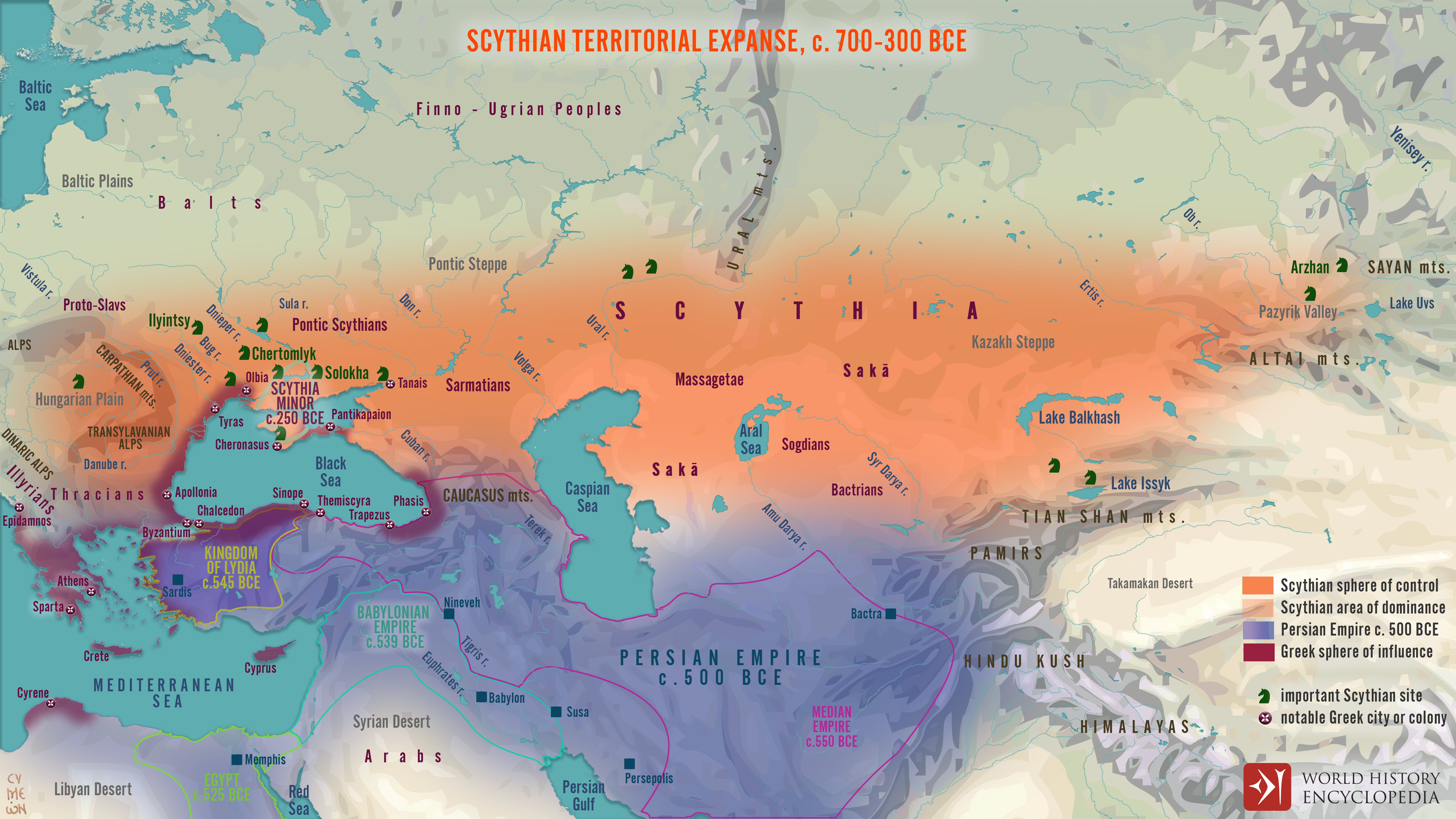
The westward expansion of the [Scythians](https://www.worldhistory.org/Scythians/) (c. 700–300 BCE) illustrates how mobile steppe societies could reshape the political and cultural landscapes of Eurasia without building territorial empires. Originating in the Central Asian steppes, [Scythian](https://www.worldhistory.org/Scythians/) groups moved steadily west into the Pontic–Caspian region, exploiting their mastery of horse-based [warfare](https://www.worldhistory.org/warfare/) and flexible social organization. Their mobility allowed them to dominate vast grasslands, control key corridors between Asia and [Europe](https://www.worldhistory.org/europe/), and intervene decisively in the affairs of settled states along the fringes of the steppe world.
From the [Near East](https://www.worldhistory.org/Near_East/) to the northern Black Sea, Scythians interacted with major civilizations through warfare, alliance, tribute, and [trade](https://www.worldhistory.org/disambiguation/trade/). They confronted [Assyria](https://www.worldhistory.org/assyria/) during the late Neo-Assyrian period (7th century BCE), engaged with the [Achaemenid](https://www.worldhistory.org/disambiguation/Achaemenid/) [Persian Empire](https://www.worldhistory.org/disambiguation/Persian_Empire/) under rulers such as [Darius I](https://www.worldhistory.org/Darius_I/) (reigned 522–486 BCE), and maintained close, often tense, relations with [Greek](https://www.worldhistory.org/disambiguation/greek/) colonies along the Black Sea coast. Archaeological evidence from richly furnished kurgan burials reveals a stratified society, long-distance exchange networks, and a shared elite [culture](https://www.worldhistory.org/disambiguation/culture/) expressed through weaponry, animal-style art, and goldwork. By the late 4th–3rd centuries BCE, pressure from related nomadic groups, especially the Sarmatians, fragmented Scythian power, yet their legacy endured in classical historiography, steppe traditions, and the long-standing model of mounted nomadic dominance.
*Special thanks to [Patrick Scott Smith](https://www.worldhistory.org/user/patrickscottsmith1956/) for his research and input.*
#### Editorial Review
This human-authored image has been reviewed by our editorial team before publication to ensure accuracy, reliability and adherence to academic standards in accordance with our [editorial policy](https://www.worldhistory.org/static/editorial-policy/).
## About the Author
Simeon is a freelance visual designer and history educator, passionate about the human stories that shape the past.
- [Linkedin Profile](https://www.linkedin.com/in/simeon-netchev/)
## Cite This Work
### APA
Netchev, S. (2026, January 26). Map of the Scythian Expanse, c. 700-300 BCE. *World History Encyclopedia*.
### Chicago
Netchev, Simeon. "Map of the Scythian Expanse, c. 700-300 BCE." *World History Encyclopedia*, January 26, 2026. .
### MLA
Netchev, Simeon. "Map of the Scythian Expanse, c. 700-300 BCE." *World History Encyclopedia*, 26 Jan 2026, .
## License & Copyright
Submitted by [Simeon Netchev](https://www.worldhistory.org/user/simeonnetchev/ "User Page: Simeon Netchev"), published on 26 January 2026. The copyright holder has published this content under the following license: [Creative Commons Attribution-NonCommercial-NoDerivs](https://creativecommons.org/licenses/by-nc/4.0deed.en). This licence only allows others to download this content and share it with others as long as the author is credited, but they can't change the content in any way or use it commercially. When republishing on the web a hyperlink back to the original content source URL must be included. Please note that content linked from this page may have different licensing terms.