---
title: Map of the Islamic Conquests in the 7th-9th Centuries
author: Simeon Netchev
source: https://www.worldhistory.org/image/14212/map-of-the-islamic-conquests-in-the-7th-9th-centur/
format: machine-readable-alternate
license: Creative Commons Attribution-NonCommercial-NoDerivs (https://creativecommons.org/licenses/by-nc/4.0)
updated: 2025-09-02
---
# Map of the Islamic Conquests in the 7th-9th Centuries
_Authored by [Simeon Netchev](https://www.worldhistory.org/user/simeonnetchev/)_
## Image File
[](https://www.worldhistory.org/uploads/images/14212.png)
## Image Caption
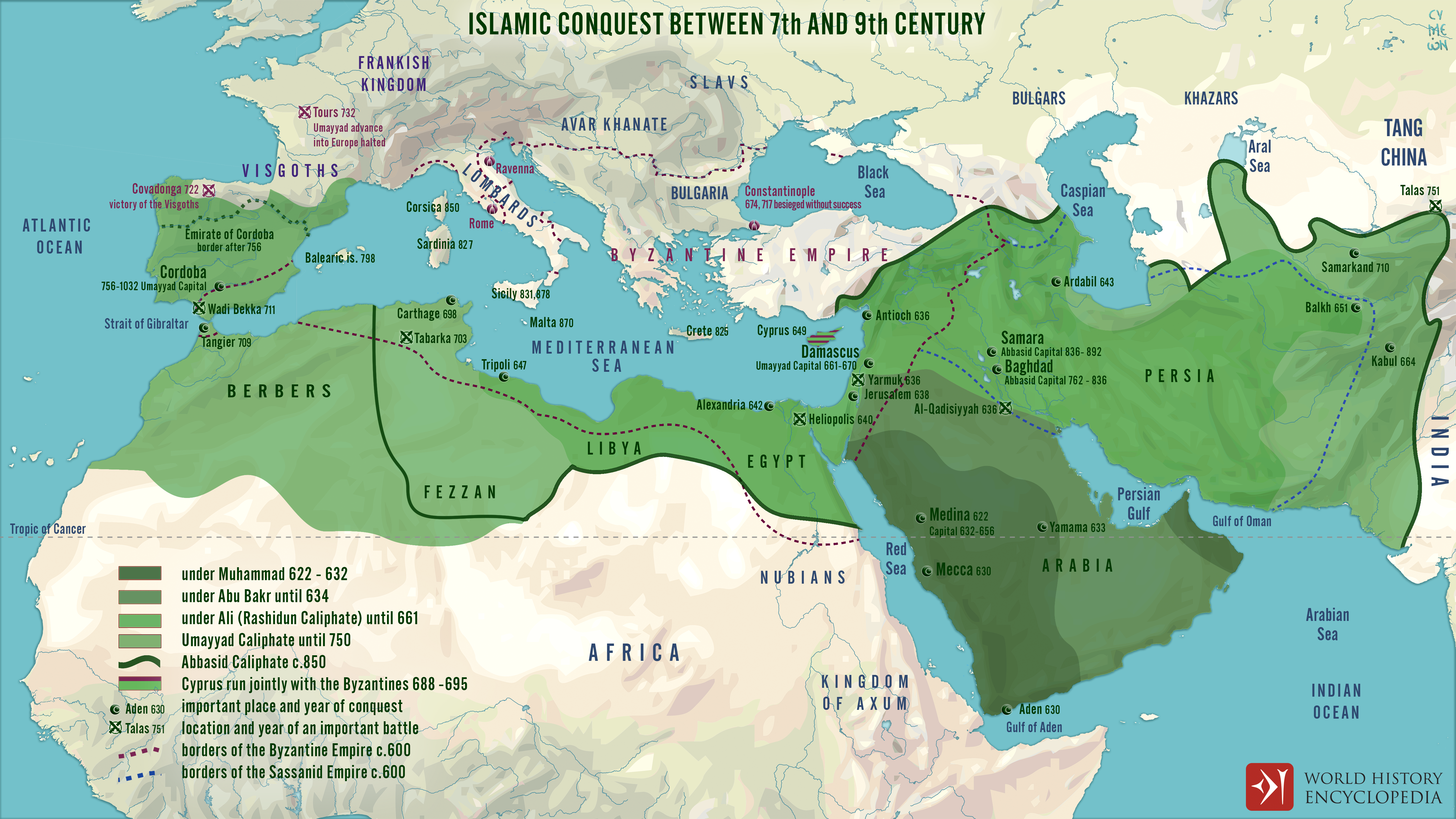
This map illustrates the rise and rapid expansion of [Islam](https://www.worldhistory.org/islam/) from the time of the [Prophet Muhammad](https://www.worldhistory.org/Prophet_Muhammad/) (622–632 CE) through the great caliphates of the 7th to 9th centuries. Beginning in [Arabia](https://www.worldhistory.org/Arabia/), the new faith and its armies spread under the Rashidun Caliphs (632–661 CE), followed by the [Umayyad Caliphate](https://www.worldhistory.org/Umayyad_Dynasty/) (661–750 CE) and the [Abbasid Caliphate](https://www.worldhistory.org/Abbasid_Dynasty/) (750–c. 900 CE), creating one of history’s largest and most dynamic empires within just a few generations.
The conquests reshaped the political map of Eurasia and North [Africa](https://www.worldhistory.org/disambiguation/africa/). [Byzantine](https://www.worldhistory.org/disambiguation/Byzantine/) and [Sassanian](https://www.worldhistory.org/Sasanian_Empire/) strongholds fell: Damascus (635), [Jerusalem](https://www.worldhistory.org/jerusalem/) (638), [Ctesiphon](https://www.worldhistory.org/ctesiphon/) (636), and [Alexandria](https://www.worldhistory.org/alexandria/) (642), while new [cities](https://www.worldhistory.org/city/) like Baghdad (founded 762 CE) rose as imperial capitals. Expansion continued west into North Africa and the Iberian Peninsula, culminating in the [Umayyad](https://www.worldhistory.org/Umayyad_Dynasty/) Emirate of Córdoba (756–1031), and eastward into Central Asia as far as Samarkand (710). Beyond military victories, the spread of Islam brought lasting cultural, linguistic, and religious change, weaving together diverse peoples from Spain to [Persia](https://www.worldhistory.org/Persia/) under shared networks of faith, [trade](https://www.worldhistory.org/disambiguation/trade/), and learning.
#### Editorial Review
This human-authored image has been reviewed by our editorial team before publication to ensure accuracy, reliability and adherence to academic standards in accordance with our [editorial policy](https://www.worldhistory.org/static/editorial-policy/).
## About the Author
Simeon is a freelance visual designer and history educator, passionate about the human stories that shape the past.
- [Linkedin Profile](https://www.linkedin.com/in/simeon-netchev/)
## Cite This Work
### APA
Netchev, S. (2021, June 08). Map of the Islamic Conquests in the 7th-9th Centuries. *World History Encyclopedia*.
### Chicago
Netchev, Simeon. "Map of the Islamic Conquests in the 7th-9th Centuries." *World History Encyclopedia*, June 08, 2021. .
### MLA
Netchev, Simeon. "Map of the Islamic Conquests in the 7th-9th Centuries." *World History Encyclopedia*, 08 Jun 2021, .
## License & Copyright
Submitted by [Simeon Netchev](https://www.worldhistory.org/user/simeonnetchev/ "User Page: Simeon Netchev"), published on 08 June 2021. The copyright holder has published this content under the following license: [Creative Commons Attribution-NonCommercial-NoDerivs](https://creativecommons.org/licenses/by-nc/4.0deed.en). This licence only allows others to download this content and share it with others as long as the author is credited, but they can't change the content in any way or use it commercially. When republishing on the web a hyperlink back to the original content source URL must be included. Please note that content linked from this page may have different licensing terms.