---
title: Map of the Aztec Empire, c. 1427–1521: The Rise and Fall of Mesoamerica’s Warrior Kings
author: Simeon Netchev
source: https://www.worldhistory.org/image/14181/map-of-the-aztec-empire-c-1427-1521/
format: machine-readable-alternate
license: Creative Commons Attribution-NonCommercial-NoDerivs (https://creativecommons.org/licenses/by-nc/4.0)
updated: 2025-04-23
---
# Map of the Aztec Empire, c. 1427–1521: The Rise and Fall of Mesoamerica’s Warrior Kings
_Authored by [Simeon Netchev](https://www.worldhistory.org/user/simeonnetchev/)_
## Image File
[](https://www.worldhistory.org/uploads/images/14181.png)
## Image Caption
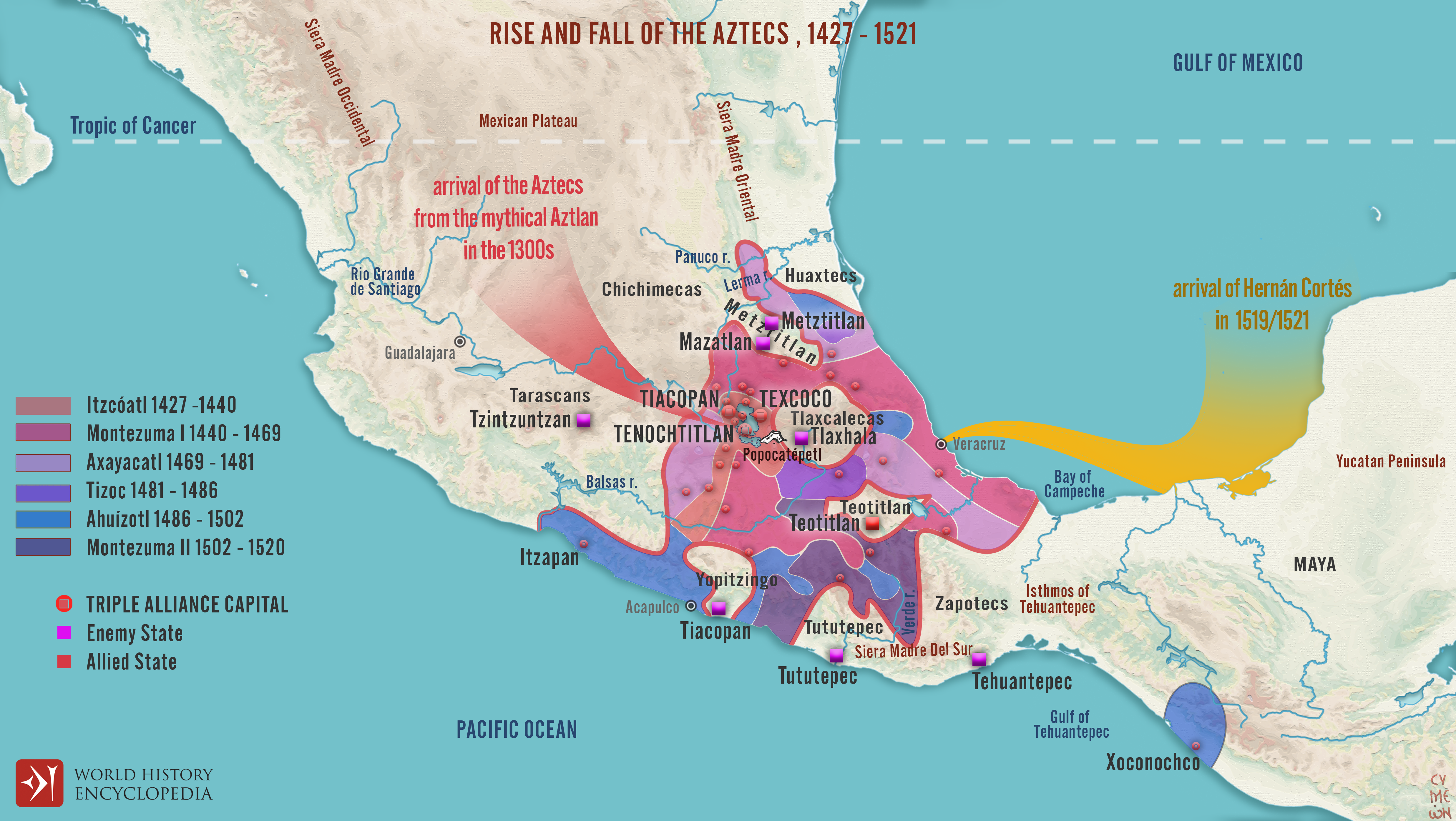
This map illustrates the origins and territorial expansion of the [Aztec Empire](https://www.worldhistory.org/Aztec_Civilization/) in Mesoamerica between the 14th and 16th centuries. Emerging from a network of Nahua-speaking [city](https://www.worldhistory.org/city/)-states in central and southern Mexico, the [empire](https://www.worldhistory.org/empire/) rose to dominate the region through military [conquest](https://www.worldhistory.org/warfare/), strategic alliances, and a tribute-based system centered on its capital, Tenochtitlán.
The Aztecs trace their origins to the 12th century, when they began settling in the Valley of Mexico among other competing city-states. By the 15th century, their empire had grown into the most powerful polity in Mesoamerica, rivaled only by the [Inca](https://www.worldhistory.org/Inca_Civilization/) Empire in South America. At its peak, the [Aztec](https://www.worldhistory.org/Aztec_Civilization/) Triple Alliance—comprising Tenochtitlán, [Tetzcoco](https://www.worldhistory.org/Texcoco/), and Tlacopan—controlled vast territories through a combination of [warfare](https://www.worldhistory.org/warfare/) and diplomacy. Tenochtitlán, the capital (now Mexico City), was a thriving metropolis with a population exceeding 200,000. Following its conquest in the early 16th century by Spanish forces under [Hernán Cortés](https://www.worldhistory.org/Hernan_Cortes/), the city became the nucleus of the Viceroyalty of New Spain.
#### Editorial Review
This human-authored image has been reviewed by our editorial team before publication to ensure accuracy, reliability and adherence to academic standards in accordance with our [editorial policy](https://www.worldhistory.org/static/editorial-policy/).
## About the Author
Simeon is a freelance visual designer and history educator, passionate about the human stories that shape the past.
- [Linkedin Profile](https://www.linkedin.com/in/simeon-netchev/)
## Cite This Work
### APA
Netchev, S. (2021, June 03). Map of the Aztec Empire, c. 1427–1521: The Rise and Fall of Mesoamerica’s Warrior Kings. *World History Encyclopedia*.
### Chicago
Netchev, Simeon. "Map of the Aztec Empire, c. 1427–1521: The Rise and Fall of Mesoamerica’s Warrior Kings." *World History Encyclopedia*, June 03, 2021. .
### MLA
Netchev, Simeon. "Map of the Aztec Empire, c. 1427–1521: The Rise and Fall of Mesoamerica’s Warrior Kings." *World History Encyclopedia*, 03 Jun 2021, .
## License & Copyright
Submitted by [Simeon Netchev](https://www.worldhistory.org/user/simeonnetchev/ "User Page: Simeon Netchev"), published on 03 June 2021. The copyright holder has published this content under the following license: [Creative Commons Attribution-NonCommercial-NoDerivs](https://creativecommons.org/licenses/by-nc/4.0deed.en). This licence only allows others to download this content and share it with others as long as the author is credited, but they can't change the content in any way or use it commercially. When republishing on the web a hyperlink back to the original content source URL must be included. Please note that content linked from this page may have different licensing terms.