---
title: Map of the Fertile Crescent
author: Simeon Netchev
source: https://www.worldhistory.org/image/12521/map-of-the-fertile-crescent/
format: machine-readable-alternate
license: Creative Commons Attribution-NonCommercial-NoDerivs (https://creativecommons.org/licenses/by-nc/4.0)
updated: 2025-11-06
---
# Map of the Fertile Crescent
_Authored by [Simeon Netchev](https://www.worldhistory.org/user/simeonnetchev/)_
## Image File
[](https://www.worldhistory.org/uploads/images/12521.png)
## Image Caption
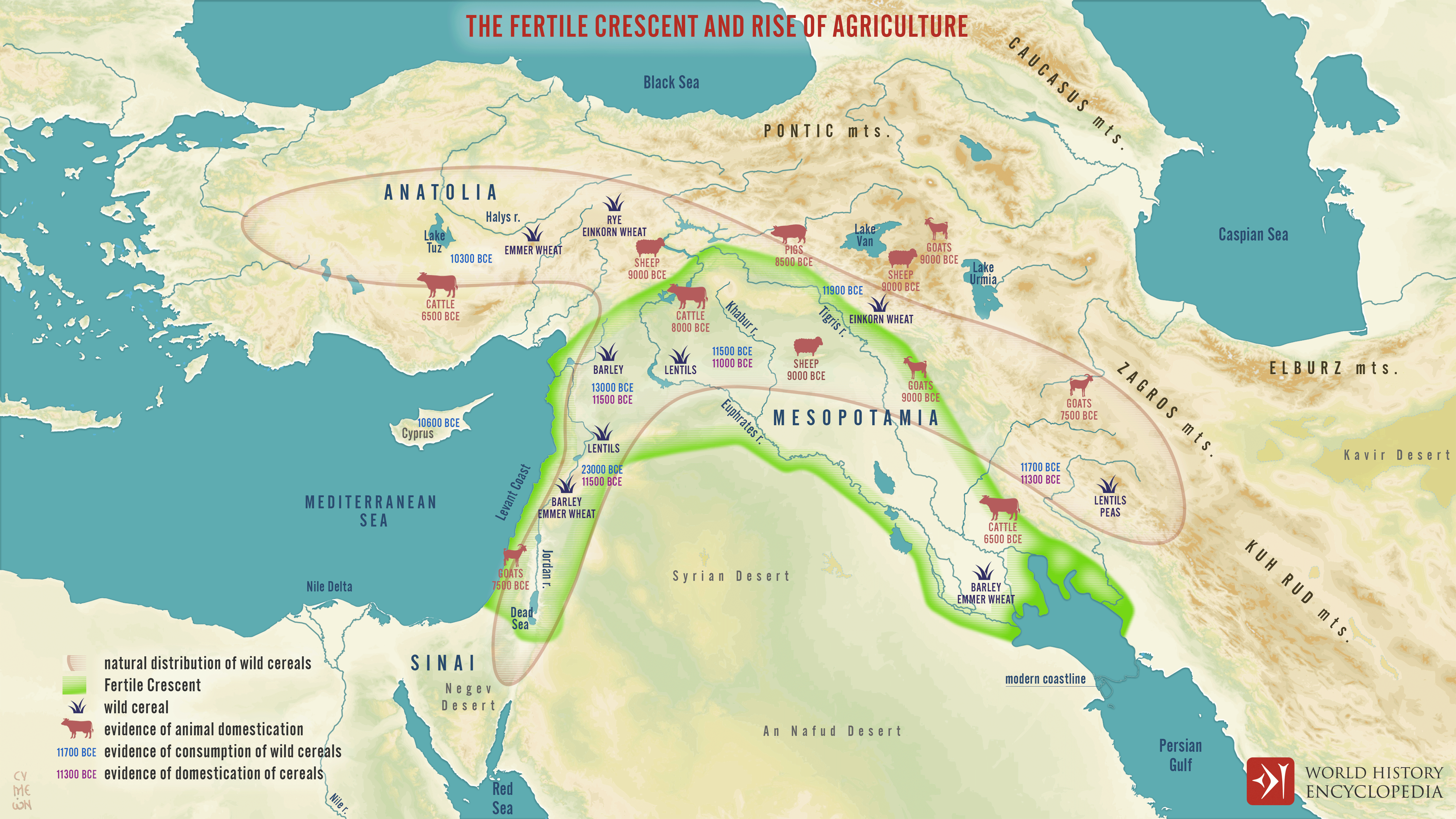
The term “*[Fertile Crescent](https://www.worldhistory.org/Fertile_Crescent/)*”, coined in 1916 by Egyptologist James Henry Breasted, refers to a broad arc of land stretching from the eastern [Mediterranean](https://www.worldhistory.org/disambiguation/mediterranean/) through [Anatolia](https://www.worldhistory.org/Asia_Minor/) and into [Mesopotamia](https://www.worldhistory.org/Mesopotamia/). Encompassing parts of today’s Iraq, [Syria](https://www.worldhistory.org/syria/), Lebanon, [Israel](https://www.worldhistory.org/disambiguation/Israel/), [Palestine](https://www.worldhistory.org/palestine/), [Jordan](https://www.worldhistory.org/Jordan/), [Turkey](https://www.worldhistory.org/Asia_Minor/), and western Iran, this region earned its name due to its unusually rich soils, varied ecosystems, and river systems, most notably the Tigris and Euphrates. Archaeological evidence shows that by the 9th millennium BCE, communities had shifted from mobile foraging to settled [agriculture](https://www.worldhistory.org/disambiguation/Agriculture/), cultivating early cereals such as wheat and barley and domesticating animals including sheep, goats, and pigs. These environmental and technological advantages created the material foundations for population growth, social differentiation, and increasingly complex forms of community organization.
Over time, the Fertile Crescent became a catalyst for the rise of some of the world’s earliest urban and state-level societies. Surplus food production enabled specialization, long-distance [trade](https://www.worldhistory.org/disambiguation/trade/) networks, and the emergence of administrative and religious institutions that shaped early political authority. This process culminated in the rise of urban centers in [Sumer](https://www.worldhistory.org/sumer/), [Akkad](https://www.worldhistory.org/akkad/), [Assyria](https://www.worldhistory.org/assyria/), and later the [Levant](https://www.worldhistory.org/levant/), polities whose innovations in [writing](https://www.worldhistory.org/writing/), [law](https://www.worldhistory.org/disambiguation/law/), irrigation, and governance left a lasting imprint on human history. Although the term “Fertile Crescent” reflects a modern framing, it underscores the region’s long continuity as a crossroads of cultures and ideas, highlighting how geography, environment, and human adaptation interacted to create one of the most influential developmental cores of the ancient world.
#### Editorial Review
This human-authored image has been reviewed by our editorial team before publication to ensure accuracy, reliability and adherence to academic standards in accordance with our [editorial policy](https://www.worldhistory.org/static/editorial-policy/).
## About the Author
Simeon is a freelance visual designer and history educator, passionate about the human stories that shape the past.
- [Linkedin Profile](https://www.linkedin.com/in/simeon-netchev/)
## Cite This Work
### APA
Netchev, S. (2020, August 05). Map of the Fertile Crescent. *World History Encyclopedia*.
### Chicago
Netchev, Simeon. "Map of the Fertile Crescent." *World History Encyclopedia*, August 05, 2020. .
### MLA
Netchev, Simeon. "Map of the Fertile Crescent." *World History Encyclopedia*, 05 Aug 2020, .
## License & Copyright
Submitted by [Simeon Netchev](https://www.worldhistory.org/user/simeonnetchev/ "User Page: Simeon Netchev"), published on 05 August 2020. The copyright holder has published this content under the following license: [Creative Commons Attribution-NonCommercial-NoDerivs](https://creativecommons.org/licenses/by-nc/4.0deed.en). This licence only allows others to download this content and share it with others as long as the author is credited, but they can't change the content in any way or use it commercially. When republishing on the web a hyperlink back to the original content source URL must be included. Please note that content linked from this page may have different licensing terms.