---
title: The Roman Aqueduct of Pont du Gard
author: Michael Gwyther-Jones
source: https://www.worldhistory.org/image/125/the-roman-aqueduct-of-pont-du-gard/
format: machine-readable-alternate
license: Creative Commons Attribution (https://creativecommons.org/licenses/by/4.0)
updated: 1970-01-01
---
# The Roman Aqueduct of Pont du Gard
_Authored by Michael Gwyther-Jones_
## Image File
[](https://www.worldhistory.org/uploads/images/125.jpg)
## Image Caption
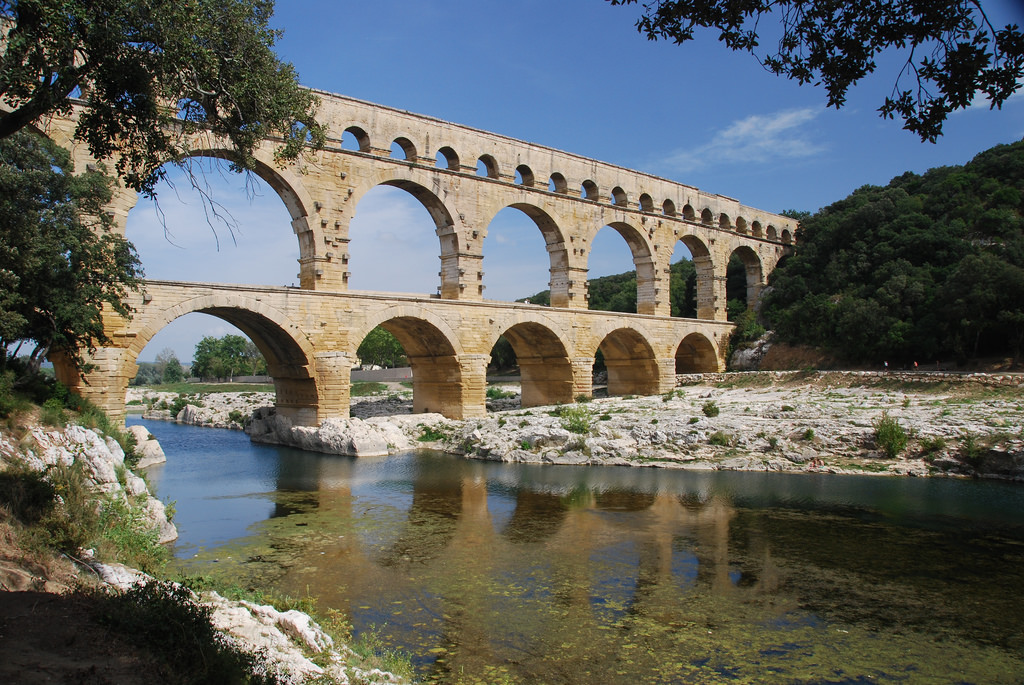
The Pont du Gard is an [aqueduct](https://www.worldhistory.org/aqueduct/) in the South of France constructed by the [Roman Empire](https://www.worldhistory.org/Roman_Empire/), and located in Vers-Pont-du-Gard near Remoulins, in the Gard département. It has long been thought that the Pont du Gard was built by [Augustus](https://www.worldhistory.org/augustus/)' son-in-[law](https://www.worldhistory.org/disambiguation/law/) and aide, Marcus Vipsanius [Agrippa](https://www.worldhistory.org/Marcus_Agrippa/), around the year 19 BC. Newer excavations, however, suggest the construction may have taken place in the middle of the first century A.D, consequently, opinion is now somewhat divided on the matter. Designed to carry the water across the small Gardon river valley, it was part of a nearly 50 km (31 mi) aqueduct that brought water from the Fontaines d'Eure springs near Uzès to the Castellum in the [Roman](https://www.worldhistory.org/disambiguation/Roman/) [city](https://www.worldhistory.org/city/) of Nemausus (Nîmes).\[1\]The full aqueduct had a gradient of 34 cm/km (1/3000), descending only 17 m vertically in its entire length and delivering 20,000 cubic meters (5 million gallons) of water daily. It was constructed entirely without the use of mortar. The aqueduct's stones – some of which weigh up to 6 tons – were precisely cut to fit perfectly together eliminating the need for mortar. The masonry was lifted into place by block and tackle with a massive human-powered treadmill providing the power for the winch. A complex scaffold was erected to support the aqueduct as it was being built. The face of the aqueduct still bears the [mark](https://www.worldhistory.org/disambiguation/Mark/) of its construction, in the form of protruding scaffolding supports and ridges on the piers which supported the semicircular wooden frames on which the arches were constructed. It is believed to have taken about three years to build, employing between 800 and 1,000 workers. Description from Wikipedia under the GNU Free Documentation License.
## Cite This Work
### APA
Gwyther-Jones, M. (2012, April 26). The Roman Aqueduct of Pont du Gard. *World History Encyclopedia*.
### Chicago
Gwyther-Jones, Michael. "The Roman Aqueduct of Pont du Gard." *World History Encyclopedia*, April 26, 2012. .
### MLA
Gwyther-Jones, Michael. "The Roman Aqueduct of Pont du Gard." *World History Encyclopedia*, 26 Apr 2012, .
## License & Copyright
[](http://www.flickr.com/photos/12587661@N06/2853533206/)This image was first published on [Flickr](http://www.flickr.com). [Original image](http://www.flickr.com/photos/12587661@N06/2853533206/) by [**Michael Gwyther-Jones**](http://www.flickr.com/photos/12587661@N06/2853533206/). Submitted by [Jan van der Crabben](https://www.worldhistory.org/user/jvdc/ "User Page: Jan van der Crabben"), published on 26 April 2012. The copyright holder has published this content under the following license: [Creative Commons Attribution](https://creativecommons.org/licenses/by/4.0deed.en). This license lets others distribute, remix, tweak, and build upon your work, even commercially, as long as they credit you for the original creation. When republishing on the web a hyperlink back to the original content source URL must be included. Please note that content linked from this page may have different licensing terms.