---
title: Stele of Dadusha, King of Eshnunna
author: Osama Shukir Muhammed Amin
source: https://www.worldhistory.org/image/10751/stele-of-dadusha-king-of-eshnunna/
format: machine-readable-alternate
updated: 1970-01-01
---
# Stele of Dadusha, King of Eshnunna
_Authored by [Osama Shukir Muhammed Amin](https://www.worldhistory.org/user/OsamaSMAmin/)_
## Image File
[](https://www.worldhistory.org/uploads/images/10751.jpg)
## Image Caption
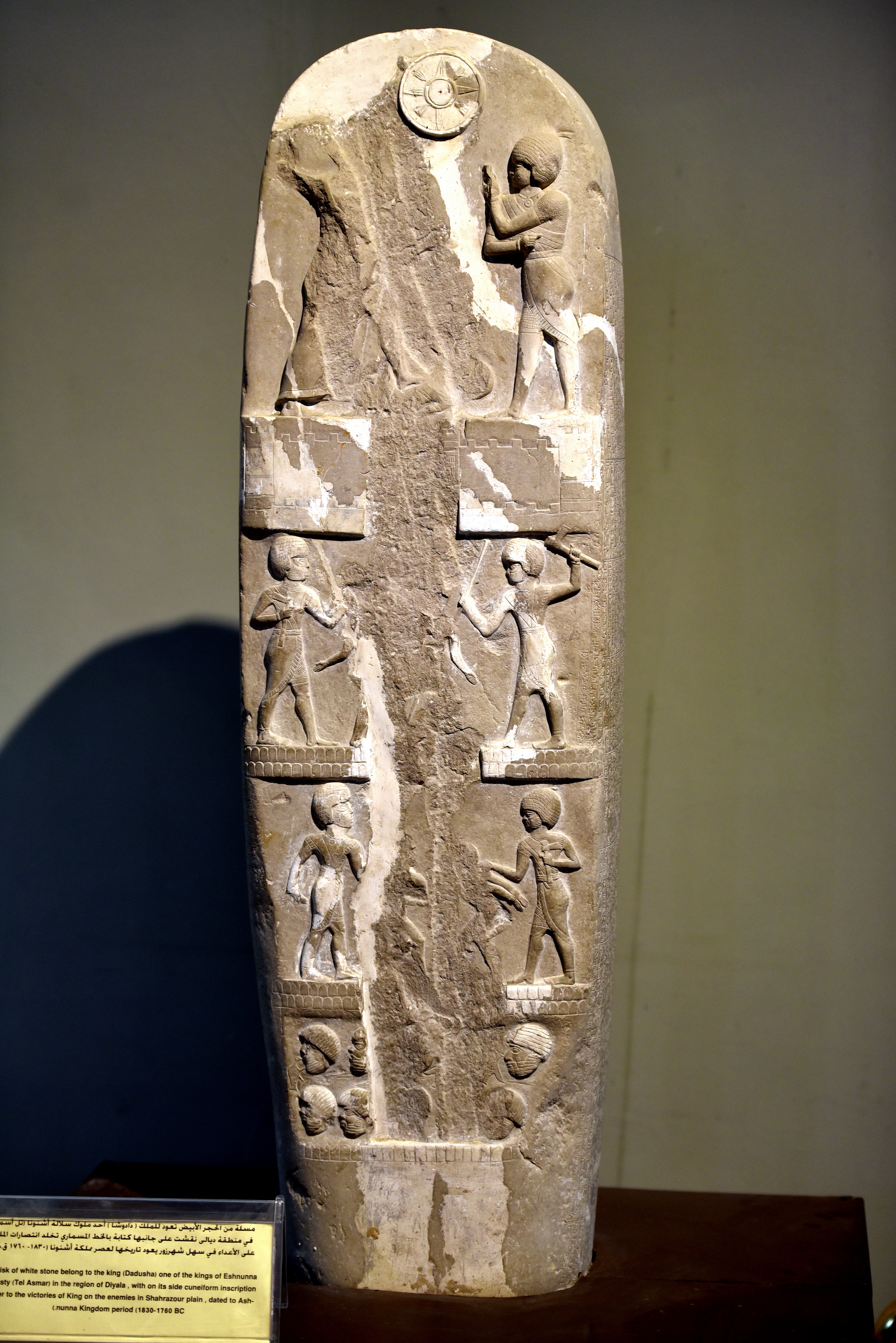
The stele is an elongated stone monument which originally stood at the [Temple](https://www.worldhistory.org/temple/) of Adad at Eshnunna. The front side is carved with four registers while the narrow sides were inscribed with 220 lines of a [cuneiform](https://www.worldhistory.org/cuneiform/) text divided into 17 columns. Dadudha was a king of Eshnunna and this stele commemorates his victory over the [city](https://www.worldhistory.org/city/) of Qabara in Arbela (modern-day Erbil, in Iraqi Kurdistan) and its king Banu-[Ishtar](https://www.worldhistory.org/ishtar/), with the help of king Shamshi-Addu of Ekallatum. The stele was found accidentally in 1983 CE while digging out a well in the outskirts of ancient Eshnunna (modern-day Tell Asmar) in Diyala Governorate, Iraq. The center of the front side was damaged during the discovery. This is the upper register (the image of heroism) which shows Dadudha (left) in a position of a slayer, standing over the slain king of Qabara, Banu-Ishtar. A standing male figure (right) adores Dadusha; this is probably a crown-prince or a military general. The sun-disc with its rays of [Shamash](https://www.worldhistory.org/Utu-Shamash/), combined with the crescent of Sin, appears at the central upper part. At the bottom of the image, the city walls of Qabara appears. Old-Babylonian period, 1830-1760 BCE. It is on display at the Iraq Museum in Baghdad, Republic of Iraq.
#### Editorial Review
This human-authored image has been reviewed by our editorial team before publication to ensure accuracy, reliability and adherence to academic standards in accordance with our [editorial policy](https://www.worldhistory.org/static/editorial-policy/).
## About the Author
Associate Professor of Neurology and lover of the Cradle of Civilization, Mesopotamia. I'm very interested in Mesopotamian history and always try to take photos of archaeological sites and artifacts in museums, both in Iraq and around the world.
- [Facebook Profile](https://www.facebook.com/MRCPian)
- [Linkedin Profile](https://www.linkedin.com/in/osama-shukir-muhammed-amin/)
## Cite This Work
### APA
Amin, O. S. M. (2019, May 21). Stele of Dadusha, King of Eshnunna. *World History Encyclopedia*.
### Chicago
Amin, Osama Shukir Muhammed. "Stele of Dadusha, King of Eshnunna." *World History Encyclopedia*, May 21, 2019. .
### MLA
Amin, Osama Shukir Muhammed. "Stele of Dadusha, King of Eshnunna." *World History Encyclopedia*, 21 May 2019, .
## License & Copyright
Submitted by [Osama Shukir Muhammed Amin](https://www.worldhistory.org/user/OsamaSMAmin/ "User Page: Osama Shukir Muhammed Amin"), published on 21 May 2019. The copyright holder has published this content under the following license: [Copyright](http://en.wikipedia.org/wiki/Copyright). You cannot use, copy, distribute, or modify this item without explicit permission from the author. Please note that content linked from this page may have different licensing terms.