---
title: The Bassetki Statue at the Iraq Museum
author: Osama Shukir Muhammed Amin
source: https://www.worldhistory.org/image/10273/the-bassetki-statue-at-the-iraq-museum/
format: machine-readable-alternate
updated: 1970-01-01
---
# The Bassetki Statue at the Iraq Museum
_Authored by [Osama Shukir Muhammed Amin](https://www.worldhistory.org/user/OsamaSMAmin/)_
## Image File
[](https://www.worldhistory.org/uploads/images/10273.jpg)
## Image Caption
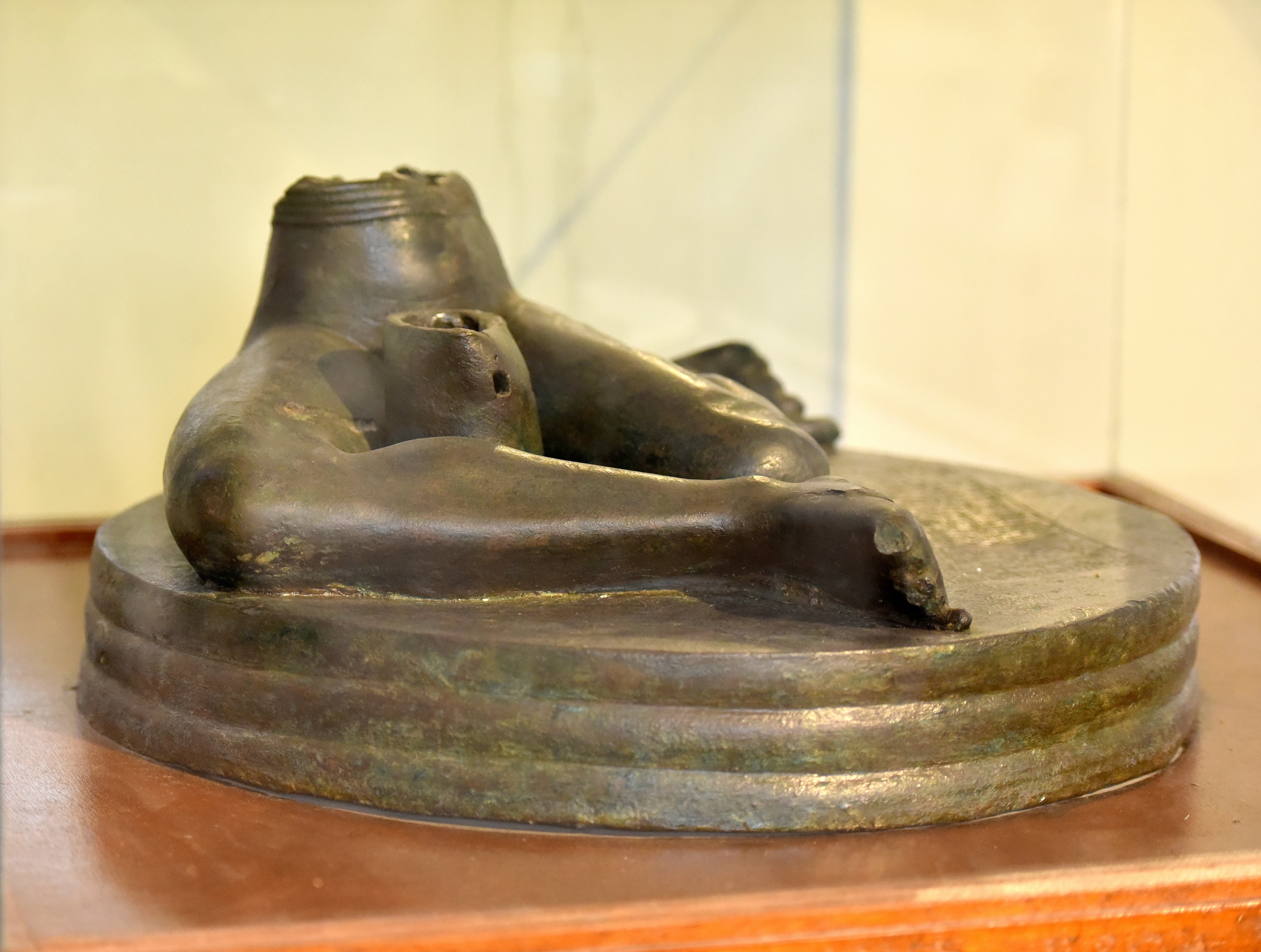
This statue weighs about 150 Kg and is made of pure [copper](https://www.worldhistory.org/copper/), a more difficult casting that requires a much higher temperature than that of [bronze](https://www.worldhistory.org/disambiguation/bronze/). The diameter of the rounded pedestal is about 67 cm and the height of the surviving statue is 43 cm. It depicts a seated nude male figure, wearing a waist belt, with his legs twisted sideways, and holding what appears to be a standard or a doorpost, the lower part of which survives. There is an Old [Akkadian](https://www.worldhistory.org/disambiguation/akkadian/) text inscribed on the upper surface of the pedestal before the left leg, which states that this statue guarded an entrance into a [palace](https://www.worldhistory.org/disambiguation/palace/) of [Naram-Sin](https://www.worldhistory.org/Naram-Sin/) (in what we call today southern Iraq). The statue was found accidentally in the 1960s CE while constructing a road between Zakho and Dohuk, near the modern-day village of Bassetki, Dukok Governorate, Iraqi Kurdistan. How this statue made its way, 100s of kilometers away from its original place, it is unknown. It seems that the upper part was cut deliberately in antiquity, probably to use the copper of the statue for another purpose. The statue was looted somewhere between April 10-12, 2003 CE, after the fall of Saddam's regime. In November 2003 CE, a combined raid by the American Military Police and Iraqi Police retrieved the statue, which was covered with axle grease and submerged in a cesspool in a house in the outskirts of Baghdad. The Bassetki Statue was number 2 on the list of the 30 most-wanted looted artifacts from the Iraq Museum in April 2003 CE. Akkadian period, 2300-2200 BCE. It is now on display at the Iraq Museum in Baghdad, Republic of Iraq.
#### Editorial Review
This human-authored image has been reviewed by our editorial team before publication to ensure accuracy, reliability and adherence to academic standards in accordance with our [editorial policy](https://www.worldhistory.org/static/editorial-policy/).
## About the Author
Associate Professor of Neurology and lover of the Cradle of Civilization, Mesopotamia. I'm very interested in Mesopotamian history and always try to take photos of archaeological sites and artifacts in museums, both in Iraq and around the world.
- [Facebook Profile](https://www.facebook.com/MRCPian)
- [Linkedin Profile](https://www.linkedin.com/in/osama-shukir-muhammed-amin/)
## Cite This Work
### APA
Amin, O. S. M. (2019, March 21). The Bassetki Statue at the Iraq Museum. *World History Encyclopedia*.
### Chicago
Amin, Osama Shukir Muhammed. "The Bassetki Statue at the Iraq Museum." *World History Encyclopedia*, March 21, 2019. .
### MLA
Amin, Osama Shukir Muhammed. "The Bassetki Statue at the Iraq Museum." *World History Encyclopedia*, 21 Mar 2019, .
## License & Copyright
Submitted by [Osama Shukir Muhammed Amin](https://www.worldhistory.org/user/OsamaSMAmin/ "User Page: Osama Shukir Muhammed Amin"), published on 21 March 2019. The copyright holder has published this content under the following license: [Copyright](http://en.wikipedia.org/wiki/Copyright). You cannot use, copy, distribute, or modify this item without explicit permission from the author. Please note that content linked from this page may have different licensing terms.