---
title: Hoplite: The Key Infantry Soldier of Ancient Greece
author: Mark Cartwright
source: https://www.worldhistory.org/hoplite/
format: machine-readable-alternate
license: Creative Commons Attribution-NonCommercial-ShareAlike (https://creativecommons.org/licenses/by-nc-sa/4.0/)
updated: 2025-04-18
---
# Hoplite: The Key Infantry Soldier of Ancient Greece
_Authored by [Mark Cartwright](https://www.worldhistory.org/user/markzcartwright/)_
A hoplite (from *ta hopla* meaning tool or equipment) was the most common type of heavily armed foot-soldier in ancient [Greece](https://www.worldhistory.org/greece/) from the 7th to 4th centuries BCE, and most ordinary citizens of [Greek](https://www.worldhistory.org/disambiguation/greek/) [city](https://www.worldhistory.org/city/)-states with sufficient means were expected to equip and make themselves available for the role when necessary.
[Athens](https://www.worldhistory.org/Athens/) had a system of compulsory military service for 18-20-year-olds, but during a [war](https://www.worldhistory.org/disambiguation/War/), all male citizens up to the age of 60 could be called up to the armed forces. Other [cities](https://www.worldhistory.org/city/) across ancient Greece followed a similar policy which meant that hoplites were not professional soldiers and often lacked sufficient military training, although some states did maintain a small elite professional unit, the *epilektoi*. The most famous of these was the [Sacred Band of Thebes](https://www.worldhistory.org/Sacred_Band_of_Thebes/), a unit composed of 150 pairs of male lovers who swore to defend their partner to the [death](https://www.worldhistory.org/disambiguation/Death/). [Sparta](https://www.worldhistory.org/sparta/), where all male citizens over 20 were members of a permanent professional army, was the notable exception to this approach of only calling up an army when absolutely needed and, consequently, their hoplites were famed for their military prowess.
### Weapons & Armour
The principal weapons of a hoplite infantryman were a long ash wood spear (*doru*) and a short sword (*xiphos*). The spear measured on average 2.5 metres (8 ft.) in length and was fitted with a [bronze](https://www.worldhistory.org/disambiguation/bronze/) or iron blade and a four-sided end spike (*sauroter*). The sword was also of iron with a straight or sometimes curved blade (*machaira* or *kopis*) no more than 60 cm in length. No doubt many hoplites also carried a dagger (*encheiridion*) as extra insurance. Protection was provided by a leather-lined bronze helmet which could vary in design, was often crested, and protected the head, neck, and face. A corselet or breastplate (*thorax*) of bronze or leather (later reduced to a laminated linen vest to save weight - a *linothorax*), bronze greaves (*knemides*) to protect the shins, and sometimes arm-guards were also worn. The hoplite carried a large circular shield (*hoplon* or *aspis*) some 80 cm (30 in.) in diameter and weighing as much as 8 kg. This was made of wood or stiff leather, faced with bronze, and was held with the left arm placed through a central band (*porpax*) and gripped via a strap (*antilabe*) attached to the shield rim. Shields often carried particular designs - the most famous being the inverted V-shape of Spartan hoplites - and emblems - particularly popular was the gorgon from [Greek mythology](https://www.worldhistory.org/Greek_Mythology/) with its association with changing the onlooker into stone. Surviving examples of breastplates and helmets also display engraved decoration. Fully armoured then, the hoplite was required to carry some 20 kg of equipment and so good physical training must have given one side a strong advantage (e.g. the well-trained and professional Spartans). Precisely because all of this equipment amounted to quite an investment, being a hoplite also indicated that the individual had a certain status in wider Greek society. In addition, the bronze cuirass and shield of the hoplite - taken, for example, as booty after a military campaign - were often dedicated at sacred sites across ancient Greece from [Delphi](https://www.worldhistory.org/delphi/) to [Delos](https://www.worldhistory.org/delos/).
[  Kylix with Black-Figure Hoplites Mark Cartwright (CC BY-NC-SA) ](https://www.worldhistory.org/image/7056/kylix-with-black-figure-hoplites/ "Kylix with Black-Figure Hoplites")### Hoplite Phalanx
Hoplites were organised into regiments or *lokhoi* (several hundred men strong), and they fought in ranks eight or more men deep (known as a phalanx), and standing close together, half of the shield of one man protected his neighbour on his left side. This, interestingly, meant that the phalanx often moved forward at a slight angle to the right as men sought to keep behind the shield of their neighbour. This resulted in the left flank usually breaking formation first, and so this was the flank a competent commander would attack with priority, and he would, therefore, ensure he had his best troops on his own right flank. The [Greek phalanx](https://www.worldhistory.org/article/110/the-greek-phalanx/) advanced at a walk or faster, often accompanied by rhythmic [music](https://www.worldhistory.org/disambiguation/Music/) from [aulos](https://www.worldhistory.org/Aulos/) players, and shouting a tremendous war-cry (*paean*). On engaging the enemy the hoplites first thrust their spears, usually overarm. After that initial contact, the opposing lines usually went through a series of pushing and shoving (*othismos*) and close-quarter fighting with swords which only ended when one side broke ranks. The pursuit of retreating hoplites was usually only over a short distance in order to maintain the protective close formation.
[ 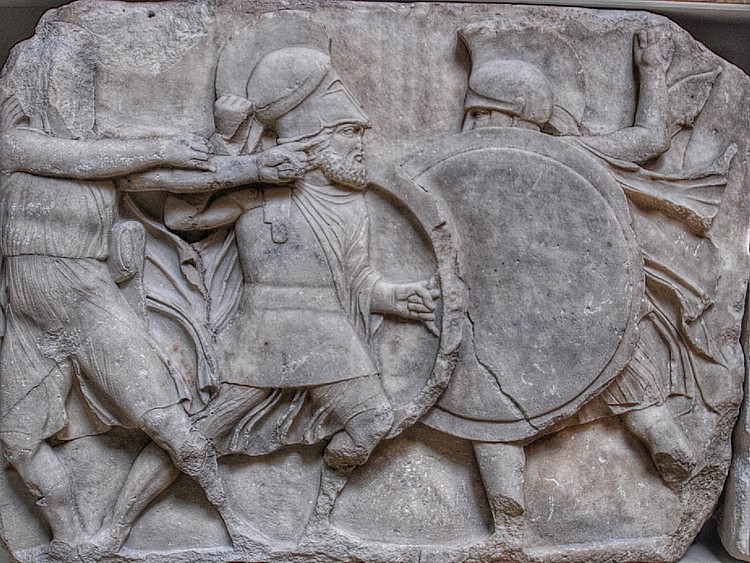 Greek Hoplites Fighting Jan van der Crabben (CC BY-NC-SA) ](https://www.worldhistory.org/image/3012/greek-hoplites-fighting/ "Greek Hoplites Fighting")Hoplites were instrumental in [Greek warfare](https://www.worldhistory.org/Greek_Warfare/) and the victories of Greek armies over [Persia](https://www.worldhistory.org/Persia/) at the [battle](https://www.worldhistory.org/disambiguation/battle/) of [Marathon](https://www.worldhistory.org/marathon/) (490 BCE) and the battle of [Plataea](https://www.worldhistory.org/Plataea/) (479 BCE) during the Greco-[Persian Wars](https://www.worldhistory.org/Persian_Wars/). The weaknesses of the phalanx formation - attack from the flanks, rear by light cavalry, or when on rough terrain - were sometimes exploited by more wily commanders; however, the formation, albeit with lighter-armed infantry, was still in use through [Hellenistic](https://www.worldhistory.org/Hellenic_World/) and early [Roman](https://www.worldhistory.org/disambiguation/Roman/) times.
#### Editorial Review
This human-authored definition has been reviewed by our editorial team before publication to ensure accuracy, reliability and adherence to academic standards in accordance with our [editorial policy](https://www.worldhistory.org/static/editorial-policy/).
## Bibliography
- [Boys-Stones et al. *The Oxford Handbook of Hellenic Studies.* Oxford University Press, USA, 2009.](https://www.worldhistory.org/books/0199286140/)
- [Fields, N. *Thermopylae 480 BC.* Osprey Publishing, 2007.](https://www.worldhistory.org/books/184176180X/)
- [Hornblower, S. *The Oxford Classical Dictionary.* Oxford University Press, USA, 2012.](https://www.worldhistory.org/books/0199545561/)
- [Kinzl, K.H. (ed). *A Companion to the Classical Greek World.* Wiley-Blackwell, 2010.](https://www.worldhistory.org/books/1444334123/)
- [Xenophon. *The Landmark Xenophon's Hellenika.* Anchor, 2010.](https://www.worldhistory.org/books/1400034760/)
## About the Author
Mark is WHE’s Publishing Director and has an MA in Political Philosophy (University of York). He is a full-time researcher, writer, historian and editor. Special interests include art, architecture and discovering the ideas that all civilizations share.
## Timeline
- **c. 650 BCE - c. 350 BCE**: Hoplites are the major protagonists in [Greek](https://www.worldhistory.org/disambiguation/greek/) land [warfare](https://www.worldhistory.org/warfare/).
- **520 BCE**: The *hoplitodromos* (a foot-race in [hoplite](https://www.worldhistory.org/hoplite/) armour is added to the schedule of the [Olympic Games](https://www.worldhistory.org/Olympic_Games/).
- **11 Sep 490 BCE**: A combined force of [Greek](https://www.worldhistory.org/disambiguation/greek/) hoplites defeat the Persians at [Marathon](https://www.worldhistory.org/marathon/).
- **Aug 480 BCE**: [Battle of Thermopylae](https://www.worldhistory.org/thermopylae/). 300 Spartans under King [Leonidas](https://www.worldhistory.org/disambiguation/Leonidas/) and other [Greek](https://www.worldhistory.org/disambiguation/greek/) allies hold back the Persians led by [Xerxes I](https://www.worldhistory.org/Xerxes_I/) for three days but are defeated.
- **479 BCE**: [Xerxes](https://www.worldhistory.org/Xerxes_I/)' Persian forces are defeated by [Greek](https://www.worldhistory.org/disambiguation/greek/) forces at [Plataea](https://www.worldhistory.org/Plataea/) effectively ending [Persia](https://www.worldhistory.org/Persia/)'s imperial ambitions in [Greece](https://www.worldhistory.org/greece/).
- **457 BCE**: [Sparta](https://www.worldhistory.org/sparta/) wins the [battle](https://www.worldhistory.org/disambiguation/battle/) of Tanagra during the 1st [Peloponnesian War](https://www.worldhistory.org/Peloponnesian_War/) with [Athens](https://www.worldhistory.org/Athens/).
- **440 BCE**: Hoplites become increasingly lighter-armoured, as new [battle](https://www.worldhistory.org/disambiguation/battle/) tactics required more mobility.
- **425 BCE**: Athenian and Corinthian hoplites fight a street [battle](https://www.worldhistory.org/disambiguation/battle/) in the suburbs of Solygeia.
- **424 BCE**: A force of Athenian peltasts defeat Spartan hoplites on Sphaktria in the [Peloponnese](https://www.worldhistory.org/Peloponnese/).
- **422 BCE**: Spartan general [Brasidas](https://www.worldhistory.org/Brasidas/) employs Myrkinian and Chalkidian peltasts to defeat a force of Athenian hoplites at [Amphipolis](https://www.worldhistory.org/Amphipolis/).
- **390 BCE**: Athenian leader Iphikrates employs peltasts to defeat Spartan hoplites at Lechaion near [Corinth](https://www.worldhistory.org/corinth/).
## External Links
- [This is Sparta: Fierce warriors of the ancient world - Craig Zimmer](http://ed.ted.com/lessons/this-is-sparta-fierce-warriors-of-the-ancient-world-craig-zimmer)
- [Warfare in Ancient Greece | Essay | The Metropolitan Museum of Art | Heilbrunn Timeline of Art History](https://www.metmuseum.org/toah/hd/gwar/hd_gwar.htm)
## Cite This Work
### APA
Cartwright, M. (2013, February 09). Hoplite: The Key Infantry Soldier of Ancient Greece. *World History Encyclopedia*.
### Chicago
Cartwright, Mark. "Hoplite: The Key Infantry Soldier of Ancient Greece." *World History Encyclopedia*, February 09, 2013. .
### MLA
Cartwright, Mark. "Hoplite: The Key Infantry Soldier of Ancient Greece." *World History Encyclopedia*, 09 Feb 2013, .
## License & Copyright
Submitted by [Mark Cartwright](https://www.worldhistory.org/user/markzcartwright/ "User Page: Mark Cartwright"), published on 09 February 2013. The copyright holder has published this content under the following license: [Creative Commons Attribution-NonCommercial-ShareAlike](https://creativecommons.org/licenses/by-nc-sa/4.0/deed.en). This license lets others remix, tweak, and build upon this content non-commercially, as long as they credit the author and license their new creations under the identical terms. When republishing on the web a hyperlink back to the original content source URL must be included. Please note that content linked from this page may have different licensing terms.