---
title: Homer
author: James Lloyd
source: https://www.worldhistory.org/homer/
format: machine-readable-alternate
license: Creative Commons Attribution-NonCommercial-ShareAlike (https://creativecommons.org/licenses/by-nc-sa/4.0/)
updated: 1970-01-01
---
# Homer
_Authored by [James Lloyd](https://www.worldhistory.org/user/jtl203/)_
Homer (c. 750 BCE) is perhaps the greatest of all epic poets and his legendary status was well established by the time of Classical [Athens](https://www.worldhistory.org/Athens/). He composed (not wrote, since the poems were created and transmitted orally, they were not written down until much later) two major works, the *[Iliad](https://www.worldhistory.org/iliad/)* and the *[Odyssey](https://www.worldhistory.org/Odyssey/)*; other works were attributed to Homer, but even in antiquity their authorship was disputed. In conjunction with [Hesiod](https://www.worldhistory.org/hesiod/), Homer acts as a great pool of information for the Greeks about their gods. Homer is the earliest poet in Western [culture](https://www.worldhistory.org/disambiguation/culture/) whose works have survived intact.
### The *Iliad*
The *Iliad* is composed of 15,693 hexameters (lines of verse), and is divided into 24 books corresponding to each letter of the [Greek alphabet](https://www.worldhistory.org/Greek_Alphabet/) - alpha to omega, a system that was already in place by the time of [Herodotus](https://www.worldhistory.org/herodotus/). The *Iliad* traces the anger of [Achilles](https://www.worldhistory.org/achilles/) (“Sing [Muse](https://www.worldhistory.org/muse/), of the wrath of Achilles” *Iliad*.1.1) and takes place over 51 days during the tenth and final year of the [Trojan War](https://www.worldhistory.org/Trojan_War/). The poem takes its name from the [city](https://www.worldhistory.org/city/) of [Troy](https://www.worldhistory.org/troy/), which is also known as [Ilium](https://www.worldhistory.org/troy/).
Achilles, respect the gods and have pity on me, remembering your own father.
Priam to AchillesHighlights include: the lengthy Catalogue of Ships of the [Greek](https://www.worldhistory.org/disambiguation/greek/) invading forces, the [death](https://www.worldhistory.org/disambiguation/Death/) of [Patroclus](https://www.worldhistory.org/Patroclus/) and the description of him being carried away by the twins Hypnos and [Thanatos](https://www.worldhistory.org/Thanatos/) (Sleep and Death), the description of the shield of Achilles, the reconciliation between Achilles and Priam, perhaps one of the most moving scenes in Western [literature](https://www.worldhistory.org/literature/), and several set-piece battles between pairs of Greek heroes, most famously the fight between Achilles and Hektor. In all of these events the intervention of the Greek gods, especially [Athena](https://www.worldhistory.org/athena/) on the side of the Greeks and [Apollo](https://www.worldhistory.org/apollo/) for the Trojans, is instrumental in the outcome of all of the human actions during the [war](https://www.worldhistory.org/disambiguation/War/).
[ 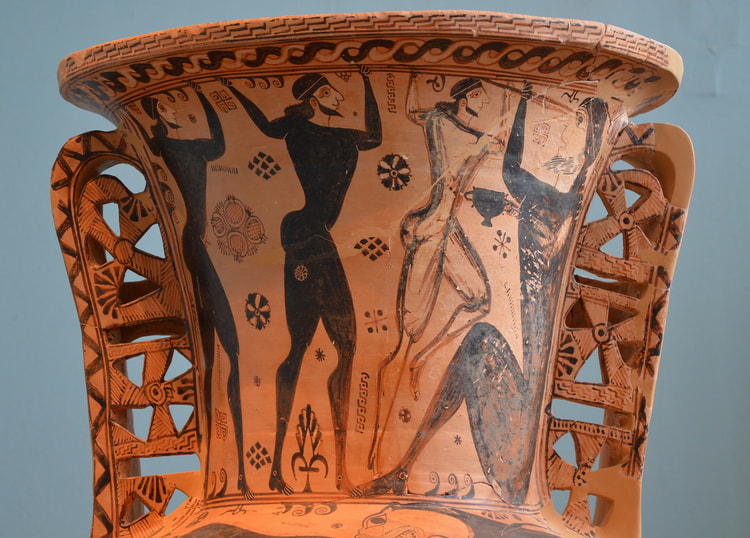 The Blinding of Polyphemus Carole Raddato (CC BY-SA) ](https://www.worldhistory.org/image/3356/the-blinding-of-polyphemus/ "The Blinding of Polyphemus")### The *Odyssey*
The *Odyssey* is composed of 12,109 hexameters and is also divided into 24 in the same manner as the *Iliad*. Whereas war and anger were the themes of the *Iliad*, the *Odyssey* takes place after the Trojan War has been won by the Achaeans, as the Greeks are referred to by Homer. The *Odyssey* is concerned with the *nostos* (journey) of the Greek hero [Odysseus](https://www.worldhistory.org/odysseus/) (the protagonist after whom the poem is named) and the troubles that he faces on his way home from Troy, foiled on his way by godly interventions, especially those of [Poseidon](https://www.worldhistory.org/poseidon/). Highlights include Odysseus' famous encounters with the Sirens, with the [Cyclops](https://www.worldhistory.org/disambiguation/Cyclops/) Polyphemus, and the slaying of his wife Penelope's suitors upon his return to Ithaca.
We handled our pole with its red-hot point and twisted it in his eye till the blood boiled up round the burning wood.
Odysseus on blinding the CyclopsUnlike Hesiod, who mentions his family and life within his works, this is not really the case for Homer, and since [writing](https://www.worldhistory.org/writing/) is generally believed to have started around 700 BCE, there is no contemporary source on him either, but there are various later [Hellenistic](https://www.worldhistory.org/Hellenic_World/) and even [Roman](https://www.worldhistory.org/disambiguation/Roman/) descriptions of his life (and also the Contest of Homer and Hesiod). Because the dialect of Homer's works is composed in an [archaic](https://www.worldhistory.org/disambiguation/Archaic/) form of Ionian Greek and he displays a familiarity with the geography of [Asia Minor](https://www.worldhistory.org/Asia_Minor/) in the *Iliad*, there could be some element of truth to claims that Homer's birthplace was Smyrna, Chios, or Ios.
### A Single Homer?
There have always been debates as to the 'person' of Homer: many places claim to be his birthplace. It is even debated whether or not the two great works were written by the same person: the ancients called those who thought this the *chorizontes*; the separatists. Some even doubt if one single person was behind these works, and that leads to 'the Homeric Question', the idea that the poems are a compilation of layers rolled into one story, which could explain inconsistencies in the narrative and the formulaic language used. According to this school of thought, the poems would most likely have been sung episodically by rhapsodes. This idea was first argued by F. A. Wolf in his 1795 CE work *Prolegomena ad Homerum*.
Nevertheless, whether Homer was a 'she', a 'he', or a 'they' does not diminish the greatness of the *Iliad* and the *Odyssey*, and this can be seen by the fact that the two poems have come down to us in a continuous tradition. The poems were first compiled, organised, and edited under the Athenian [Peisistratus](https://www.worldhistory.org/Pisistratus/), but the Greek text that we have survives from such Alexandrian scholars as Zenodotus and [Aristophanes](https://www.worldhistory.org/Aristophanes/) of [Byzantium](https://www.worldhistory.org/Byzantium/) and Aristarchus and their comments on the texts. The first printed editions of Homer were in 1488 CE in Florence by Chalcondyles of Athens. Homer's work was hugely influential on [Greek culture](https://www.worldhistory.org/disambiguation/Greek_Culture/), and scenes from his works appeared in [Greek sculpture](https://www.worldhistory.org/Greek_Sculpture/), on [Greek pottery](https://www.worldhistory.org/Greek_Pottery/), and in [Greek tragedy](https://www.worldhistory.org/Greek_Tragedy/) and comedy. He was studied as part of Greek education, and the legends within his work would influence Hellenistic culture, Roman culture, and far beyond, so that Homer's lasting legacy is that his works are still studied to this day.
#### Editorial Review
This human-authored definition has been reviewed by our editorial team before publication to ensure accuracy, reliability and adherence to academic standards in accordance with our [editorial policy](https://www.worldhistory.org/static/editorial-policy/).
## Bibliography
- [Graziosi, B. *Inventing Homer.* Cambridge University Press, 2002, 98-101.](https://www.worldhistory.org/books/0521809665/)
- [Herodotus. *The Landmark Herodotus.* Anchor Books, 2009, 2.53..](https://www.worldhistory.org/books/1400031141/)
- Heubeck, A. ; West, Stephanie; Hainsworth, J. B. "Commentary on Homer's Odyssey." *Oxford: Oxford University Press.*, ISBN 0-19-814047-9, p. 3.
## About the Author
James' main area of research is ancient Greek music, but he has general interests in mythology, religion, and art & archaeology. A self-confessed philhellene, James keeps at least one eye on the Roman pie.
- [Facebook Profile](https://www.facebook.com/jan.vandercrabben@ancient.eu)
## Timeline
- **1750 BCE - 1300 BCE**: [Troy](https://www.worldhistory.org/troy/) VI - probable Troy of [Homer](https://www.worldhistory.org/homer/)'s [Iliad](https://www.worldhistory.org/iliad/). [City](https://www.worldhistory.org/city/) at its zenith.
- **c. 800 BCE - c. 700 BCE**: [Homer](https://www.worldhistory.org/homer/) of [Greece](https://www.worldhistory.org/greece/) writes his *[Iliad](https://www.worldhistory.org/iliad/)* and *[Odyssey](https://www.worldhistory.org/Odyssey/)*.
## External Links
- [A map of Odysseus's journey](http://blog.oup.com/2014/06/map-odysseus-journey/)
- [Welcome to the Chicago Homer](http://digital.library.northwestern.edu/homer/)
- [The science behind the myth: Homer's "Odyssey" - Matt Kaplan](http://ed.ted.com/lessons/the-science-behind-the-myth-homer-s-odyssey-matt-kaplan)
- [Everything you need to know to read Homer's "Odyssey" - Jill Dash](https://ed.ted.com/lessons/everything-you-need-to-know-to-read-homer-s-odyssey-jill-dash)
- [episode 9: Glittering Bronze Men](http://literatureandhistory.com/index.php/episode-009-glittering-bronze-men)
- [episode 10: Homer's Gods](http://literatureandhistory.com/index.php/episode-010-homer-s-gods)
- [episode 11: Who Was Homer?](http://literatureandhistory.com/index.php/episode-011-who-was-homer)
- [episode 12: Kleos and Nostos](http://literatureandhistory.com/index.php/episode-012-kleos-and-nostos)
- [episode 13: His Mind Teeming](http://literatureandhistory.com/index.php/episode-13-his-mind-teeming)
- [episode 14: The Autumn Leaves](http://literatureandhistory.com/index.php/episode-14-the-autumn-leaves)
- [In Our Time, The Iliad](https://www.bbc.co.uk/programmes/b0bh5x1y)
- [Who was Homer? | British Museum](https://www.britishmuseum.org/blog/who-was-homer)
## Cite This Work
### APA
Lloyd, J. (2013, June 19). Homer. *World History Encyclopedia*.
### Chicago
Lloyd, James. "Homer." *World History Encyclopedia*, June 19, 2013. .
### MLA
Lloyd, James. "Homer." *World History Encyclopedia*, 19 Jun 2013, .
## License & Copyright
Submitted by [James Lloyd](https://www.worldhistory.org/user/jtl203/ "User Page: James Lloyd"), published on 19 June 2013. The copyright holder has published this content under the following license: [Creative Commons Attribution-NonCommercial-ShareAlike](https://creativecommons.org/licenses/by-nc-sa/4.0/deed.en). This license lets others remix, tweak, and build upon this content non-commercially, as long as they credit the author and license their new creations under the identical terms. When republishing on the web a hyperlink back to the original content source URL must be included. Please note that content linked from this page may have different licensing terms.