---
title: Heimdall
author: Irina-Maria Manea
source: https://www.worldhistory.org/heimdall/
format: machine-readable-alternate
license: Creative Commons Attribution-NonCommercial-ShareAlike (https://creativecommons.org/licenses/by-nc-sa/4.0/)
updated: 2024-02-20
---
# Heimdall
_Authored by [Irina-Maria Manea](https://www.worldhistory.org/user/irinamaria.manea/)_
Heimdall is a mysterious deity of [Norse mythology](https://www.worldhistory.org/Norse_Mythology/) whose main attribute refers to guarding the realm of the gods, Asgard, from his high fortress called Himinbjörg found at the top of Bifröst, the rainbow bridge. He has the might of sea and earth, very keen eyesight, always on the lookout for danger, and when intruders are approaching, he sounds his Gjallarhorn, the resounding horn. This horn will announce the beginning of [Ragnarök](https://www.worldhistory.org/Ragnarok/), the apocalypse that will have Heimdall battling [Loki](https://www.worldhistory.org/Loki/), one of the leaders of [giants](https://www.worldhistory.org/Giants/). Furthermore, some fragments of Norse poetry describe Heimdall as the father of all mankind.
### Sources
According to Snorri Sturluson, the 13th-century Icelandic scholar and author of the mythological textbook *The Prose [Edda](https://www.worldhistory.org/Edda/)*, Heimdall belongs to the Æsir family as a son of [Odin](https://www.worldhistory.org/odin/) and is known as the white [god](https://www.worldhistory.org/God/), whiteness in Old Norse being linked to beauty and uprightness. He has a horse named Gulltopp and a horn called Gjallar. He needs less sleep than a bird, he can see at an extraordinary distance, he can hear the grass and the wool on sheep grow. He is also called Gullintanni ("golden-toothed") and Hallinskidi ("the one with sided horns" – indicating an unclear link to rams).
Snorri also quotes a poem called *Heimdalargaldr*, which probably states one of the most curious details about Heimdall, that he is the offspring of nine mothers, nine sisters (Snorri, 26). This detail is corroborated with several lines in the poem *Völuspá in skamma*, or the short *Völuspá*, actually, a few stanzas surviving within another poem, the *Hyndluljoth* (Old Norse: *Hyndluljóð*), and one stanza quoted by Snorri. Originally found in a large compilation called *Flateyjarbók*, *Hyndluljoth* was later included in the *Poetic Edda*, the collection of mythological poems written in the 13th century in Iceland but circulating back in the 900s.
In the poem, the woman Hyndla traces some genealogies of heroes from the *sagas*. The inserted short *Völuspá* seems a tad confused and rushed, and its informative value is low. We should mention though that Heimdall’s [giant](https://www.worldhistory.org/Giants/) mothers are mentioned here by name, which can be rendered Griper, Yelper, Foamer, Sand-Strewer, She-Wolf, Dusk, Fury, Sorrow-Flood, and Iron-Sword. We can only speculate about Heimdall’s birth, perhaps these mothers created his various parts or more abstract energies. Or given his mothers’ names, maybe he is born out of sea waves, the daughters of the sea god Aegir. Another question would be whether his mothers could be somehow connected to the nine worlds recalled by the seeress questioned by Odin in the first poem of *The Poetic Edda*, *Völuspá* (the prophecy of the wise woman) at the beginning of time (Hildebrand, 13).
[ 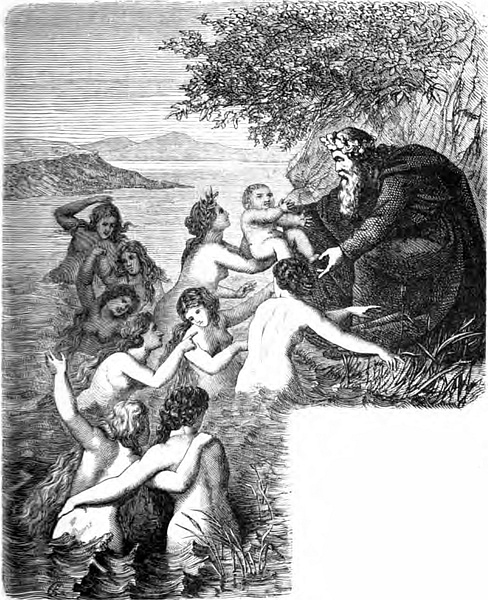 Birth of Heimdall by Carl Ehrenberg Carl Ehrenberg (Public Domain) ](https://www.worldhistory.org/image/13624/birth-of-heimdall-by-carl-ehrenberg/ "Birth of Heimdall by Carl Ehrenberg")Another scrap of information about Heimdall we get from the same source in stanza 27 where the prophetess says she knows about the god’s horn (*hljōþ*) and that it is hidden under the holy tree, Yggdrasil. On it there pours a stream apparently coming from Odin’s eye, the one he sacrificed to get wisdom from the spirit Mimir. So is the horn buried there until Heimdall announces Ragnarök? Or would it rather refer to the sense of hearing and not an object? Maybe Heimdall placed his ear there as Odin did with his eye, which implies a connection to the World Tree, in other words with the cosmic order.
Speaking of Ragnarök, Snorri talks about the enmity between Heimdall and Loki who will face each other in this great event, but there were probably more stories involving these two characters that are now lost. The poem *Húsdrápa*, quoted in *The Prose Edda*, implies that these two once fought in the form of seals over Brisingamen, the goddess [Freyja](https://www.worldhistory.org/Freyja/)’s necklace. Moreover, the poem *[Lokasenna](https://www.worldhistory.org/article/1938/lokasenna/)* where Loki insults all the gods also refers to their hostility. In stanza 48, Loki silences Heimdall after he tells him off for being mad and drunk by saying that he must face the evil fate of having a stiff back all the time. This insult could be interpreted as Heimdall’s function as the watchman of the gods so he cannot move around freely.
One more scrap of myth comes up in the poem *Thrymskvith*a (Old Norse Þrymskviða*), dealing with the disappearance of [Thor](https://www.worldhistory.org/Thor/)’s hammer, where Heimdall makes an appearance in stanza 14 as "the whitest of gods", meaning the most handsome. In his wisdom, he suggests to Thor to get dressed up with the bridal veil to trick the giant who hid his weapon. The same fragment adds another interesting detail, that he can foretell the future like the Vanir, the other godly family in the Nordic [pantheon](https://www.worldhistory.org/Pantheon/) broadly symbolizing prosperity, however, the term Vanir might simply be used to rhyme in the stanza.
Last but not least, in the chapter *Skálskaparmál* of the *Prose Edda*, where Snorri teaches poets to use metaphors (*kenningar*), he says that a sword can be referred to as Heimdall’s head because he was struck with a man’s head. This story has been lost. In the same source, he is identified as a son of Odin.
### Heimdall the Creator
The main literary source for Heimdall’s role in Norse [mythology](https://www.worldhistory.org/mythology/) as a forefather would be the poem *Rigsthula* (Old Norse: *Rígsþula*). The poem now belongs to the *Poetic Edda*, however, it is not found in the main manuscripts preserving it. Instead, it has been kept on the last page of a manuscript of the *Prose Edda*, Snorri Sturluson’s version of Norse myth. The manuscript called *Codex Wormianus* is, unfortunately, missing the end of the poem. Generally speaking, the poem deals with explaining the origins of the three main categories of Nordic society – serfs, commoners, and noblemen, with the last group providing the one who would become the future king. Iceland did not have kings and so the poem was most likely written on the continent, likely even for a particular king, but the manuscript breaks at the point where it could have made the connection between the mythical king and a real one.
[  Heimdall in the Edda Oblongata S.babylonica (Public Domain) ](https://www.worldhistory.org/image/13621/heimdall-in-the-edda-oblongata/ "Heimdall in the Edda Oblongata")
The use of the name Rig ('king' in Old Irish) and some other words of [Celtic](https://www.worldhistory.org/celt/) origin reflect the frequent contacts between Norsemen and inhabitants from the Western Isles like the Orkneys. Perhaps the poet had been wandering for a while in Celtic-influenced territories and then composed his work for a Danish or Norwegian king. The person who added the introductory prose passage to the poem in the 13th or 14th century identified Rig with the god Heimdall, although this idea seems very doubtful. This Rig who is the forefather of mankind, described as old and wise, mighty and strong reminds us more of Odin than anyone else. It also reminds us of the fact that Norse mythology is much more twisted and messy than we like to believe. Besides this introduction, there is nothing in the poem confirming the equivalence of Rig and Heimdall. Nevertheless, there are a couple of vague references in other poems: in *Völuspá in skamma / Hyndluljoth* stanza 40 he is called "the kinsman of men" and stanza 13 of *Grímnismál* might imply that Heimdall "rules over men". *Völuspá*, the creation poem and prophecy about the end of the world, refers to the classes of men as "greater and lesser children of Heimdall" in the very first stanza (Hildebrand, 12).
First Rig reaches the dwelling of Ai and Edda, great-grandfather and great-grandmother. On his visit Rig receives heavy and thick bread with calf broth, indicative of the low status of the family. The god then sleeps between them three nights long and nine months later Edda bears a son named Thrall (slave) whom they sprinkle with water, a habit apparently present in pre-Christian [religion](https://www.worldhistory.org/religion/) as well. Thrall has wrinkled skin, an ugly face, and a twisted back, and wrapped in a filthy cloth, "he made rope and carried baskets, all day long he carried firewood home" - (Hildebrand, 281). One day Thrall/Slave meets a woman called Thrir/Slave woman, with crooked legs, a flat nose, and sunburned arms. They beget children, whose names reflect their low social status: Lumpy, Barn-cleaner, Stinker, Horse-fly, etc. They mainly take care of pigs, grow crops, and shovel manure.
After creating the race of thralls, Rig/Heimdall moves on and comes across the next couple, Afi and Ama, grandfather and grandmother. This couple has a tidier appearance indicating their higher status. The man has a trimmed beard and fitting clothes, while his wife is wearing a headdress with brooches and a necklace. Their activities, carving and weaving, also seem more elevated. The same thing happens; Rig sleeps between them, and nine months later Karl (yeoman, freeman) is born. As he grows up, Karl "tames oxen, prepares plows, builds houses and barns, makes carts, and takes care of the plow" (Hildebrand, 287). Karl then exchanges rings with his future wife, Snör (daughter-in-[law](https://www.worldhistory.org/disambiguation/law/)), dressed in goatskins and carrying the keys of the household. Their children bear revealing names for their status as well, such as Strong, Keeper of Lands, Craftsman, Dwelling-Owner, Farm-Keeper for men, and Worthy, Proud, Graceful, Fair for [women](https://www.worldhistory.org/disambiguation/women/).
Rig finally arrives at the third hall, with a wide portal and fresh straw on the floor, as if in preparation for a feast. Fathir, obviously father, is fashioning bows, as archery represents a high-status activity. The appearance of the lady of the house, Mothir, mother, enforces the image of elevated rank; a dress of quality cloth, a nice cap, a blue gown, clasps, bright brows, beautiful breasts, and most importantly, a white neck, a sign of nobility because it meant avoiding work outside and getting sunburnt. When they sit down to eat, she covers the board with embroidered cloth and brings thin loaves, well-cooked meat in [silver](https://www.worldhistory.org/Silver/) vessels, and precious cups of wine. The pair’s son, born after Rig lays between them, is named Jarl (nobleman), wrapped in [silk](https://www.worldhistory.org/Silk/).
[ 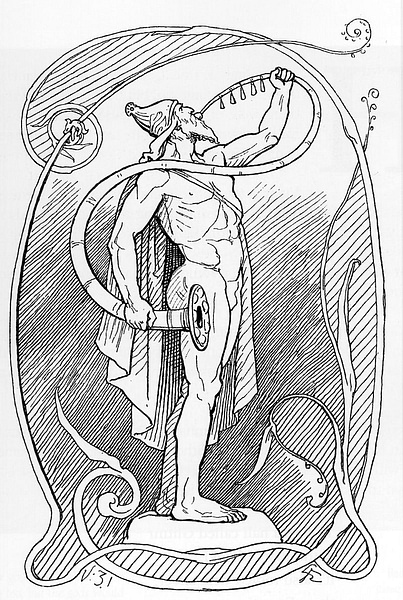 Heimdall Blows Gjallarhorn Lorenz Frølich (Public Domain) ](https://www.worldhistory.org/image/13531/heimdall-blows-gjallarhorn/ "Heimdall Blows Gjallarhorn")As the blonde and bright boy with grim eyes like a snake grows, he engages in hunting, archery, and riding. Rig/Heimdall comes to him because he has the essential knowledge to share with his chosen one: "Rig came striding / he taught him [runes](https://www.worldhistory.org/runes/) / he gave him his name / called him his son / asked him to claim lands / to claim old villages" (Hildebrand, 293). Jarl follows his master’s teachings and goes to [war](https://www.worldhistory.org/disambiguation/War/), reddening the fields and killing many. He amasses great wealth and offers arm rings to his followers to ensure loyalties. His messengers reach the hall of Hersir, a generic name referring to a local chieftain, the highest recognized authority before the establishment of the kingdom of Norway, to make a marriage proposal to his daughter Erna (“the Capable”). They get married and their children are named very vaguely Boy, Offspring, Descendant, or Heir. They play chess, swim, tame beasts and shake spears, but the wittiest seems to be Konr ungr, Kon the Young, which contracted is *konungr*, king. He learns to use the runes, understand the speech of birds, how to quench fires and calm sorrows, and soon becomes even craftier than Rig, gaining the right to take his name.
The poem ends abruptly with a crow urging Konr ungr to stop shooting arrows at birds and better [battle](https://www.worldhistory.org/disambiguation/battle/) other men, like the two rich chieftains living nearby. Their given names, Dan and Danp, might suggest a connection with the Danes.
### Hypothetical Meanings
Lindow makes an interesting remark about Heimdall’s place in Norse mythology:
> \[Heimdall\] seems to have a certain connection with peripheral locations: born at the edge of the earth, encountering humans by a coast, stationed at the end of heaven to guard against giants. These places are all to some extent boundaries: between land and sea, between the world of the gods and that of the giants. Being born in days of yore also situates Heimdall at a temporal periphery. Heimdall’s other main action in the mythology involves not a spatial but a temporal boundary, namely, his sounding of the Gjallarhorn at the outset of Ragnarök. (Lindow 2002, 171).
Heimdall and humanity begin their existence somewhere at the edge. At the same time, due to his role as a watchman, we could assume Heimdall may have been thought of as some kind of guardian spirit of the household. Heimdall seems to be important in literary sources, at least hinted at in what has survived, but his obscure name does not seem to have been preserved in place names, unlike that of other obscure gods. *Heim* means 'world', but *dall* remains unclear (not to be confused with *dalr* – valley), although Jan de Vries’ explanation - a type of fruitful tree, in this case solidifying the bond between the god, nature, and mankind - could work. The *Poetic Edda* tells us that the first humans were pieces of wood, then Heimdall comes and continues the act of creation. If we accept this etymology, his name would be synonymous with Yggdrasil, the ash tree keeping the universe together. The idea of a tree-figure, a pillar watching over us is quite common in circumpolar myths as well and so some have proposed Finnic influence.
Parallels to other gods are hard to draw, but we can look at some vague similarities with Mannus, the primal being fathering the three main Germanic tribes mentioned by [Tacitus](https://www.worldhistory.org/tacitus/) (c. 56 - c. 118 CE); [Agni](https://www.worldhistory.org/Agni/) the fire god of Vedic mythology who also begets human descendants; civilizing heroes like the [Greek](https://www.worldhistory.org/disambiguation/greek/) [Prometheus](https://www.worldhistory.org/Prometheus/) or Finnish Väinämöinen; and the White Youth fathering the human race in Yakut legends. Davidson also points to Irish traditions about a god of the sea, Manannán, going from house to house. Heimdall has the might of earth and sea, as told in the shorter *Völuspá*. His links with Asgard, the World Tree, mankind, the sea, the beginning, and the end make him a complex and intriguing god. Besides the literary sources, a 10th-century cross in Cumbria, [England](https://www.worldhistory.org/disambiguation/england/), depicts on one of the panels a character with a horn; most likely the cross draws parallels between Norse and Christian myths. The inconclusive case of Heimdall reminds us that the incoherent stories and contradictory aspects of mythological figures were just an expression of the big diversity of beliefs.
#### Editorial Review
This human-authored definition has been reviewed by our editorial team before publication to ensure accuracy, reliability and adherence to academic standards in accordance with our [editorial policy](https://www.worldhistory.org/static/editorial-policy/).
## Bibliography
- [Andrén, Anders & Jennbert, Kristina. *Old Norse Religion in Long-Term Perspectives& Interactions .* Nordic Academic Press, 2006.](https://www.worldhistory.org/books/918911681X/)
- [H. Davidson. *Gods and Myths of Northern Europe - 1990 Edition.* Penguin Books Ltd, 1990.](https://www.worldhistory.org/books/B004LK0HQC/)
- Hildebrand, K. (ed.). *The Poetic Edda, Old Norse-English Diglot.* Melbourne, 2011
- [Lindow, John. *Norse Mythology.* Oxford University Press, 2002.](https://www.worldhistory.org/books/0195153820/)
- [Simek, Rudolf. *Lexikon der germanischen Mythologie (Kröners Taschenausgabe) .* A. Kröner, 1984.](https://www.worldhistory.org/books/3520368013/)
- Snorri Sturluson, tr. Anthony Faulkes. *The Prose Edda .* Everyman London, 1995
- Tolley, C. *Shamanism in Norse Myth and Magic .* Academia Scientiarum Fennica, 2009
- [Turville-Petre, E. O. G. *Myth and Religion of the North.* Praeger, 1975.](https://www.worldhistory.org/books/0837174201/)
## About the Author
A curious and open mind, fascinated by the past. Historian with a keen interest in Norse myth and the Viking Age, as well as history teacher and language instructor. Originally from Bucharest, Romania, now residing in Hesse, Germany.
- [Facebook Profile](https://www.facebook.com/irinaskuld)
- [Linkedin Profile](https://www.linkedin.com/in/irinamariamanea/)
## Cite This Work
### APA
Manea, I. (2021, March 15). Heimdall. *World History Encyclopedia*.
### Chicago
Manea, Irina-Maria. "Heimdall." *World History Encyclopedia*, March 15, 2021. .
### MLA
Manea, Irina-Maria. "Heimdall." *World History Encyclopedia*, 15 Mar 2021, .
## License & Copyright
Submitted by [Irina-Maria Manea](https://www.worldhistory.org/user/irinamaria.manea/ "User Page: Irina-Maria Manea"), published on 15 March 2021. The copyright holder has published this content under the following license: [Creative Commons Attribution-NonCommercial-ShareAlike](https://creativecommons.org/licenses/by-nc-sa/4.0/deed.en). This license lets others remix, tweak, and build upon this content non-commercially, as long as they credit the author and license their new creations under the identical terms. When republishing on the web a hyperlink back to the original content source URL must be included. Please note that content linked from this page may have different licensing terms.