---
title: Hadrian
author: Joshua J. Mark
source: https://www.worldhistory.org/hadrian/
format: machine-readable-alternate
license: Creative Commons Attribution-NonCommercial-ShareAlike (https://creativecommons.org/licenses/by-nc-sa/4.0/)
updated: 2025-03-11
---
# Hadrian
_Authored by [Joshua J. Mark](https://www.worldhistory.org/user/JPryst/)_
Hadrian (l. 78-138 CE) was emperor of [Rome](https://www.worldhistory.org/Rome/) (r. 117-138 CE) and is recognized as the third of the Five Good Emperors ([Nerva](https://www.worldhistory.org/Nerva/), [Trajan](https://www.worldhistory.org/trajan/), Hadrian, [Antoninus Pius](https://www.worldhistory.org/Antoninus_Pius/), and [Marcus Aurelius](https://www.worldhistory.org/Marcus_Aurelius/)) who ruled justly. His reign marked the height of the [Roman Empire](https://www.worldhistory.org/Roman_Empire/), usually given as c. 117 CE, and provided a firm foundation for his successor.
Born Publius Aelius Hadrianus, in Italica (modern Spain), Hadrian is best known for his literary pursuits, his substantial building projects throughout the [Roman](https://www.worldhistory.org/disambiguation/Roman/) [Empire](https://www.worldhistory.org/empire/), and, especially, [Hadrian's Wall](https://www.worldhistory.org/Hadrians_Wall/) in northern [Britain](https://www.worldhistory.org/disambiguation/Britain/). He is also remembered for his love affair with the Bithynian youth [Antinous](https://www.worldhistory.org/antinous/) (l. c. 110-130 CE) whom he deified after the young man’s [death](https://www.worldhistory.org/disambiguation/Death/), resulting in the popular cult of Antinous which, early on, rivaled [Christianity](https://www.worldhistory.org/christianity/).
Hadrian was deeply interested in [literature](https://www.worldhistory.org/literature/) – especially [Greek literature](https://www.worldhistory.org/Greek_Literature/) – and [Egyptian](https://www.worldhistory.org/disambiguation/Egyptian/) mysticism and magic. He was among the most highly cultured of the Roman emperors – even among the famous best five – wrote his own poetry and other works and insisted on personally supervising as many of the building projects he had commissioned as he possibly could. Under his reign, the Bar Kokhba Revolt (132-136 CE) broke out in [Judaea](https://www.worldhistory.org/disambiguation/judaea/), which Hadrian personally put down and, afterwards, erased the name of the region, renamed it [Syria](https://www.worldhistory.org/syria/) Palaestina, and exiled the Jewish population from the area.
The revolt took an enormous toll on the emperor, who had suffered health problems since 127 CE, and his health steadily declined after c. 136 CE. His wife, Vibia Sabina (l. 83 - c. 137 CE), died in c. 136/137 CE, and he had her deified, but theirs had been an unhappy marriage as Hadrian was homosexual and frequently had dalliances with younger men. He adopted Antoninus Pius (r. 138-161 CE) as his successor and died, most likely of heart attack, in 138 CE.
### Early Life
Hadrian was well educated in his hometown of Italica Hispania (modern-day Seville, Spain) either by a private tutor or a school for the sons of upper-class Romans, as his parents were. His father was a senator who died when Hadrian was 10, and, at this time, he was sent to school in Rome and taken under care by Trajan c. 86 CE, prior to the latter’s ascendancy. Trajan’s wife, Plotina, was fond of the young Hadrian and encouraged his literary pursuits, especially his interest in [Greek](https://www.worldhistory.org/disambiguation/greek/) poetry and [culture](https://www.worldhistory.org/disambiguation/culture/). Scholar Anthony Everitt comments:
> Quite suddenly he became infatuated with all things Greek. Soon after the death of his father, he immersed himself in Greek studies so enthusiastically that he was nicknamed *Graeculus*, “little Greek boy”. (15)
Hadrian’s lifelong admiration for [Greece](https://www.worldhistory.org/greece/) began at this time and would associate him with the country and culture throughout his reign. Even in the present day, Hadrian is often mistakenly identified as a Greek or of Grecian lineage.
His first military service was as [tribune](https://www.worldhistory.org/Tribune/) under Emperor Nerva (r. 96-98 CE), and he was selected to bring Trajan the news that he was Nerva’s successor. When Nerva died, Trajan ascended to the throne. Emperor Trajan (r. 98-117 CE) was the first Roman ruler of provincial origin. Later biographers would attempt to place the birth of both Trajan and Hadrian in the [city](https://www.worldhistory.org/city/) of Rome, but both were of Spanish ethnicity, and this commonality has been assumed by some to be the reason for Trajan's adoption of Hadrian as his successor. Most scholars dispute this, however, as it is possible that Trajan did not name Hadrian at all.
Trajan died on campaign in [Cilicia](https://www.worldhistory.org/Cilicia/) in 117 CE, with Hadrian in command of his rearguard, and is not believed to have named a successor. Trajan's wife, Plotina signed the papers of succession, claiming Trajan had selected Hadrian, and it is thought that she, not the emperor, was responsible for Hadrian's adoption as heir. However that may be, it is known that Trajan respected Hadrian and had considered him as his successor even if he did not officially name him as such. Hadrian's service to Trajan is well documented through the various important positions he held prior to becoming [Roman emperor](https://www.worldhistory.org/Roman_Emperor/).
At the same time, however, some dispute between the two men seems to have set them at odds sometime in 100 CE. There is no documentation on this but, afterwards, Trajan refused to elevate Hadrian in rank, and, in fact, the positions Hadrian was given removed him from Trajan’s immediate circle. As both men were homosexual, and Trajan surrounded himself with a number of favorite young men, it has been suggested that Hadrian may have seduced, or tried to seduce, one of these around the time of his marriage to Sabina, causing a rift between himself and Trajan, but this is speculation.
[  Trajan Bust, Vatican Museums Mark Cartwright (CC BY-NC-SA) ](https://www.worldhistory.org/image/1250/trajan-bust-vatican-museums/ "Trajan Bust, Vatican Museums")Plotina, not Trajan, was clearly the main force behind Hadrian’s advancement from the time he entered her sphere of influence. Plotina and Salonia Matidia (Trajan’s niece, who was also fond of Hadrian) pushed for his marriage to Matidia’s daughter, Vibia Sabina, and Matidia may have also had a hand in making him emperor. He would be a far better ruler than husband. Sabina never seems to have embraced the marriage from the start, and Hadrian preferred the company of men. Although his marriage could not be considered a success on any level, his reign was spectacular.
### Hadrian as Emperor
Hadrian’s close relationship with the troops meant he instantly had the army’s support, and even if the [Roman Senate](https://www.worldhistory.org/Roman_Senate/) had wanted to question his succession, there was nothing they could have done. Hadrian was embraced by the majority of the people of Rome and was greatly admired throughout the time he held office. His popularity as emperor is attested to by the fact that, even though he was absent from Rome for the better part of his reign, no sign of rebuke or criticism for this appears in his early biographies. Earlier Roman rulers, such as [Nero](https://www.worldhistory.org/Nero/) (r. 54-68 CE), were harshly criticized for spending far less time away from the city. Professor D. Brendan Nagle writes:
> \[Hadrian\] spent most of his reign (twelve out of twenty-one years) traveling all over the Empire visiting the provinces, overseeing the administration, and checking the discipline of the army. He was a brilliant administrator who concerned himself with all aspects of government and the administration of justice. (278)
His devotion to the [Roman army](https://www.worldhistory.org/Roman_Army/) was such that he would sleep and eat among the common soldiers, and he is commonly depicted in military attire even though his reign was marked by relative peace. The empire’s stability, and increasing prosperity, allowed Hadrian the luxury of travel to the provinces where he inspected first-hand the projects he had commissioned from Rome.
Hadrian's building projects are perhaps his most enduring legacy. He visited [Britannia](https://www.worldhistory.org/Roman_Britain/) in 122 CE shortly after a revolt had been put down and ordered a long, defensive [wall](https://www.worldhistory.org/wall/) built to prevent easy invasion by the northern [Picts](https://www.worldhistory.org/picts/); this structure is the famous Hadrian’s Wall in modern-day [England](https://www.worldhistory.org/disambiguation/england/). He established [cities](https://www.worldhistory.org/city/), raised monuments, improved roads, and strengthened the infrastructure of provinces throughout the Balkan Peninsula, [Egypt](https://www.worldhistory.org/egypt/), [Asia Minor](https://www.worldhistory.org/Asia_Minor/), North [Africa](https://www.worldhistory.org/disambiguation/africa/), and Greece. He visited Greece at least twice and became an initiate in the Eleusinian Mysteries. The Arch of Hadrian, constructed by the citizens of [Athens](https://www.worldhistory.org/Athens/) in 131/132 CE, honor Hadrian as the founder of the city. Inscriptions on the arch name [Theseus](https://www.worldhistory.org/Theseus/) (the traditional founder) but add Hadrian owing to the latter's substantial contributions to Athens such as the grand [Temple](https://www.worldhistory.org/temple/) of [Zeus](https://www.worldhistory.org/zeus/).
[  Map of the Travels of Hadrian & the Roman Empire c. 125 CE Simeon Netchev (CC BY-NC-ND) ](https://www.worldhistory.org/image/14744/map-of-the-travels-of-hadrian--the-roman-empire-c/ "Map of the Travels of Hadrian & the Roman Empire c. 125 CE")In Rome, he rebuilt the [Pantheon](https://www.worldhistory.org/Pantheon/) (which had been destroyed by fire) and Trajan's Forum as well as funding construction of other buildings, [Roman baths](https://www.worldhistory.org/Roman_Baths/), and villas. Many of these structures survived intact for centuries, some as late as the 19th century CE, and the Pantheon, still perfectly preserved, may be visited in the present day. Hadrian had a great interest in [architecture](https://www.worldhistory.org/disambiguation/architecture/) and seems to have contributed ideas or even plans to the architects, though scholars no longer believe that he was the lead architect on any single project.
### Hadrian's Wall
Of all his significant monuments and buildings, Hadrian's Wall in northern Britain is the most famous. Construction of the wall, known in antiquity as Vallum Hadriani, was begun around 122 CE and corresponded to Hadrian's visit to the province. It marked the northern boundary of the Roman Empire in Britain, but the length and breadth of the project (stretching, as it did, from coast to coast) suggests that the more important purpose of the wall was a show of Rome's power. The wall was originally 9.7 feet (3 m) wide and 16-20 feet (c. 6 m) high east of the River Irthing, all built of stone, and 20 feet (6 m) wide by 11 feet (3.5 m) high west of the river, made up of stone and turf, stretching 73 miles (120 km) across uneven terrain.
[ 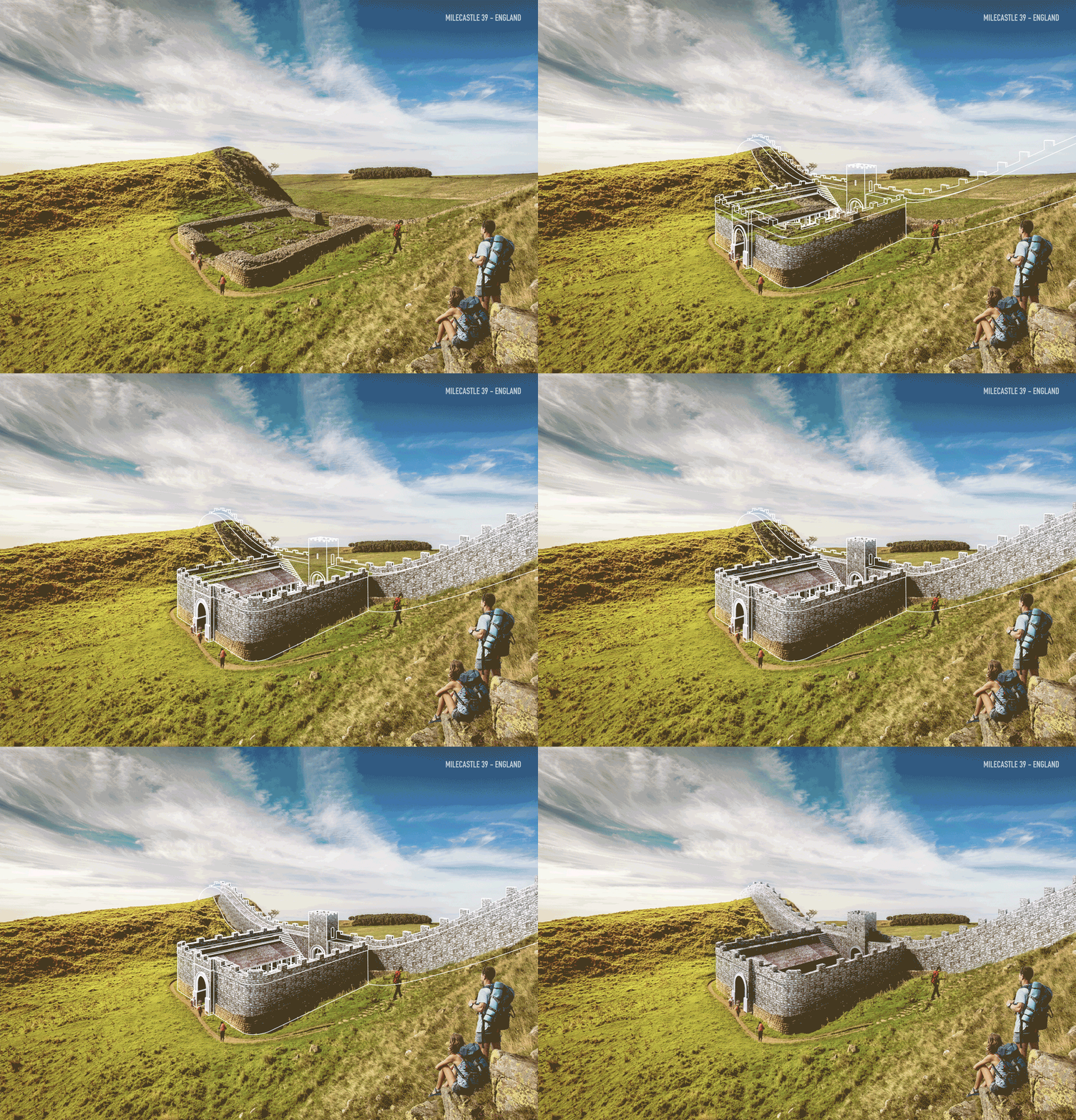 Reconstruction of Fort on Hadrian's Wall NeoMam Studios/THISISRENDER/Expedia (Copyright) ](https://www.worldhistory.org/image/12717/reconstruction-of-fort-on-hadrians-wall/ "Reconstruction of Fort on Hadrian's Wall")It was built in six years by the legions stationed in [Roman Britain](https://www.worldhistory.org/Roman_Britain/). There were between 14-17 fortifications along the length of the wall and a vallum (a ditch purposefully constructed of earthworks) which ran parallel to the wall. The vallum measured 20 feet (6 m) wide by 10 feet (3 m) deep, flanked by large mounds of tightly packed earth. As Hadrian's foreign policy was 'peace through strength', it is thought that the wall, which was originally plastered and whitewashed, would have clearly represented the might of the Roman Empire.
### Antinous
Following his visit to Britannia, Hadrian went to Asia Minor and traveled to the region of Bithynia to inspect the restoration of Nicomedia he had funded after the city was damaged in an [earthquake](https://www.worldhistory.org/disambiguation/earthquake/). It was either in Nicomedia or nearby Claudiopolis that he met the young Antinous in 123 CE who become his almost constant companion for the next seven years. Antinous was possibly 13-15 years old at this time, but same-sex liaisons between older men and young boys were acceptable in Roman culture as long as both parties consented. Some of these love affairs were brief 'flings' but others, like that of Hadrian and Antinous, were serious, committed relationships.
Hadrian arranged for Antinous to be sent to a prestigious boarding school in Rome that trained young men for life at court and then, from 125-130 CE, the young man was Hadrian’s beloved, living with him at his villa outside Rome and traveling with him to the provinces. Their relationship was patterned on that of the Greeks in which an older man would help a younger in moral and intellectual development and social advancement. Everitt comments:
> \[Hadrian\] could well have regarded his Bithynian boy as a plaything – With Hadrian’s reputation as a procurer of every luxury and licentiousness, Antinous was simply another in a long line of conquests…\[But\] this most [Hellenic](https://www.worldhistory.org/greece/) of emperors cast himself as an *erastes* (lover) with Antinous as his *eromenos* (beloved). If he followed the rules, he would have treated the boy with respect, wooed him, and given him the choice whether or not to accept his advances. Any “favors” Hadrian was granted would have been matched by a serious commitment to Antinous’ moral development as he grew into an adult. (243)
This seems to have been precisely the course Hadrian followed. The couple traveled together from 127-130 CE, arriving in Egypt in time to celebrate the Festival of [Osiris](https://www.worldhistory.org/osiris/) in October 130 CE. At some point toward the end of the month, just before the festival, Antinous drowned in the [Nile](https://www.worldhistory.org/nile/) River. Hadrian reported it as an accident, but historians such as [Cassius Dio](https://www.worldhistory.org/Cassius_Dio/) (l. c. 155 - c. 235 CE) and Aurelius Victor (l. c. 320 - c. 390 CE) claim that Antinous sacrificed himself in a ritual to cure Hadrian of an illness (precisely what is unknown) he had been suffering from the past few years. This claim is strengthened by the observation that Antinous, as Hadrian’s beloved favorite, would no doubt have been attended by servants who would have rescued him from the river and, further, by a trip the couple took to Heliopolis just before Antinous’ death where they conferred with a priest on mystical rites. Hadrian’s health seems to have improved afterwards, but his grief at the loss of his lover and best friend was overwhelming.
[  The Braschi Antinous Mark Cartwright (CC BY-NC-SA) ](https://www.worldhistory.org/image/1188/the-braschi-antinous/ "The Braschi Antinous")Hadrian had Antinous deified immediately. This was unprecedented as, usually, an emperor would submit the suggestion to the Senate who would approve it. He ordered the city of Antinopolis built in Antinous’ honor on the bank of the Nile where he had drowned and, quite quickly, a cult grew up around the youth which spread quickly through the provinces. Antinous became a dying-and-reviving [god](https://www.worldhistory.org/God/) figure who, because he was once human, was thought to respond more quickly to supplications than other deities. He was understood as a god of healing and compassion and his adherents raised statues of him in temples and shrines throughout the empire. It is estimated there were once over 2,000 statues of Antinous of which 115 have been recovered. The cult of Antinous became so popular that, over 200 years later, it rivaled the new [religion](https://www.worldhistory.org/religion/) of Christianity and the well-established cult of [Isis](https://www.worldhistory.org/isis/).
### [Jerusalem](https://www.worldhistory.org/jerusalem/) & Revolt
Hadrian dealt with his grief as best he could and continued on with his business of touring the provinces. Although he was a learned and cultivated man, his policy of peaceful relations with others, whether personally or professionally, was not always adhered to. He was known to lose his temper frequently with scholars at court he disagreed with and once accidentally blinded a servant in one eye when he threw a stylus at him in a rage. In Jerusalem, Hadrian would give full rein to his temper on a massive and tragic scale when the Jews revolted against his construction of a temple.
[ 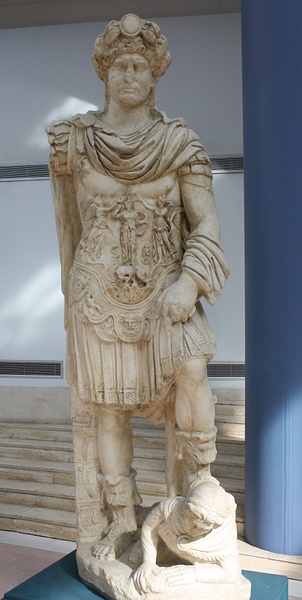 Hadrian in Military Armour Mark Cartwright (CC BY-NC-SA) ](https://www.worldhistory.org/image/4481/hadrian-in-military-armour/ "Hadrian in Military Armour")In 132 CE, Hadrian visited Jerusalem, which was still in ruins from the First Roman-Jewish [War](https://www.worldhistory.org/disambiguation/War/) of 66-73 CE. He rebuilt the city according to his own designs and renamed it Aelia Capitolina [Jupiter](https://www.worldhistory.org/jupiter/) Capitolinus after himself and the king of the Roman gods. When he built a temple to Jupiter on the ruins of the Temple of [Solomon](https://www.worldhistory.org/solomon/) (the Second Temple, considered sacred by the Jews), the populace rose up under the leadership of Simon bar Kochba (also given as Shimon Bar-Cochba, Bar Kokhbah, Ben-Cozba, Cosiba or Coziba) in what has come to be known as [the Bar-Kochba Revolt](https://www.worldhistory.org/The_Bar-Kochba_Revolt/).
Roman losses in this campaign were enormous but Jewish losses were no less significant. By the time the rebellion was put down, 580,000 Jews had been killed and over 1000 towns and villages destroyed. Hadrian then banished the remaining Jews from the region and renamed it Syria Palaestina after the traditional enemies of the Jewish people, the [Philistines](https://www.worldhistory.org/Philistines/). He ordered a public burning of the [Torah](https://www.worldhistory.org/Torah/), executed the Jewish scholars, and prohibited the practice and observance of [Judaism](https://www.worldhistory.org/disambiguation/judaism/).
### Death & Successor
Hadrian’s handling of the Bar-Kochba Revolt is the one dark stain on his otherwise admirable reign, but he made his choices based on traditional Roman policy in handling revolts: a harsh response followed by restoration. He may have taken his response as far as he did from personal outrage that anyone would have had a problem with his temple or any of his other decisions.
His health now failing, Hadrian returned to Rome and occupied himself in [writing](https://www.worldhistory.org/writing/) poetry and tending to administrative affairs. He named Antoninus Pius his successor on the stipulation that Antoninus would adopt the young Marcus Aurelius (r. 161-180 CE) as his own. Aurelius would co-rule with [Lucius Verus](https://www.worldhistory.org/Lucius_Verus/) (r. 161-169 CE) whose father was Hadrian’s adopted son. Hadrian died in 138 CE, presumably of a heart attack, at the age of 62.
[  Cities Founded or Renamed in Hadrian’s Name (117 -138 CE) Simeon Netchev (CC BY-NC-ND) ](https://www.worldhistory.org/image/20133/cities-founded-or-renamed-in-hadrians-name-117--13/ "Cities Founded or Renamed in Hadrian’s Name (117 -138 CE)")He was buried first at Puteoli, on the grounds of the former estate of the rhetorician [Cicero](https://www.worldhistory.org/Cicero/) (as homage to Hadrian's love of learning), but when Antoninus Pius completed the great [Tomb](https://www.worldhistory.org/tomb/) of Hadrian in Rome the following year, his body was cremated and the ashes interred there with those of his wife and his adopted son Lucius Aelius [Caesar](https://www.worldhistory.org/disambiguation/caesar/), father of Lucius Verus. Antoninus Pius had Hadrian deified and temples built in his honor. Regarding the legacy of his reign, historian [Edward Gibbon](https://www.worldhistory.org/Edward_Gibbon/) notes:
> \[Hadrian's rule was\] the period in the history of the world during which the condition of the human race was most happy and prosperous…when the vast [extent of the Roman Empire](https://www.worldhistory.org/article/851/the-extent-of-the-roman-empire/) was governed by absolute power under the guidance of virtue and wisdom. (61)
Hadrian’s reign is generally considered in keeping with Gibbon's estimation. Even among the Five Good Emperors of ancient Rome, he stands out as an exceptional statesman. Aurelius, the last of the Five Good Emperors, would reign during far more troubled times than Hadrian knew, and his son, [Commodus](https://www.worldhistory.org/commodus/) (r. 176-192 CE), became an unofficial dictator whose uneven reign and assassination led to political and social disturbances which would never have even been imagined under Hadrian.
#### Editorial Review
This human-authored definition has been reviewed by our editorial team before publication to ensure accuracy, reliability and adherence to academic standards in accordance with our [editorial policy](https://www.worldhistory.org/static/editorial-policy/).
## Bibliography
- [Adkins, L. & Adkins, R. A. *Handbook to Life in Ancient Rome.* Oxford University Press, 1998.](https://www.worldhistory.org/books/0195123328/)
- [Everitt, A. *Hadrian and the Triumph of Rome.* Random House, 2010.](https://www.worldhistory.org/books/0812978145/)
- [Gibbon, E. *The Decline and Fall of the Roman Empire.* Everyman's Library, 1993.](https://www.worldhistory.org/books/0679423087/)
- [Grant, M. *Readings in the Classical Historians.* Scribner, 1993.](https://www.worldhistory.org/books/0684192454/)
- [Harvey, B. K. *Daily Life in Ancient Rome.* Focus, 2016.](https://www.worldhistory.org/books/1585107956/)
- [Lewis, J. E. *The Mammoth Book of Eyewitness Ancient Rome.* Running Press, 2003.](https://www.worldhistory.org/books/078671168X/)
- [Mellor, R. *The Historians of Ancient Rome.* Routledge, 2012.](https://www.worldhistory.org/books/0415527163/)
- [Scarre, C. & Fagan, B. M. *Ancient Civilizations.* Routledge, 2016.](https://www.worldhistory.org/books/1138181633/)
## About the Author
Joshua J. Mark is World History Encyclopedia's co-founder and Content Director. He was previously a professor at Marist College (NY) where he taught history, philosophy, literature, and writing. He has traveled extensively and lived in Greece and Germany.
- [Linkedin Profile](https://www.linkedin.com/pub/joshua-j-mark/38/614/339)
## Timeline
- **76 CE - 138 CE**: Life of Emperor [Hadrian](https://www.worldhistory.org/hadrian/).
- **c. 100 CE**: [Hadrian](https://www.worldhistory.org/hadrian/) marries Vibia Sabina.
- **117 CE**: [Roman emperor](https://www.worldhistory.org/Roman_Emperor/) [Hadrian](https://www.worldhistory.org/hadrian/) grants independence to the Kingdom of [Armenia](https://www.worldhistory.org/armenia/).
- **117 CE - 138 CE**: Rule of the [Roman Emperor](https://www.worldhistory.org/Roman_Emperor/) [Hadrian](https://www.worldhistory.org/hadrian/) who supports great building projects in and around the [Agora](https://www.worldhistory.org/agora/) of [Athens](https://www.worldhistory.org/Athens/).
- **11 Aug 117 CE - 10 Jul 138 CE**: Reign of [Roman Emperor](https://www.worldhistory.org/Roman_Emperor/) [Hadrian](https://www.worldhistory.org/hadrian/).
- **118 CE**: [Hadrian](https://www.worldhistory.org/hadrian/) returns to [Rome](https://www.worldhistory.org/Rome/). Execution of the four consulars.
- **118 CE - 121 CE**: Beginning of the works of [Hadrian](https://www.worldhistory.org/hadrian/)'s villa at Tivoli.
- **121 CE - 125 CE**: First trip of [Hadrian](https://www.worldhistory.org/hadrian/) around the [Empire](https://www.worldhistory.org/empire/): [Gaul](https://www.worldhistory.org/gaul/), Germania, Noricum, [Britain](https://www.worldhistory.org/disambiguation/Britain/), Cappadocia, [Galatia](https://www.worldhistory.org/galatia/), Bithynia, Asia, [Greece](https://www.worldhistory.org/greece/), Moesia, [Dacia](https://www.worldhistory.org/dacia/), and Pannonia.
- **122 CE**: Construction begins on [Hadrian's Wall](https://www.worldhistory.org/Hadrians_Wall/).
- **123 CE**: [Hadrian](https://www.worldhistory.org/hadrian/) meet [Antinous](https://www.worldhistory.org/antinous/) in Bithynia.
- **124 CE**: [Roman emperor](https://www.worldhistory.org/Roman_Emperor/) [Hadrian](https://www.worldhistory.org/hadrian/) visits [Lydia](https://www.worldhistory.org/lydia/).
- **c. 127 CE**: The Baths of [Hadrian](https://www.worldhistory.org/hadrian/) at [Lepcis Magna](https://www.worldhistory.org/Lepcis_Magna/) are completed.
- **128 CE**: [Hadrian](https://www.worldhistory.org/hadrian/) visits Sicilia and [Africa](https://www.worldhistory.org/disambiguation/africa/). He inspects the African army and gives the Lambesis speech.
- **128 CE - 134 CE**: [Hadrian](https://www.worldhistory.org/hadrian/) travels to [Greece](https://www.worldhistory.org/greece/), [Anatolia](https://www.worldhistory.org/Asia_Minor/), [Syria](https://www.worldhistory.org/syria/), Judea, [Arabia](https://www.worldhistory.org/Arabia/), [Egypt](https://www.worldhistory.org/egypt/) and goes back via Greece.
- **130 CE**: [Death](https://www.worldhistory.org/disambiguation/Death/) of [Antinous](https://www.worldhistory.org/antinous/), [Hadrian](https://www.worldhistory.org/hadrian/)'s beloved, in [Egypt](https://www.worldhistory.org/egypt/).
- **131 CE**: The declining institution of Amphictyony is replaced with the Panhellenion by the [Roman emperor](https://www.worldhistory.org/Roman_Emperor/) [Hadrian](https://www.worldhistory.org/hadrian/) but survives no longer than a year.
- **132 CE - 136 CE**: [The Bar-Kochba Revolt](https://www.worldhistory.org/The_Bar-Kochba_Revolt/).
- **136 CE**: Adoption of L. Aelius [Caesar](https://www.worldhistory.org/disambiguation/caesar/) by [Hadrian](https://www.worldhistory.org/hadrian/).
- **1 Jan 138 CE**: [Death](https://www.worldhistory.org/disambiguation/Death/) of L. Aelius [Caesar](https://www.worldhistory.org/disambiguation/caesar/).
- **28 Feb 138 CE**: Adoption of [Antoninus Pius](https://www.worldhistory.org/Antoninus_Pius/) by [Roman emperor](https://www.worldhistory.org/Roman_Emperor/) [Hadrian](https://www.worldhistory.org/hadrian/).
## External Links
- [FOLLOWING HADRIAN](http://followinghadrian.com/)
- [Hadrian: The Roamin' Emperor](http://www.open.edu/openlearn/history-the-arts/history/classical-studies/hadrian-the-roamin-emperor)
- [following hadrian photography](https://followinghadrianphotography.com/)
- [The early reforms and economic policies of Hadrian (#Hadrian1900)](https://followinghadrian.com/2018/07/24/the-early-reforms-and-economic-policies-of-hadrian-hadrian1900/)
- [Roman Emperors](http://www.roman-emperors.org/hadrian.htm)
- [Art History Presentation Archive: The Pantheon and Hadrian's Building Program](http://honorsaharchive.blogspot.com/2007/01/pantheon-and-hadrians-building-program.html)
- [Following Hadrian](https://followinghadrian.com/)
- [List of Rulers of the Roman Empire | Lists of Rulers | Heilbrunn Timeline of Art History | The Metropolitan Museum of Art](https://www.metmuseum.org/toah/hd/roru/hd_roru.htm)
## Cite This Work
### APA
Mark, J. J. (2021, May 18). Hadrian. *World History Encyclopedia*.
### Chicago
Mark, Joshua J.. "Hadrian." *World History Encyclopedia*, May 18, 2021. .
### MLA
Mark, Joshua J.. "Hadrian." *World History Encyclopedia*, 18 May 2021, .
## License & Copyright
Submitted by [Joshua J. Mark](https://www.worldhistory.org/user/JPryst/ "User Page: Joshua J. Mark"), published on 18 May 2021. The copyright holder has published this content under the following license: [Creative Commons Attribution-NonCommercial-ShareAlike](https://creativecommons.org/licenses/by-nc-sa/4.0/deed.en). This license lets others remix, tweak, and build upon this content non-commercially, as long as they credit the author and license their new creations under the identical terms. When republishing on the web a hyperlink back to the original content source URL must be included. Please note that content linked from this page may have different licensing terms.