---
title: Gold in Antiquity
author: Mark Cartwright
source: https://www.worldhistory.org/gold/
format: machine-readable-alternate
license: Creative Commons Attribution-NonCommercial-ShareAlike (https://creativecommons.org/licenses/by-nc-sa/4.0/)
updated: 1970-01-01
---
# Gold in Antiquity
_Authored by [Mark Cartwright](https://www.worldhistory.org/user/markzcartwright/)_
Gold, chemical symbol Au (from the Latin *aurum* meaning 'shining dawn'), is a precious [metal](https://www.worldhistory.org/disambiguation/metal/) which has been used since antiquity in the production of jewellery, [coinage](https://www.worldhistory.org/coinage/), [sculpture](https://www.worldhistory.org/disambiguation/Sculpture/), vessels and as a decoration for buildings, monuments and statues.
Gold does not corrode and so it became a symbol of immortality and power in many ancient cultures. Its rarity and aesthetic qualities made it an ideal material for ruling classes to demonstrate their power and position. First found at surface level near rivers in [Asia Minor](https://www.worldhistory.org/Asia_Minor/) such as the Pactolus in [Lydia](https://www.worldhistory.org/lydia/), gold was also mined underground from 2000 BCE by the Egyptians and later by the Romans in [Africa](https://www.worldhistory.org/disambiguation/africa/), Portugal and Spain. There is also evidence that the Romans smelted gold particles from ores such as iron pyrites. Easily worked and mixed with other metals such as [silver](https://www.worldhistory.org/Silver/) and [copper](https://www.worldhistory.org/copper/) to increase its strength and change its colour, gold was used for a wide range of purposes.
### Jewellery
In most ancient cultures gold was popular in jewellery and art because of its value, aesthetic qualities, ductility and malleability. Electrum (the natural alloy of gold and silver) was used in jewellery by the Egyptians from 5000 BCE. Gold jewellery was worn by both men and [women](https://www.worldhistory.org/disambiguation/women/) in the [Sumer](https://www.worldhistory.org/sumer/) [civilization](https://www.worldhistory.org/civilization/) around 3000 BCE and gold chains were first produced in the [city](https://www.worldhistory.org/city/) of [Ur](https://www.worldhistory.org/ur/) in 2500 BCE. The [Minoan civilization](https://www.worldhistory.org/Minoan_Civilization/) on [Crete](https://www.worldhistory.org/crete/) in the early 2nd millennium BCE is credited with producing the first cable chain jewellery and the Minoans made a vast array of jewellery items using an extensive range of techniques. Gold jewellery took the form of necklaces, bracelets, earrings, rings, diadems, pendants, pins and brooches. Techniques and shapes included filigree (a technique known to the Egyptians from 2500 BCE) where the gold is pulled into wire and twisted into different designs), beaten thin shapes, granulation (surface decoration with small, soldered granules of gold), embossing, chasing, inlaying, moulding and engraving. In South America, gold was similarly worked by the [Chavin civilization](https://www.worldhistory.org/Chavin_Civilization/) of Peru around 1200 BCE and gold casting was perfected by the [Nazca](https://www.worldhistory.org/Nazca_Civilization/) society from 500 BCE. The Romans used gold as a setting for precious and semi-precious gemstones, a fashion continued into the [Byzantine](https://www.worldhistory.org/disambiguation/Byzantine/) era with the use of pearls, gems and enamels.
[ 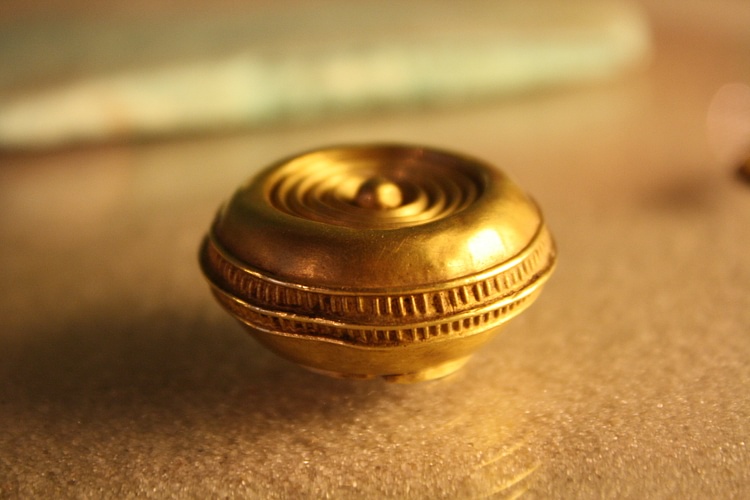 Neolithic Gold Bead Mark Cartwright (CC BY-NC-SA) ](https://www.worldhistory.org/image/2951/neolithic-gold-bead/ "Neolithic Gold Bead")### Currency
Gold was first used as coinage in the late 8th century BCE in Asia Minor. Irregular in shape and often with only one side stamped, the coins were usually made of electrum. The first pure gold coins with stamped images are credited to king [Croesus](https://www.worldhistory.org/croesus/) of Lydia, 561-546 BCE and a contemporary gold refinery has been excavated at the capital, [Sardis](https://www.worldhistory.org/sardis/). Even the purest naturally occurring gold can contain 5% silver but the Lydians were able to refine their gold using salt and furnace temperatures of between 600 and 800°C. The salt mixed with the silver and formed a vapour of silver chloride leaving behind pure gold which could be used to create a standardised coinage of guaranteed gold content. The [Mycenaean civilization](https://www.worldhistory.org/Mycenaean_Civilization/) also widely used gold coins, as did the later [Greek](https://www.worldhistory.org/disambiguation/greek/) and [Roman](https://www.worldhistory.org/disambiguation/Roman/) Empires, although silver was the more usual material used. One of the most famous gold coins in antiquity was the Roman bezant. First introduced in the reign of Emperor [Constantine](https://www.worldhistory.org/disambiguation/Constantine/) it weighed up to 70 [Troy](https://www.worldhistory.org/troy/) grains and was in currency from the 4th to the 12th centuries CE.
[  Macedonian Gold Stater Mark Cartwright (CC BY-NC-SA) ](https://www.worldhistory.org/image/805/macedonian-gold-stater/ "Macedonian Gold Stater")### Religious Artefacts & Other Uses
The value and beauty of solid gold made it an ideal material for particularly important political and religious objects such as crowns, sceptres, symbolic statues, libation vessels and votive offerings. Gold items were sometimes buried with the dead as a symbol of the deceased's status and the conspicuous (and non-profitable) consumption of such a rare and valuable material must surely have been designed to impress. Perhaps the most famous example is the so-called mask of [Agamemnon](https://www.worldhistory.org/disambiguation/Agamemnon/) found at [Mycenae](https://www.worldhistory.org/mycenae/). In the [Inca civilization](https://www.worldhistory.org/Inca_Civilization/) of Peru gold was considered the sweat of the sun [god](https://www.worldhistory.org/God/) [Inti](https://www.worldhistory.org/Inti/) and so was used to manufacture all manner of objects of religious significance, especially masks and sun disks. In ancient Colombia gold was similarly revered for its lustre and association with the sun and in powdered form was used to cover the body of the future king in a lavish coronation ceremony which gave rise to the legend of [El Dorado](https://www.worldhistory.org/El_Dorado/).
As a decorative covering, gold plate and gold leaf (gold beaten into extremely thin sheets) have been used to decorate shrines, temples, tombs, sarcophagi, statues, ornamental weapons and armour, ceramics, glassware and jewellery since [Egyptian](https://www.worldhistory.org/disambiguation/Egyptian/) times. Perhaps the most famous example of gold leaf from antiquity is the [death](https://www.worldhistory.org/disambiguation/Death/) mask of King [Tutankhamun](https://www.worldhistory.org/Tutankhamun/).
Gold, with its malleability and incorruptibility, has also been used in dental work for over 3000 years. The [Etruscans](https://www.worldhistory.org/Etruscan_Civilization/) in the 7th century BCE used gold wire to fix in place substitute animal teeth. As thread, gold was also woven into fabrics. Gold has also been used in [medicine](https://www.worldhistory.org/disambiguation/medicine/), for example, Pliny in the 1st century BCE suggests gold should be applied to wounds as a defence to 'magic potions'.
[ 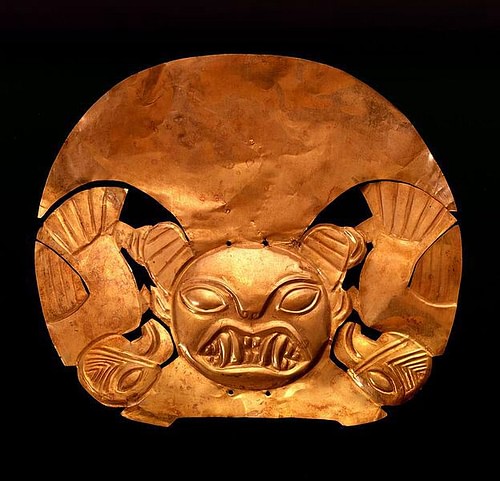 Moche Gold Headdress Lyndsay Ruell (Public Domain) ](https://www.worldhistory.org/image/2939/moche-gold-headdress/ "Moche Gold Headdress")### Grading Gold
Concerns over the authenticity of gold led the Egyptians to devise a method to determine the purity of gold around 1500 BCE (or earlier). This method is called fire assaying and involves taking a small sample of the material under test and firing it in a small crucible with a quantity of lead. The crucible was made of bone ash and absorbed the lead and any other base metals during the firing process leaving only gold and silver. The silver was removed using nitric acid and the remaining pure gold was weighed and compared to the weight before firing. [Archimedes](https://www.worldhistory.org/Archimedes/) was also aware that the specific gravity of gold is altered depending on the percentage content of base metals, pure gold having twice the gravity of silver for example.
Gold is such a precious material that for centuries various attempts were made to produce it through [alchemy](https://www.worldhistory.org/Alchemy/) - that is the chemical transformation of base metals into gold using the philosopher's stone (*lapis philosophorum*). First attempts were made in [China](https://www.worldhistory.org/china/) in the 4th century BCE and also in ancient [Greece](https://www.worldhistory.org/greece/) and although unsuccessful, nevertheless, the activity laid the foundations of modern chemistry.
#### Editorial Review
This human-authored definition has been reviewed by our editorial team before publication to ensure accuracy, reliability and adherence to academic standards in accordance with our [editorial policy](https://www.worldhistory.org/static/editorial-policy/).
## Bibliography
- [Cline, E.H. *The Oxford Handbook of the Bronze Age Aegean.* Oxford University Press, USA, 2012.](https://www.worldhistory.org/books/0199873607/)
- [Green, T. *The Gold Companion.* Rosendale Press, 1992.](https://www.worldhistory.org/books/1872803024/)
- [Higgins, R. *Minoan and Mycenaean Art.* Thames & Hudson, 1997.](https://www.worldhistory.org/books/0500203032/)
- [Oleson, J.P. *The Oxford Handbook of Engineering and Technology in the Classical World.* Oxford University Press, USA, 2009.](https://www.worldhistory.org/books/0199734852/)
- [Vila Llonch, E. *Beyond El Dorado.* British Museum Press, 2013.](https://www.worldhistory.org/books/0714125415/)
## About the Author
Mark is WHE’s Publishing Director and has an MA in Political Philosophy (University of York). He is a full-time researcher, writer, historian and editor. Special interests include art, architecture and discovering the ideas that all civilizations share.
## Timeline
- **c. 5000 BCE**: Electrum ([gold](https://www.worldhistory.org/gold/) and [silver](https://www.worldhistory.org/Silver/) alloy) used by the Egyptians in jewellery.
- **c. 3000 BCE**: [Sumer](https://www.worldhistory.org/sumer/) [civilization](https://www.worldhistory.org/civilization/) in [Mesopotamia](https://www.worldhistory.org/Mesopotamia/) use [gold](https://www.worldhistory.org/gold/) in jewellery manufacture.
- **c. 2500 BCE**: Egyptians invent the technique of filigree in the manufacture of [gold](https://www.worldhistory.org/gold/) objects.
- **c. 1800 BCE**: Minoans on [Crete](https://www.worldhistory.org/crete/) use [gold](https://www.worldhistory.org/gold/) in jewellery manufacture.
- **c. 1550 BCE**: [Gold](https://www.worldhistory.org/gold/) [death](https://www.worldhistory.org/disambiguation/Death/) masks (including that of '[Agamemnon](https://www.worldhistory.org/disambiguation/Agamemnon/)') made at [Mycenae](https://www.worldhistory.org/mycenae/).
- **1200 BCE**: [Chavin civilization](https://www.worldhistory.org/Chavin_Civilization/) in Peru manufactures [gold](https://www.worldhistory.org/gold/) goods.
- **c. 635 BCE - 585 BCE**: Reign of Alyattes of [Lydia](https://www.worldhistory.org/lydia/). Minting of first coins made from electrum.
- **c. 560 BCE**: [Croesus](https://www.worldhistory.org/croesus/) of [Lydia](https://www.worldhistory.org/lydia/) first manufactures coins of solid [gold](https://www.worldhistory.org/gold/).
## External Links
- [Gold in Ancient Egypt | Essay | The Metropolitan Museum of Art | Heilbrunn Timeline of Art History](https://www.metmuseum.org/toah/hd/egold/hd_egold.htm)
## Cite This Work
### APA
Cartwright, M. (2014, April 04). Gold in Antiquity. *World History Encyclopedia*.
### Chicago
Cartwright, Mark. "Gold in Antiquity." *World History Encyclopedia*, April 04, 2014. .
### MLA
Cartwright, Mark. "Gold in Antiquity." *World History Encyclopedia*, 04 Apr 2014, .
## License & Copyright
Submitted by [Mark Cartwright](https://www.worldhistory.org/user/markzcartwright/ "User Page: Mark Cartwright"), published on 04 April 2014. The copyright holder has published this content under the following license: [Creative Commons Attribution-NonCommercial-ShareAlike](https://creativecommons.org/licenses/by-nc-sa/4.0/deed.en). This license lets others remix, tweak, and build upon this content non-commercially, as long as they credit the author and license their new creations under the identical terms. When republishing on the web a hyperlink back to the original content source URL must be included. Please note that content linked from this page may have different licensing terms.