---
title: Giza
author: Joshua J. Mark
source: https://www.worldhistory.org/giza/
format: machine-readable-alternate
license: Creative Commons Attribution-NonCommercial-ShareAlike (https://creativecommons.org/licenses/by-nc-sa/4.0/)
updated: 1970-01-01
---
# Giza
_Authored by [Joshua J. Mark](https://www.worldhistory.org/user/JPryst/)_
Giza is a plateau southwest of modern Cairo which served as the necropolis for the royalty of the [Old Kingdom of Egypt](https://www.worldhistory.org/Old_Kingdom_of_Egypt/). Most famous for the [pyramids](https://www.worldhistory.org/pyramid/) of Khufu (completed c. 2560 BCE) Khafre (c. 2530 BCE) and Menkaure (c. 2510 BCE) and the Great [Sphinx](https://www.worldhistory.org/sphinx/) (built 2500 BCE), recent excavations on the plateau have revealed numerous private [tomb](https://www.worldhistory.org/tomb/) complexes and workers' quarters.
The original necropolis of Giza was laid out with amazing precision and skill but, once it became associated with the great kings of [Egypt](https://www.worldhistory.org/egypt/) and their pyramids, attracted the attention of less prominent officials of lower rank. These officials had enough money and prestige to buy their way into [burial](https://www.worldhistory.org/burial/) plots at Giza but had no regard for the symmetry of the original schematics and had their tombs dug wherever they found available space. This resulted in a number of [grave](https://www.worldhistory.org/burial/) complexes throughout Giza, which would not have been authorized by the kings who built the famous pyramids which, throughout history, have drawn visitors from around the world.
### The Pyramids of Khufu, Khafre, & Menkaure
Although the Giza plateau is most closely associated with the pyramids of Khufu, Khafre, and Menkaure, the site was used as early as the [First Dynasty of Egypt](https://www.worldhistory.org/First_Dynasty_of_Egypt/) as evidenced by the tomb of the king Djet which was found toward the edge of the plateau. Evidence of at least one king from the [Second Dynasty of Egypt](https://www.worldhistory.org/Second_Dynasty_of_Egypt/) (Nynetjer) buried at Giza has also been found. Further, inscriptions relate how king Khufu had to clear many earlier tombs and grave complexes to build the [Great Pyramid of Giza](https://www.worldhistory.org/Great_Pyramid_of_Giza/). What happened to the corpses or the grave goods from those tombs is not known.
The [Great Pyramid](https://www.worldhistory.org/Great_Pyramid_of_Giza/) of Khufu (also known as the [pyramid](https://www.worldhistory.org/pyramid/) of Cheops, the king's [Greek](https://www.worldhistory.org/disambiguation/greek/) name) is the last remaining of the ancient [Seven Wonders](https://www.worldhistory.org/The_Seven_Wonders/) of the World and rises to a height of 481 feet (147 metres). The pyramid of Khafre is 471 feet (144 metres) tall, and that of Menkaure rises to 213 feet (65 metres). The [Great Sphinx of Giza](https://www.worldhistory.org/Great_Sphinx_of_Giza/) sits on the eastern side of the plateau apart from the pyramids but it is thought it once was an important part of the pyramid complex which covered the area. The head of the Sphinx is believed by Egyptologists to be that of the king Khafre though others contend that represents Khufu. Further on, the great solar barge of Khufu, which is the oldest intact ship extant, was found buried in a pit near the Great Pyramid in 1954 CE. Dating from c.2500 BCE, the ship is 143 feet (43 metres) long and 19 feet (5.9 metres) wide. Near the Pyramid complex there are a number of smaller structures known as the Queen's Pyramids. It is uncertain who was buried beneath these pyramids but evidence suggests they were the tombs of Hetepheres I (Khufu's mother), Meretites (Khufu's wife) and a later queen named Henutsen.
The pyramids were once encased in polished limestone which, according to ancient writers, reflected the light of the sun brilliantly. The limestone was stripped away over the years for use in other building projects, most notably the mosques of Cairo. Of the three major pyramids, however, only Menkaure's is seen today without any of its original limestone casing; Khafre's Pyramid retains its casing stones at its apex while Khufu's has a smaller remainder at its base. The sides of all three of the Giza pyramids were oriented astronomically to be precisely north-south and east-west within a small fraction of a degree.
### Other Tombs
The original layout of the necropolis at Giza seems to have been very precise and well-ordered but, after the end of the [Old Kingdom](https://www.worldhistory.org/disambiguation/Old_Kingdom/), other tombs were dug without regard for the original pattern. Sometimes they were dug above existing tombs, making present-day Giza a wealth of archaeological material. Recent excavations have uncovered tombs of high officials, magistrates, and supervisors of building projects, as well as monuments honoring the [Egyptian](https://www.worldhistory.org/disambiguation/Egyptian/) workers who labored on the pyramids and others who were employed and lived in the immediate vicinity.
[ 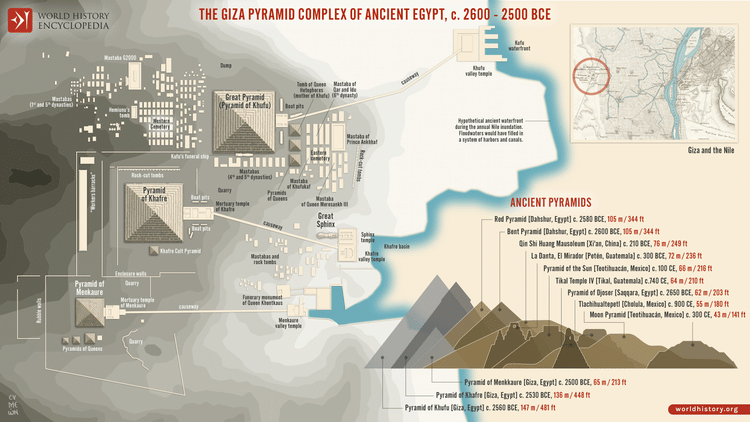 Map of the Giza Complex of Ancient Egypt Simeon Netchev (CC BY-NC-ND) ](https://www.worldhistory.org/image/15684/map-of-the-giza-complex-of-ancient-egypt/ "Map of the Giza Complex of Ancient Egypt")Largely due to engravings and etchings from the 19th century and early 20th centuries (and postcards and calendars of modern times) many people think of the Giza plateau and the pyramids as resting in a remote, wind-swept desert locale, when in reality it sits at the very edge of urban sprawl of Cairo today. In its time it would have also been a center of daily activity with many buildings, colonnades, terraces, and shops. The image of the Giza plateau in the modern day is thus vastly different from how it looked during the Fourth Dynasty of Egypt when the pyramids were built. There was a worker's village, which has been discovered and excavated, around 1300 feet (400 meters) south of the Great Sphinx where the laborers who worked on Menkaure's pyramid lived and those who built Khufu's pyramid founded a small village (Khufu's Village) on the far side of the complex.
### The Pyramids' Builders
No evidence of Hebrew slave laborers has been discovered at Giza nor anywhere else in the entirety of Egypt, contrary to popular opinion and film versions of Egyptian history based on the biblical Book of Exodus. In fact, it is well documented that Egyptians were compelled to perform community service for the [pharaoh](https://www.worldhistory.org/pharaoh/) through the construction of monuments, public parks, and tombs. The evolution of the Shabti doll (figurines in the likeness of an individual which were buried with the dead) grew out of this policy of requiring Egyptians to give up a part of their year to work on public building projects.
The only way one could evade this service was by having another take one's place. It was thought, since the afterlife was a mirror image of Egypt, that the great [god](https://www.worldhistory.org/God/) [Osiris](https://www.worldhistory.org/osiris/) would require the same service from the souls in the afterlife. The Shabti doll, blessed with incantations and funerary rites, would come to life in the next world and labor for Osiris in place of the soul of the deceased. Graves and tombs throughout Egypt are easily recognized as belonging to richer or poorer citizens based on the number of Shabti dolls found in them; the more dolls, the richer the person, and the more leisurely their afterlife was supposed to be. The tradition of Hebrew slaves laboring in bondage in Egypt is not supported by any ancient document other than the Book of Exodus while the practice of skilled Egyptian workers building the pyramids of Giza, and the other monuments throughout the land, is well documented from ancient records and archaeological evidence.
[  Great Pyramid of Giza, Reconstructed NeoMam Studios (CC BY-SA) ](https://www.worldhistory.org/image/12087/great-pyramid-of-giza-reconstructed/ "Great Pyramid of Giza, Reconstructed")These workers were well fed and taken care of. It is estimated that up to 4,000 pounds of meat from cattle, sheep, and goats was consumed by the workers daily and they had access to the best medical care. These claims are substantiated by the number of animal bones found at the site (over 25,000 sheep bones and 8,000 cattle, among other animals) and the graves of workers whose skeletons show expertly mended bones. These workers also appear to have had dental care and it is thought, based on skeletons found elsewhere, that pyramid workers enjoyed a higher quality of life than they would have in the villages they came from.
### Abandonment & Discovery
During the [First Intermediate Period](https://www.worldhistory.org/disambiguation/First_Intermediate_Period/) (c. 2181-2040 BCE) Giza was abandoned and fell into decay during the [Middle Kingdom](https://www.worldhistory.org/disambiguation/Middle_Kingdom/) (c. 2040-1782 BCE). The tombs, including the pyramids, were broken into and robbed and kings of the Middle Kingdom tore down temples, broke up walkways, and removed statuary for use in their own building projects. The pharaohs of the [New Kingdom](https://www.worldhistory.org/disambiguation/New_Kingdom/) (1570-1069 BCE) reversed this policy and dedicated themselves to preservation efforts.
[Ramesses II](https://www.worldhistory.org/Ramesses_II/) (1279-1213 BCE) was especially interested in Giza and had a small [temple](https://www.worldhistory.org/temple/) built there in front of the Sphinx. It was [Ramesses](https://www.worldhistory.org/disambiguation/ramesses/)' fourth son [Khaemweset](https://www.worldhistory.org/Khaemweset/), however, who worked the hardest to preserve the site. Khaemweset never ruled Egypt but was a crown prince whose efforts to restore the monuments of the past are well documented. In fact, he is considered today the world's "first Egyptologist" for his work in restoration, preservation, and recording of ancient monuments. Khaemweset brought the Giza plateau back to life and it continued to be used as a necropolis by the following dynasties, with less and less frequency, until Egypt was taken over by the [Roman Empire](https://www.worldhistory.org/Roman_Empire/) in 30 BCE.
The Giza plateau was more or less neglected - except by tourists, those dismantling the structures for their own uses, and grave robbers - until [Napoleon](https://www.worldhistory.org/disambiguation/Napoleon/)'s Egyptian Campaign of 1798-1801 CE. Napolean had brought along a team of scientists, artists, and engineers who he set to work investigating and recording facts about the Giza monuments and others throughout Egypt. Napoleon's work there attracted others to Egypt and archaeologists, adventure-seekers, entrepreneurs, and scholars began traveling to Egypt to investigate these monuments for themselves.
Among the most famous of these was Sir William [Matthew Flinders](https://www.worldhistory.org/Matthew_Flinders/) Petrie (1853-1942 CE) whose work is still considered the most important contribution to Egyptology and who brought the Great Pyramid to world attention. It is because of the work of men like Flinders Petrie that ongoing preservation, restoration, and archaeological work has continued almost non-stop from the 19th century to the present. The Giza plateau is one of the world's most popular tourist attractions and continues to draw visitors from around the world daily.
#### Editorial Review
This human-authored definition has been reviewed by our editorial team before publication to ensure accuracy, reliability and adherence to academic standards in accordance with our [editorial policy](https://www.worldhistory.org/static/editorial-policy/).
## Bibliography
- [Bunson, M. *Encyclopedia of Ancient Egypt.* Gramercy, 1999.](https://www.worldhistory.org/books/0517203804/)
- [Durant, W. *Our Oriental Heritage.* Simon & Schuster, 1954.](https://www.worldhistory.org/books/B00005WJGO/)
- [Institute of Eqyptian Art and Archaeology :: Giza - Plateau :: University of Memphis](http://www.memphis.edu/egypt/giza2.php "Institute of Eqyptian Art and Archaeology :: Giza - Plateau :: University of Memphis"), accessed 1 Dec 2016.
## About the Author
Joshua J. Mark is World History Encyclopedia's co-founder and Content Director. He was previously a professor at Marist College (NY) where he taught history, philosophy, literature, and writing. He has traveled extensively and lived in Greece and Germany.
- [Linkedin Profile](https://www.linkedin.com/pub/joshua-j-mark/38/614/339)
## Timeline
- **2589 BCE - 2566 BCE**: Reign of King Khufu (Cheops), builder of the [Great Pyramid of Giza](https://www.worldhistory.org/Great_Pyramid_of_Giza/), in [Egypt](https://www.worldhistory.org/egypt/).
- **c. 2560 BCE**: The [Great Pyramid of Giza](https://www.worldhistory.org/Great_Pyramid_of_Giza/) is constructed by [Pharaoh](https://www.worldhistory.org/pharaoh/) Khufu (Cheops).
- **2532 BCE - 2503 BCE**: Reign of King Menkaure, builder of the third [pyramid](https://www.worldhistory.org/pyramid/) at [Giza](https://www.worldhistory.org/giza/), in [Egypt](https://www.worldhistory.org/egypt/).
- **c. 2530 BCE**: [Pyramid](https://www.worldhistory.org/pyramid/) of Khafre is built at [Giza](https://www.worldhistory.org/giza/).
- **c. 2510 BCE**: [Pyramid](https://www.worldhistory.org/pyramid/) of Menkaure is built at [Giza](https://www.worldhistory.org/giza/).
- **c. 2500 BCE**: The [Great Sphinx of Giza](https://www.worldhistory.org/Great_Sphinx_of_Giza/) is built.
## External Links
- [Street View Treks: Egypt – About – Google Maps](http://www.google.com/maps/about/behind-the-scenes/streetview/treks/pyramids-of-giza/)
- [Who built the Pyramids?](https://ed.ted.com/featured/ANsldtAV)
- [History of Giza](https://www.pbs.org/wgbh/nova/pyramid/explore/gizahistory.html)
- [Seven Wonder of the Ancient World: Khufu's Great Pyramid](http://www.unmuseum.org/kpyramid.htm)
- [Great Pyramid Complex: The Queen's Pyramids](http://ancientegyptonline.co.uk/queens-pyramids/)
## Cite This Work
### APA
Mark, J. J. (2009, September 02). Giza. *World History Encyclopedia*.
### Chicago
Mark, Joshua J.. "Giza." *World History Encyclopedia*, September 02, 2009. .
### MLA
Mark, Joshua J.. "Giza." *World History Encyclopedia*, 02 Sep 2009, .
## License & Copyright
Submitted by [Joshua J. Mark](https://www.worldhistory.org/user/JPryst/ "User Page: Joshua J. Mark"), published on 02 September 2009. The copyright holder has published this content under the following license: [Creative Commons Attribution-NonCommercial-ShareAlike](https://creativecommons.org/licenses/by-nc-sa/4.0/deed.en). This license lets others remix, tweak, and build upon this content non-commercially, as long as they credit the author and license their new creations under the identical terms. When republishing on the web a hyperlink back to the original content source URL must be included. Please note that content linked from this page may have different licensing terms.