---
title: Europe
author: Joshua J. Mark
source: https://www.worldhistory.org/europe/
format: machine-readable-alternate
license: Creative Commons Attribution-NonCommercial-ShareAlike (https://creativecommons.org/licenses/by-nc-sa/4.0/)
updated: 2023-07-30
---
# Europe
_Authored by [Joshua J. Mark](https://www.worldhistory.org/user/JPryst/)_
Europe is a continent forming the westernmost part of the land mass of Eurasia and comprised of 49 sovereign states. Its name may come from the [Greek](https://www.worldhistory.org/disambiguation/greek/) myth of [Europa](https://www.worldhistory.org/Europa/), but human habitation of the region predates that tale, going back over 150,000 years. It is the birthplace of Western [Civilization](https://www.worldhistory.org/civilization/) and the modern concept of the state.
Scholars regularly refer to Europe as a peninsula bounded by the Arctic Ocean (north), [Mediterranean](https://www.worldhistory.org/disambiguation/mediterranean/) Sea (south), and Atlantic Ocean (west) with Asia on its eastern border. Modern-day countries of Europe are usually classified according to the cardinal directions and include:
**Northern Europe**
- Denmark (including Faroe Islands and Greenland)
- Estonia
- Finland
- Iceland
- [Ireland](https://www.worldhistory.org/disambiguation/Ireland/)
- Latvia
- Lithuania
- Norway
- Sweden
- United Kingdom (including [England](https://www.worldhistory.org/disambiguation/england/), Northern Ireland, [Scotland](https://www.worldhistory.org/disambiguation/Scotland/), and Wales)
**Southern Europe**
- Albania
- Andorra
- Bosnia and Herzegovina
- Croatia
- [Cyprus](https://www.worldhistory.org/cyprus/)
- Gibraltar (part of the UK)
- [Greece](https://www.worldhistory.org/greece/)
- [Italy](https://www.worldhistory.org/italy/)
- Kosovo
- North Macedonia
- Malta
- Monaco
- Montenegro
- Portugal
- San Marino
- Serbia
- Slovenia
- Spain
- [Turkey](https://www.worldhistory.org/Asia_Minor/) (west of the Bosporus)
- Vatican [City State](https://www.worldhistory.org/Polis/)
**Eastern Europe**
- Belarus
- Bulgaria
- Czech Republic
- Hungary
- Kazakhstan
- Moldova
- Poland
- Romania
- Russia (west of the Ural Mountains)
- Slovakia
- Ukraine
**Western Europe**
- Austria
- Belgium
- France
- Germany
- Liechtenstein
- Luxembourg
- The Netherlands
- Switzerland
From the earliest hominins, who first appear in the region over 1 million years ago, the population spread, eventually developing diverse cultures from the prehistoric period to the classical, late antiquity, Middle Ages, early modern, to the modern era.
### Prehistory
Archaeological evidence places *[Homo erectus](https://www.worldhistory.org/Homo_Erectus/)* in Europe c. 600,000 years ago during the Lower [Paleolithic](https://www.worldhistory.org/Paleolithic/) Period and [Neanderthals](https://www.worldhistory.org/Neanderthal/) by c. 150,000 years ago in the Middle Paleolithic Period. Although Neanderthals have routinely been discounted in the past as brutes, they actually developed an impressive [culture](https://www.worldhistory.org/disambiguation/culture/) which included cave art, [grave](https://www.worldhistory.org/burial/) goods (suggesting a belief in an afterlife), industry in making stone tools and hearths, textiles (clothing, cloaks, and blankets), boats, local and long-distance [trade](https://www.worldhistory.org/disambiguation/trade/), the use of fire, and the development of [music](https://www.worldhistory.org/disambiguation/Music/).
*Homo sapiens* arrived in Europe and replaced the Neanderthals some 50,000 years ago during the Upper Paleolithic Period. They continued to use caves as communal shelters, as the Neanderthals had, and created the impressive [wall](https://www.worldhistory.org/wall/) paintings at [Chauvet Cave](https://www.worldhistory.org/Chauvet_Cave/) (dated to c. 32,000 years ago) and [Lascaux Cave](https://www.worldhistory.org/Lascaux_Cave/) (dated to c. 20,000 years ago), both located in modern-day France. By this time, dogs had already been domesticated (roughly 32,000 years ago), prior to the [First Agricultural Revolution](https://www.worldhistory.org/First_Agricultural_Revolution/) of c. 10,000 BCE. [Animal husbandry](https://www.worldhistory.org/Animal_Husbandry/) and agricultural developments led to semi-permanent and then permanent settlements as people moved away from a hunter-gatherer lifestyle.
During the Middle [Neolithic Period](https://www.worldhistory.org/Neolithic/) megaliths were constructed, probably for religious purposes, suggesting closely-knit communities which could raise a significant workforce. Among the oldest [megalithic](https://www.worldhistory.org/disambiguation/megalithic/) sites is the [Carnac](https://www.worldhistory.org/Carnac/) Stones in Brittany, dated to c. 4500 BCE, and among the oldest megalithic tombs is [Poulnabrone](https://www.worldhistory.org/Poulnabrone/) in Ireland, dated to c. 4200 BCE. The most famous megalithic site is [Stonehenge](https://www.worldhistory.org/stonehenge/) in Wiltshire, England, dated to between c. 3000-2400 BCE, but many other sites are older including [Newgrange](https://www.worldhistory.org/Newgrange/) in Ireland (3200 BCE) the [Ness of Brodgar](https://www.worldhistory.org/Ness_of_Brodgar/) in Scotland (c. 3500 BCE) or the Mnajdra [Temple](https://www.worldhistory.org/temple/) Complex in Malta, dated to c. 3600 BCE.
The most famous example of the sort of [Neolithic](https://www.worldhistory.org/Neolithic/) community that would have built these temples, tombs, and monuments is [Skara Brae](https://www.worldhistory.org/Skara_Brae/) in Orkney, Scotland, dated to between c. 3100-2500 BCE. The Ancient [Celts](https://www.worldhistory.org/celt/) appear in the upper Danube region of Europe c. 1400 BCE. The [Celtic](https://www.worldhistory.org/celt/) Urnfield Culture was flourishing c. 1300 BCE, followed by the [Hallstatt culture](https://www.worldhistory.org/Hallstatt_Culture/) and the [La Tène culture](https://www.worldhistory.org/La_Tene_Culture/) (c. 1200 to c. 450 BCE and c. 450 BCE to c. 50 CE, respectively). How the people of the region, Celts or those who came before them, referred to their land is unknown.
[  Map of the Iron Age La Tène Culture c.400 BCE - c.50 CE Simeon Netchev (CC BY-NC-ND) ](https://www.worldhistory.org/image/14458/map-of-the-iron-age-la-tene-culture-c400-bce---c50/ "Map of the Iron Age La Tène Culture c.400 BCE - c.50 CE")### Name & [Greek Colonization](https://www.worldhistory.org/Greek_Colonization/)
The first appearance of *Europe* to designate the continent comes from Greece in the 6th century BCE, but it is unclear when the term was first used. The name may derive from the myth of Europa (known by the 8th century BCE when it is referenced in [Homer](https://www.worldhistory.org/homer/)'s *[Iliad](https://www.worldhistory.org/iliad/)*) in which the Phoenician princess is abducted by [Zeus](https://www.worldhistory.org/zeus/), king of the Greek gods, who, in the form of a bull, carries her off to [Crete](https://www.worldhistory.org/crete/) where she becomes queen of the first European civilization: the [Minoan](https://www.worldhistory.org/disambiguation/Minoan/), which flourished from c. 2000 to c. 1500 BCE and, according to some scholars, created the first European written language.
This claim regarding Europe's name has long been challenged, however, from the time of [Herodotus](https://www.worldhistory.org/herodotus/) up to the present day. Herodotus writes:
> As for Europe, not only does no one know whether it is surrounded by water, but the origin of its name is also uncertain (as is the identity of the man who named it), unless we say that it is named after Europa from [Tyre](https://www.worldhistory.org/Tyre/), and that before her time the continent was after all as nameless as the other continents were. But it is clear that Europa came from Asia and never visited the land mass which the Greeks now call Europe; her travels were limited to going from [Phoenicia](https://www.worldhistory.org/phoenicia/) to Crete. (Book IV.45)
Today, debate over the origin of the name continues. Theories include a Greek origin meaning "wide gazing" in reference to the breadth of the shoreline as seen from the sea or a Phoenician origin for the name meaning "evening" as in the place where the sun set. Europe was well known to the [Phoenicians](https://www.worldhistory.org/phoenicia/) who regularly sailed as far north as Cornwall in [Britain](https://www.worldhistory.org/disambiguation/Britain/) to trade in tin, but they only knew ports along the coastline, nothing of the interior and, according to Greek writers, Europe was viewed as a "dark continent" of mystery.
[ 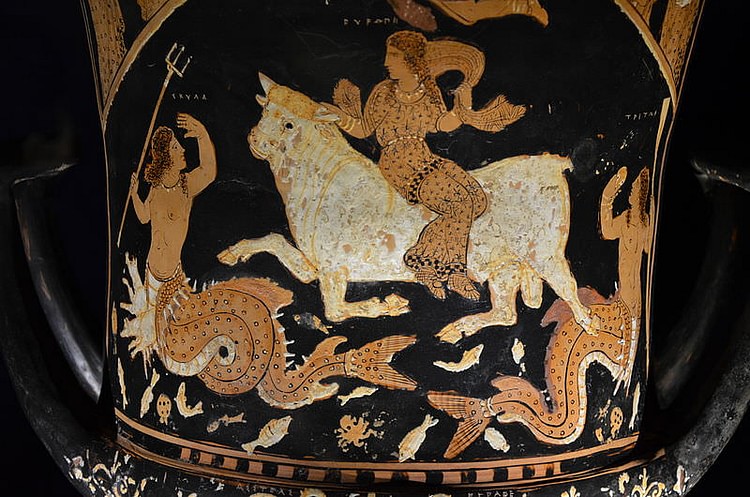 Europa & Zeus Carole Raddato (CC BY-SA) ](https://www.worldhistory.org/image/6232/europa--zeus/ "Europa & Zeus")The [Minoan civilization](https://www.worldhistory.org/Minoan_Civilization/), like the Phoenicians, was a seafaring people with trade contacts throughout the Mediterranean. The Minoans competed with the [Mycenaean Civilization](https://www.worldhistory.org/Mycenaean_Civilization/) (c. 1700-1100 BCE) in trade, and Minoan and Mycenean artifacts have been discovered in [Anatolia](https://www.worldhistory.org/Asia_Minor/), [Egypt](https://www.worldhistory.org/egypt/), Cyprus, the [Levant](https://www.worldhistory.org/levant/), [Mesopotamia](https://www.worldhistory.org/Mesopotamia/), and [Sicily](https://www.worldhistory.org/sicily/), among other places. The [Archaic](https://www.worldhistory.org/disambiguation/Archaic/) Greeks (c. 800-480 BCE) continued to follow these trade routes but went further and established colonies from southern Italy to Anatolia up toward the Black Sea. Among these was the colony of Massalia (modern-day Marseille, France), the birthplace of Pytheas (l. c. 350 BCE) the geographer, who is said to have produced the work [On the Ocean: the famous voyage of Pytheas](https://www.worldhistory.org/article/1078/on-the-ocean-the-famous-voyage-of-pytheas/) exploring Europe c. 325 BCE.
Pytheas' work, detailing his travels to Britain, the northeastern coastline of Europe, and possibly Iceland and the Arctic Ocean among other areas, has not survived save through references and passages in the works of later writers, but it does not seem he explored Europe's interior, only the coast. To place European history in a global perspective, by c. 325 BCE, the [Indus Valley Civilization](https://www.worldhistory.org/Indus_Valley_Civilization/) had already risen and fallen, the [Sumerians](https://www.worldhistory.org/Sumerians/) of Mesopotamia and the Assyrian [Empire](https://www.worldhistory.org/empire/) had come and gone, the [Persian Empire](https://www.worldhistory.org/disambiguation/Persian_Empire/) had already fallen to [Alexander the Great](https://www.worldhistory.org/Alexander_the_Great/), and Egypt was at the tail end of its Late Period with the greatest of its achievements behind it. The [pyramids](https://www.worldhistory.org/pyramid/) of [Giza](https://www.worldhistory.org/giza/) were already over 2,000 years old by the time of Pytheas' voyage and Chinese culture had been established for over 4,000 years.
Greek [colonization](https://www.worldhistory.org/disambiguation/colonization/) spread [Hellenistic](https://www.worldhistory.org/Hellenic_World/) culture and values, establishing concepts such as [Athenian democracy](https://www.worldhistory.org/Athenian_Democracy/), forming the basis of Western Civilization. Permanent settlements increased trade – which led to further towns, [cities](https://www.worldhistory.org/city/), and ports – but, again, these communities were along the coast. The interior was unknown to the Mediterranean world until the rise of the Romans.
### [Roman](https://www.worldhistory.org/disambiguation/Roman/) Expansion
[Rome](https://www.worldhistory.org/Rome/) was a small port on the banks of the Tiber River, founded in 753 BCE, which initially expanded through trade and came in contact with the Greek colonies to the south along modern-day Italy's coast. The [Etruscan civilization](https://www.worldhistory.org/Etruscan_Civilization/), to the north, and the southern Greeks both significantly influenced early Roman culture and civilization. Rome developed between the 8th and 6th centuries BCE, deposed their last king in 509 BCE, and founded the [Roman Republic](https://www.worldhistory.org/Roman_Republic/) that same year. By this time, the Romans had established themselves firmly through other colonies in Italy but expanded further during the [Punic Wars](https://www.worldhistory.org/Punic_Wars/) (264-146 BCE) after which they controlled the regions of Spain, Portugal, and [Gaul](https://www.worldhistory.org/gaul/) (modern-day Belgium and France) among others. [Julius Caesar](https://www.worldhistory.org/Julius_Caesar/) invaded Britain in 55 and 54 BCE but established no permanent presence there.
[  Map of the Expansion of the Roman Republic (c. 260 - 30 BCE) Simeon Netchev (CC BY-NC-ND) ](https://www.worldhistory.org/image/16762/map-of-the-expansion-of-the-roman-republic-c-260/ "Map of the Expansion of the Roman Republic (c. 260 - 30 BCE)")The Roman Republic became the [Roman Empire](https://www.worldhistory.org/Roman_Empire/) under [Augustus](https://www.worldhistory.org/augustus/) in 27 BCE, and under the [Roman emperor](https://www.worldhistory.org/Roman_Emperor/) [Claudius](https://www.worldhistory.org/claudius/), Britain was taken, beginning in 43 CE. By this time, the interior of regions like Spain and Gaul were well known to the Romans who established towns, ports, cities, religious sites, public baths, [aqueducts](https://www.worldhistory.org/aqueduct/), and built [Roman roads](https://www.worldhistory.org/article/758/roman-roads/) throughout their territories as they had elsewhere. They proceeded with this same policy in [Roman Britain](https://www.worldhistory.org/Roman_Britain/) and, although they met with considerable resistance – especially from the [Picts](https://www.worldhistory.org/picts/) of modern-day Scotland and from the Iceni queen [Boudicca](https://www.worldhistory.org/Boudicca/) who led a major revolt against Rome in 60/61 CE – made Britain a province of the empire and held it until 410.
Roman expansion throughout Europe united formerly disparate regions through trade and a common cultural base. The [Western Roman Empire](https://www.worldhistory.org/Western_Roman_Empire/) was in decline, but the [Eastern Roman Empire](https://www.worldhistory.org/Byzantine_Empire/) ([Byzantine Empire](https://www.worldhistory.org/Byzantine_Empire/)), with its capital at [Constantinople](https://www.worldhistory.org/Constantinople/), remained stable even during the so-called [Migration Age](https://www.worldhistory.org/Migration_Age/) when the [Avars](https://www.worldhistory.org/Avars/), Bulgars, [Goths](https://www.worldhistory.org/Goths/) – [Ostrogoths](https://www.worldhistory.org/ostrogoth/) and [Visigoths](https://www.worldhistory.org/visigoth/) – [Huns](https://www.worldhistory.org/Huns/), [Vandals](https://www.worldhistory.org/Vandals/), and others moved across Europe.
[  Map of the Migration Period in Europe in the 4th-5th Century Simeon Netchev (CC BY-NC-ND) ](https://www.worldhistory.org/image/14250/map-of-the-migration-period-in-europe-in-the-4th-5/ "Map of the Migration Period in Europe in the 4th-5th Century")[Christianity](https://www.worldhistory.org/christianity/) had been introduced to the region via the epistles and missionary work of St. [Paul the Apostle](https://www.worldhistory.org/Paul_the_Apostle/) in Greece in the 1st century and was legitimized in 313 by the emperor [Constantine I](https://www.worldhistory.org/Constantine_I/) through his Edict of Milan, decreeing religious tolerance. After [Constantine’s conversion to Christianity](https://www.worldhistory.org/article/1737/constantines-conversion-to-christianity/), the new faith would eventually replace the older pagan religions of Europe and further provide cultural unity through a common religious belief system, especially after the Council of Nicaea of 325 established the orthodox vision.
### Rise of the State, Church & [Vikings](https://www.worldhistory.org/Vikings/)
By the time the Western Roman Empire fell in 476, Christianity was well established in Europe. Kings such as [Odoacer](https://www.worldhistory.org/Odoacer/) of Italy (r. 476-493) and [Theodoric the Great](https://www.worldhistory.org/Theodoric_the_Great/) (r. 493-526) considered themselves Christian kings as did [Clovis I](https://www.worldhistory.org/Clovis_I/) of the [Franks](https://www.worldhistory.org/Franks/) (r. 481-511) and [Alboin](https://www.worldhistory.org/Alboin/) of the [Lombards](https://www.worldhistory.org/Lombards/) (r. 560-572). After the [fall of the Western Roman Empire](https://www.worldhistory.org/article/835/fall-of-the-western-roman-empire/), leaders like these arose, and through military campaigns and treaties, they established kingdoms during the Early Middle Ages (476-1000) that would develop into states through the High Middle Ages (1000-1300) and Late Middle Ages (1300-1500) until European kingdoms had, more or less, become countries with a central government. These kings, and their subjects, adhered to the vision of the Roman Catholic Church which had split from the Eastern Orthodox Church in the Great Schism of 1054.
The [medieval Church](https://www.worldhistory.org/Medieval_Church/) was understood as [God](https://www.worldhistory.org/God/)'s representative on earth and informed the lives of the people of Europe. Even though the common people did not understand Latin, the language of the Church, and did not always respect their parish priest, most people recognized its authority as the only path to redemption and eternal life in heaven. Those who did not conform were thought to spend eternity in hell or a certain time in purgatory where their sins were burned away through various tortures. Some people rejected the Church's vision, however, and these were branded as heretics and persecuted by the Church beginning with the Paulicians in the 7th-9th century.
The Church encouraged cultural and religious unity through these persecutions as it made clear there was only one true faith all people needed to follow. After the rise of [Islam](https://www.worldhistory.org/islam/) in the 7th century, the Church – and Christian European monarchs – found another 'enemy of the faith' to unify believers against, and this policy gained greater momentum after the [Battle](https://www.worldhistory.org/disambiguation/battle/) of Tours in 732 in which the Franks turned back a Muslim invasion of Europe.
[  Battle of Tours, 732 Charles de Steuben (Public Domain) ](https://www.worldhistory.org/image/11662/battle-of-tours-732/ "Battle of Tours, 732")[Charlemagne](https://www.worldhistory.org/Charlemagne/) (King of the Franks 768-814 and Holy Roman Emperor 800-814) became the champion of the Church, unifying the Franks and Lombards in 774 and suppressing European paganism through the [Saxon Wars](https://www.worldhistory.org/Saxon_Wars/) (772-804). The [monastic orders of the Middle Ages](https://www.worldhistory.org/article/1407/monastic-orders-of-the-middle-ages/) developed further under Charlemagne, and the [medieval monastery](https://www.worldhistory.org/Medieval_Monastery/) became an important center of learning and culture copying and preserving written works while also producing the famous [illuminated manuscripts](https://www.worldhistory.org/Illuminated_Manuscripts/) of Europe. A major threat to the monasteries, especially those along the coast, began in 793 through [Viking raids in Britain](https://www.worldhistory.org/article/1197/viking-raids-in-britain/), Francia, Ireland, and elsewhere, continuing up through the reign of [Alfred the Great](https://www.worldhistory.org/Alfred_the_Great/), King of Wessex (871-899), famous for his victories over the Vikings as well as encouraging literacy in Britain.
The Vikings settled in parts of Britain and France, some converting to Christianity and contributing to cultural developments, while others continued military campaigns up through 1066 when the [Viking](https://www.worldhistory.org/Vikings/) leader Harald Hardrada was defeated at the [Battle of Stamford Bridge](https://www.worldhistory.org/article/1306/battle-of-stamford-bridge/), ending the [Viking Age](https://www.worldhistory.org/collection/29/the-viking-age/). This was also the year of the Norman invasion of Britain under [William the Conqueror](https://www.worldhistory.org/William_the_Conqueror/) (r. 1066-1087), the great-great-great-grandson of [Rollo of Normandy](https://www.worldhistory.org/Rollo_of_Normandy/) (l. c. 860 to c. 930), the Viking chieftain who founded Normandy. The Norman [conquest](https://www.worldhistory.org/warfare/) made French the language of the court, the upper class, and finance, and established French culture and customs throughout Britain, linking it with France and the other states of the European continent.
### Renaissance & [Reformation](https://www.worldhistory.org/disambiguation/Reformation/)
The kingdoms and principalities of Europe had diverse languages, customs, and goals but were united – at least nominally – through religious belief and the authority of the Roman Catholic Church. In 1095, when Pope Urban II called the [First Crusade](https://www.worldhistory.org/First_Crusade/) to free the Holy Land from Muslim rule, people from all over Europe answered. Except for the first, the [crusades](https://www.worldhistory.org/Crusades/) between 1095-1270 ultimately failed in their objective but significantly altered the European cultural and political landscape. The crusades led to the rise of nation-states and monarchies supported by wider trade (and the need to protect trade routes), the establishment of more ports and trade centers, and the rise of the mercantile class. It also decreased the number of serfs working on the estate of nobles, weakening [feudalism](https://www.worldhistory.org/Feudalism/) and empowering the monarchy.
[  Map of the First Three Crusades & the 12th-Century Outremer Simeon Netchev (CC BY-NC-ND) ](https://www.worldhistory.org/image/15382/map-of-the-first-three-crusades--the-12th-century/ "Map of the First Three Crusades & the 12th-Century Outremer")The [Black Death](https://www.worldhistory.org/Black_Death/) of 1347-1352 would decrease the population further, ending the feudal system, and also weakening the authority of the Church whose efforts to end the [plague](https://www.worldhistory.org/disambiguation/plague/) repeatedly failed. The Crusades and Black [Death](https://www.worldhistory.org/disambiguation/Death/) encouraged people to question the Church and the established order, and the rediscovery of ancient [Greek literature](https://www.worldhistory.org/Greek_Literature/) and Roman texts led to the Renaissance and an increased focus on life on earth rather than what waited after death. The Renaissance encouraged the [Protestant Reformation](https://www.worldhistory.org/Protestant_Reformation/) (1517-1648), spearheaded by [Martin Luther](https://www.worldhistory.org/Martin_Luther/) (l. 1483-1546) and enabled by the printing press of [Johannes Gutenberg](https://www.worldhistory.org/Johannes_Gutenberg/) (l. c. 1398-1468), invented c. 1450. The [printing revolution in Renaissance Europe](https://www.worldhistory.org/article/1632/the-printing-revolution-in-renaissance-europe/) allowed for the wide dissemination of Luther's – and then others' – works challenging the status quo and ecclesiastical authority. The [printing press and the Protestant Reformation](https://www.worldhistory.org/article/2039/the-printing-press--the-protestant-reformation/) encouraged greater literacy and independence of thought, contributing to the Age of Enlightenment of the 17th and 18th centuries.
### Conclusion
The [Byzantine](https://www.worldhistory.org/disambiguation/Byzantine/) Empire fell to the Ottoman Turks in 1453 who then closed the [Silk Road](https://www.worldhistory.org/Silk_Road/), ending European land trade with the East and encouraging greater maritime trade, which launched the Age of Exploration. The colonization of the Americas began in 1492 and was encouraged, not only by the European need to find alternative routes to the East but also by European history. The Crusades had established a paradigm of conquest in the name of Christianity while rivalry between Catholic and Protestant nations encouraged countries and religious communities to claim lands in the name of their respective faiths.
[  Map of the Dominant Religions in Europe, 16th Century Simeon Netchev (CC BY-NC-ND) ](https://www.worldhistory.org/image/14972/map-of-the-dominant-religions-in-europe-16th-centu/ "Map of the Dominant Religions in Europe, 16th Century")The Age of Exploration established European culture in the so-called New World between 1492-1620 with greater numbers of colonists arriving up through 1720 and even more afterwards into the early 20th century. The Dutch, English, and French – among others – also established colonies elsewhere, such as [India](https://www.worldhistory.org/india/), the [Near East](https://www.worldhistory.org/Near_East/), and [Africa](https://www.worldhistory.org/disambiguation/africa/) – spreading European culture around the world. The benefits of imperialism and colonization went unquestioned by Europeans of the time but have been increasingly challenged since the mid-20th century. For better or worse, however, European history, culture, and political policies affected the development of a number of regions around the globe, influencing the establishment of many of the socio-political and religious paradigms of the modern world.
#### Editorial Review
This human-authored definition has been reviewed by our editorial team before publication to ensure accuracy, reliability and adherence to academic standards in accordance with our [editorial policy](https://www.worldhistory.org/static/editorial-policy/).
## Bibliography
- [Collins, R. *Early Modern Europe: 300-1000.* Palgrave MacMillan, 2010.](https://www.worldhistory.org/books/0198207344/)
- [Countries of Europe](https://www.nationsonline.org/oneworld/europe.htm "Countries of Europe"), accessed 5 Jun 2023.
- [Cunliffe, B. *The Extraordinary Voyage of Pytheas the Greek.* Penguin Books, 2003.](https://www.worldhistory.org/books/0142002542/)
- [Cunliffe, B. *The Oxford Illustrated History of Prehistoric Europe.* Oxford University Press, 2001.](https://www.worldhistory.org/books/0192854410/)
- [Grant, M. *Readings in the Classical Historians.* Scribners Publishing, 2002.](https://www.worldhistory.org/books/B000FSP7LE/)
- [Logan, F D. *A History of the Church in the Middle Ages.* Routledge, 2012.](https://www.worldhistory.org/books/0415669944/)
- [Osborne, R. *Civilization: A New History of the Western World.* Pegasus Books, 2008.](https://www.worldhistory.org/books/1933648767/)
- [Sawyer, P. *The Oxford Illustrated History of the Vikings .* Oxford University Press, 2000.](https://www.worldhistory.org/books/0192853651/)
- [Tacitus & Moore, C. H. *Tacitus Annals.* Harvard University Press, 2003.](https://www.worldhistory.org/books/0674992741/)
- [Waterfield, R. *Herodotus: The Histories.* Oxford University Press, 2008.](https://www.worldhistory.org/books/1932350209/)
## About the Author
Joshua J. Mark is World History Encyclopedia's co-founder and Content Director. He was previously a professor at Marist College (NY) where he taught history, philosophy, literature, and writing. He has traveled extensively and lived in Greece and Germany.
- [Linkedin Profile](https://www.linkedin.com/pub/joshua-j-mark/38/614/339)
## Timeline
- **c. 45000 BCE**: Potential earliest arrival of [Homo sapiens](https://www.worldhistory.org/Homo_Sapiens/) in [Europe](https://www.worldhistory.org/europe/).
- **30000 BCE - 12000 BCE**: Cave art [culture](https://www.worldhistory.org/disambiguation/culture/) in [Europe](https://www.worldhistory.org/europe/).
- **c. 20000 BCE**: Cave painting flourishes in Spain and France, the most famous being the Cave of [Lascaux](https://www.worldhistory.org/Lascaux_Cave/) in France.
- **5000 BCE**: Hierarchical societies emerge in southeast [Europe](https://www.worldhistory.org/europe/).
- **c. 5000 BCE**: Cultivation of peas in [Europe](https://www.worldhistory.org/europe/).
- **4300 BCE**: First [megalithic](https://www.worldhistory.org/disambiguation/megalithic/) tombs in [Europe](https://www.worldhistory.org/europe/).
- **3500 BCE**: Farming has spread across [Europe](https://www.worldhistory.org/europe/).
- **c. 3300 BCE - c. 1200 BCE**: The [Bronze Age](https://www.worldhistory.org/disambiguation/Bronze_Age/), lasting from c. 3300 BCE- c. 1200 BCE in the [Near East](https://www.worldhistory.org/Near_East/) and South Asia and c. 600 BCE in [Europe](https://www.worldhistory.org/europe/).
- **2800 BCE - 1900 BCE**: Bell beaker [culture](https://www.worldhistory.org/disambiguation/culture/) in western [Europe](https://www.worldhistory.org/europe/).
- **2300 BCE**: [Bronze](https://www.worldhistory.org/disambiguation/bronze/) is used in the [Aegean](https://www.worldhistory.org/aegean/).
- **c. 2000 BCE**: [Bronze Age](https://www.worldhistory.org/disambiguation/Bronze_Age/) begins in Northern [Europe](https://www.worldhistory.org/europe/).
- **2000 BCE - 1500 BCE**: Wessex [culture](https://www.worldhistory.org/disambiguation/culture/) introduces [bronze](https://www.worldhistory.org/disambiguation/bronze/) working to [Britain](https://www.worldhistory.org/disambiguation/Britain/).
- **1500 BCE**: Pastoral farming spreads across Eurasian steppes.
- **c. 1400 BCE**: The beginning of [Celtic](https://www.worldhistory.org/celt/) [culture](https://www.worldhistory.org/disambiguation/culture/) in the upper Danube region of central [Europe](https://www.worldhistory.org/europe/).
- **c. 1200 BCE - c. 450 BCE**: Widest date range accepted by scholars for the [Hallstatt culture](https://www.worldhistory.org/Hallstatt_Culture/) in central [Europe](https://www.worldhistory.org/europe/).
- **1100 BCE**: Dorian peoples occupy [Greece](https://www.worldhistory.org/greece/).
- **1100 BCE**: Hillforts in western [Europe](https://www.worldhistory.org/europe/).
- **1000 BCE**: Iron working in southern [Europe](https://www.worldhistory.org/europe/).
- **c. 900 BCE**: [Celtic](https://www.worldhistory.org/celt/) Migration begins in [Europe](https://www.worldhistory.org/europe/) with many [Celts](https://www.worldhistory.org/celt/) landing in [Scotland](https://www.worldhistory.org/disambiguation/Scotland/).
- **c. 800 BCE - c. 600 BCE**: The Early [Iron Age](https://www.worldhistory.org/disambiguation/Iron_Age/) [Hallstatt culture](https://www.worldhistory.org/Hallstatt_Culture/) is at its peak in central [Europe](https://www.worldhistory.org/europe/).
- **700 BCE**: Iron in wide use across [Europe](https://www.worldhistory.org/europe/).
- **c. 513 BCE - c. 512 BCE**: [Darius I](https://www.worldhistory.org/Darius_I/) of [Persia](https://www.worldhistory.org/Persia/) campaigns against [Scythians](https://www.worldhistory.org/Scythians/) into European [Scythia](https://www.worldhistory.org/Scythians/), past the Danube River, Scythians refuse to fight and [Darius](https://www.worldhistory.org/disambiguation/darius/) is forced to abandon the campaign due to lack of provisions.
- **c. 450 BCE - c. 50 BCE**: Period of the [La Tène culture](https://www.worldhistory.org/La_Tene_Culture/) in northern/western/central [Europe](https://www.worldhistory.org/europe/).
- **193 BCE**: The Boii are defeated by the Romans, suffering, according to [Livy](https://www.worldhistory.org/livy/), 14,000 dead.
- **58 BCE**: [Julius Caesar](https://www.worldhistory.org/Julius_Caesar/) invades [Gaul](https://www.worldhistory.org/gaul/). [Roman](https://www.worldhistory.org/disambiguation/Roman/) influence on the European tribes begins in earnest.
- **300 CE - 700 CE**: [Migration Age](https://www.worldhistory.org/Migration_Age/) in [Europe](https://www.worldhistory.org/europe/).
- **c. 476 CE - 1500 CE**: The Catholic Church holds supreme power in [Europe](https://www.worldhistory.org/europe/) during the Middle Ages.
- **c. 1050 CE - c. 1250 CE**: [Feudalism](https://www.worldhistory.org/Feudalism/) is the dominant system of land ownership in northern medieval [Europe](https://www.worldhistory.org/europe/).
- **1347 CE - 1352 CE**: The [Black Death](https://www.worldhistory.org/Black_Death/) [plague](https://www.worldhistory.org/disambiguation/plague/) sweeps across [Europe](https://www.worldhistory.org/europe/).
- **1453 CE**: The [Ottoman Empire](https://www.worldhistory.org/Ottoman_Empire/) closes the overland [Silk Road](https://www.worldhistory.org/Silk_Road/) [trade](https://www.worldhistory.org/disambiguation/trade/) routes between [Europe](https://www.worldhistory.org/europe/) and the East, initiating the European Age of Discovery.
## Questions & Answers
### What is Europe?
Europe is a continent forming the westernmost part of Eurasia. It is often referred to by scholars as a peninsula of the Eurasian land mass but is not considered a part of Asia.
### Where does the name "Europe" come from?
The origin of the name of Europe is unknown. It is thought to have come from the myth of Europa, a Phoenician princess abducted by Zeus who became the first queen of the Minoans, but this claim has been challenged for centuries.
### How many countries are there in Europe?
There are 50 countries in Europe, although, according to some definitions, only 44.
### When does "Europe" first appear in writing in reference to the continent?
"Europe" first appears in writing in the 6th century BCE in Greece referencing the continent of Europe, but the origin of the name is unclear.
## Cite This Work
### APA
Mark, J. J. (2023, June 09). Europe. *World History Encyclopedia*.
### Chicago
Mark, Joshua J.. "Europe." *World History Encyclopedia*, June 09, 2023. .
### MLA
Mark, Joshua J.. "Europe." *World History Encyclopedia*, 09 Jun 2023, .
## License & Copyright
Submitted by [Joshua J. Mark](https://www.worldhistory.org/user/JPryst/ "User Page: Joshua J. Mark"), published on 09 June 2023. The copyright holder has published this content under the following license: [Creative Commons Attribution-NonCommercial-ShareAlike](https://creativecommons.org/licenses/by-nc-sa/4.0/deed.en). This license lets others remix, tweak, and build upon this content non-commercially, as long as they credit the author and license their new creations under the identical terms. When republishing on the web a hyperlink back to the original content source URL must be included. Please note that content linked from this page may have different licensing terms.