---
title: Eridu: The Divine Birthplace of Kingship and Order
author: Joshua J. Mark
source: https://www.worldhistory.org/eridu/
format: machine-readable-alternate
license: Creative Commons Attribution-NonCommercial-ShareAlike (https://creativecommons.org/licenses/by-nc-sa/4.0/)
updated: 2026-01-16
---
# Eridu: The Divine Birthplace of Kingship and Order
_Authored by [Joshua J. Mark](https://www.worldhistory.org/user/JPryst/)_
Eridu (present-day [Abu](https://www.worldhistory.org/disambiguation/Abu/) Shahrein, Iraq) was considered the first [city](https://www.worldhistory.org/city/) in the world by the ancient [Sumerians](https://www.worldhistory.org/Sumerians/) and is among the most ancient of the ruins from [Mesopotamia](https://www.worldhistory.org/Mesopotamia/). Founded circa 5400 BCE, Eridu was thought to have been created by the gods, who established order upon the earth with Eridu as the starting point.
The city was home to the [god](https://www.worldhistory.org/God/) [Enki](https://www.worldhistory.org/Enki/) (also known as Ea by the Akkadians), who would develop from a local god of fresh water into the god of wisdom and magic (among other attributes) and stand with other deities such as [Anu](https://www.worldhistory.org/Anu/), [Enlil](https://www.worldhistory.org/Enlil/), and [Inanna](https://www.worldhistory.org/Inanna/) as the most important in the [Mesopotamian pantheon](https://www.worldhistory.org/article/221/the-mesopotamian-pantheon/). As Enki's home, it became associated with many of the most vital myths of Mesopotamia, including those concerning an early paradise on earth.
The [Sumerian King List](https://www.worldhistory.org/Sumerian_King_List/) cites Eridu as the "city of the first kings", stating, "After the kingship descended from heaven, the kingship was in Eridu," and the city was looked back upon by the various city-states of Mesopotamia as the initial home of human beings of a "golden age" of peace and order in the same way the writers of the biblical narrative of Genesis created a [Garden of Eden](https://www.worldhistory.org/Garden_of_Eden/) as their mythical paradise, most likely modeled on tales of Eridu. The city was abandoned circa 600 BCE, probably due to overuse of the land, and fell into ruin.
### The First City
The city of Eridu features prominently in Sumerian mythology, not only as the first city and home of the gods, but as the locale to which the goddess Inanna traveled in order to receive the gifts of [civilization](https://www.worldhistory.org/civilization/), which she then bestowed upon humanity from her home city of [Uruk](https://www.worldhistory.org/uruk/).
The ancient Sumerians certainly believed Eridu to be the first city in the world, established long before recognized human lifespans were set, and the Sumerian King List gives impossibly long reigns (between 28,000 and 36,000 years) for their kings, while Sumerian scribes maintained that kingship in the land (and, therefore, order) first came from heaven to be established at Eridu. Scholar Stephen Bertman writes:
> Tradition made it the earliest city to have a king before the days of the mythical Great Flood. Eridu's archaeological story can be traced back to at least the sixth millennium BCE. If the tradition of its antiquity is true, Eridu may well have been the first city on earth.
> (19)
If not the first, the city was among the oldest. The ancient Mesopotamians frequently built their [cities](https://www.worldhistory.org/city/) on top of the ruins of older settlements (as is also true of other cultures). Excavations at Eridu have revealed a sequence of construction dating back to the Ubaid period (circa 6500-4000 BCE) and continuing on from there to reach its height during the [Ur](https://www.worldhistory.org/ur/) III period (circa 2112-2004 BCE) under rulers such as [Ur-Nammu](https://www.worldhistory.org/Ur-Nammu/) (reign 2112-2094 BCE) and [Shulgi of Ur](https://www.worldhistory.org/Shulgi_of_Ur/) (reign 2094-2046 BCE) both of whom encouraged [trade](https://www.worldhistory.org/disambiguation/trade/) from the city, both long-distance and local. Glass from Eridu has been found in the ruins of the cities of [Egypt](https://www.worldhistory.org/egypt/).
At the same time, however, the city was never a powerful political site. Scholar Gwendolyn Leick notes:
> Eridu was never the seat of a dynasty. Its importance was religious rather than political, as the site of the main sanctuary of Enki.
> (62)
Enki, the god of wisdom, featured prominently in many Mesopotamian texts and especially in the tale of the Great Flood as told in the *[Eridu Genesis](https://www.worldhistory.org/Eridu_Genesis/)* and the *Atrahasis*.
[  Map of the Sumerian Civilization Simeon Netchev (CC BY-NC-ND) ](https://www.worldhistory.org/image/15299/map-of-the-sumerian-civilization/ "Map of the Sumerian Civilization")### Enki & Eridu
Eridu, as noted, was the home of Enki and the center of his cult. Bertman comments on the ruins of Enki's [temple](https://www.worldhistory.org/temple/):
> The god's temple has been found and shows that it was rebuilt over the course of thousands of years. In its earliest phase (dating back to about 5500 BCE), it masured abourt 12 by 15 feet, was made of mud brick, and featured a simple podium or altar for sacrifices and a niche meant to hold a statue of the god. To judge by evidence found in a later niche – fish bones and ashes scattered on the floor around the altar – the god's favorite meal was freshwater fish. The temple's antiquity makes it the oldest in Mesopotamian architectural and religious history.
> (20)
Enki was associated with fresh water, as was Eridu itself, since it was located in the southern marshes of the Euphrates River, and so it is no surprise that both Enki and Eridu feature in the earliest of the Great Flood stories from which the later tale of [Noah](https://www.worldhistory.org/Noah/) and his ark was developed. The *Eridu Genesis* (composed circa 2300 BCE) is the earliest description of the Great Flood, pre-dating the biblical [book of Genesis](https://www.worldhistory.org/Book_of_Genesis/), and is the tale of the good man Ziusudra (a character later to appear as Atrahasis and Utnapishtim in the *Atrahasis* and the *Epic of [Gilgamesh](https://www.worldhistory.org/gilgamesh/)*, respectively), who builds a great boat and gathers inside 'the seed of life' at Enki's suggestion. Enki was instrumental in the creation of humanity, and when Enlil, King of the Gods, grew tired of humanity's noise and decided to destroy them, it was Enki who preserved life on earth by saving Ziusudra and, thereby, life on earth.
The *Eridu Genesis* may have been the first written record of a long oral tradition of a time around 2800 BCE, when the Euphrates rose high above its banks and flooded the region. Excavations at the city of Ur by Leonard Wooley in 1922 revealed an 8-foot (2.5 m) layer of silt and clay, consistent with the sediment of the Euphrates, which seemed to support the claim of a catastrophic flood in the area around 2800 BCE. Notes of the excavation taken by Wooley's assistant, Max Mallowan, however, showed it was clearly a local, not a global, event.
[ 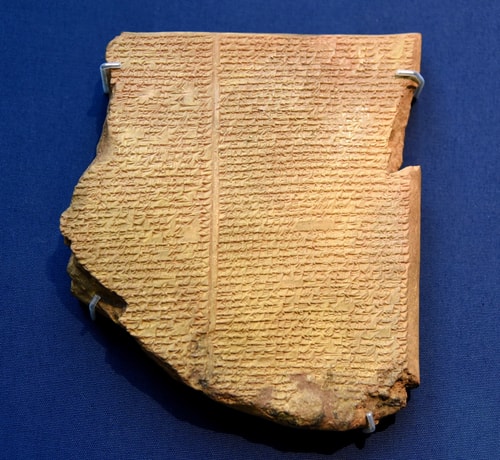 Flood Tablet of the Epic of Gilgamesh Osama Shukir Muhammed Amin (Copyright) ](https://www.worldhistory.org/image/4821/flood-tablet-of-the-epic-of-gilgamesh/ "Flood Tablet of the Epic of Gilgamesh")A proto-Genesis tale of the Garden has been found at Eridu, in which Tagtug the Weaver (or gardener) is cursed by Enki for eating of the fruit of the forbidden tree in the garden after being told not to. Eridu is further associated with the same theme through the *[Myth of Adapa](https://www.worldhistory.org/article/216/the-myth-of-adapa/),* in which the sage Adapa (son of Enki), who has been initiated into the meaning of life and all understanding by the god of wisdom, is ultimately tricked by him and denied the one thing he most wanted: knowledge of life without [death](https://www.worldhistory.org/disambiguation/Death/), to live forever.
The desire for immortality features prominently in [Mesopotamian literature](https://www.worldhistory.org/Mesopotamian_Literature/), and Sumerian writings specifically, and is epitomized in the story of Gilgamesh of Uruk. Uruk's link to Eridu is significant in that Eridu's initial importance was later eclipsed by the rise of Uruk. This transferrence of power and prestige has been seen by some scholars ([Samuel](https://www.worldhistory.org/samuel/) Noah Kramer and [Paul](https://www.worldhistory.org/disambiguation/Paul/) Kriwaczek among them) as the beginnings of [urbanization](https://www.worldhistory.org/urbanization/) in Mesopotamia and a significant shift from the rural model of agrarian life to an urban-centered model.
The story of *Inanna and the God of Wisdom*, in which Inanna, the goddess of Uruk (and daughter of Enki), takes away the sacred *meh* (gifts of civilization) from her father, the god of Eridu, can be seen as an ancient story symbolizing this shift in the paradigm of Sumerian [culture](https://www.worldhistory.org/disambiguation/culture/). The prosperous urban and commercial center of Uruk superseded the more rural, agrarian Eridu.
### Eridu as [Babel](https://www.worldhistory.org/babylon/)
Even so, Eridu was an important center for trade as well as [religion](https://www.worldhistory.org/religion/) and, at its height, was a great melting pot of cultures and diversity, as evidenced by the various forms of artistry found among the ruins. Under the reigns of Ur-Nammu and Shulgi, the city prospered. Bertman writes:
> The citizens of ancient Eridu were \[justly\] proud of another structure \[besides Enki's temple\]: a mighty [ziggurat](https://www.worldhistory.org/ziggurat/) dedicated around 2100 BCE by Ur-Nammu, king of Ur, and his son. Though its eroded platform stands only about 30 feet today, its base of oven-baked brick measures over 150 by 200 feet and once supported a far more imposing structure.
> (20)
The great Ziggurat of Amar-Suen (reign 2046-2037 BCE), son of Shulgi of Ur, in the center of the city, has been associated with the biblical Tower of Babel from the book of Genesis, and the city itself with the biblical city of Babel. This association springs from archaeological discoveries, which support the claim that the Ziggurat of Amar-Suen more closely resembles the description of the biblical tower than any description of the ziggurat at [Babylon](https://www.worldhistory.org/babylon/).
[  The Tower of Babel Classic Art Wallpapers (CC BY-SA) ](https://www.worldhistory.org/image/6123/the-tower-of-babel/ "The Tower of Babel")Further, the Babylonian historian Berossus (circa 200 BCE), who was a major source for later [Greek](https://www.worldhistory.org/disambiguation/greek/) historians, seems to be clearly referring to Eridu when he writes of "Babel" as "Babylon." His "Babylon" is in the southern marshes of the Euphrates and is patronized by the god of wisdom and fresh water. This association strongly suggests that Eridu is the original biblical Babel, as the story of the great Ziggurat of Amar-Suen was most likely passed down orally before Berossus set the legendary structure down in [writing](https://www.worldhistory.org/writing/).
### Conclusion
Eridu was abandoned intermittently over the years for reasons which remain unclear, and finally, it was left behind completely sometime around the year 600 BCE. The cause is most likely overuse of the land. Scholar Lewis Mumford, who has studied the phenomenon of the city both ancient and modern, points out that a city will decline when it is "no longer in a symbiotic relationship with its surrounding land" (6). This is no doubt what brought down many, if not most, of the great cities of Mesopotamia that were not destroyed in [conquest](https://www.worldhistory.org/warfare/).
This is not how the ancient Sumerians interpreted the fall of the city, however. Among the genres of Sumerian [literature](https://www.worldhistory.org/literature/) is the "city laments" in which Mesopotamian scribes attributed the fall of a city to its abandonment by its god. The most famous of these city laments is *The Lament for [Sumer](https://www.worldhistory.org/sumer/) and Ur* (circa 2000 BCE), but the *Lament for Eridu* (circa 1900-1600 BCE) is also well-known and describes how Enki and his consort, Damgalnuna (later known as [Ninhursag](https://www.worldhistory.org/Ninhursag/)), leave the city after their divine powers are overturned, possibly meaning that people had stopped venerating them as they had in the past.
Modern-day interpretations, however, hold that, as a popular religious and trade center, Eridu no doubt attracted many people as pilgrims and merchants, not to mention its citizens, and so the strain on the surrounding resources could have been quite significant and, finally, simply too much for the city's site to endure. As resources were used up, people migrated elsewhere, until Eridu became a kind of [ghost](https://www.worldhistory.org/ghost/) town and was left to fall into ruin.
It is possible, even likely, that the city was periodically abandoned to allow the land to recover. Whatever the reason for its final abandonment, the ruins of Eridu today are largely wind-swept sand dunes and half-buried mud-brick. Very little now remains to remind a visitor of the once mighty city, which was thought to have been founded and loved by the gods, and where, in the beginning of time, kingship, order, and [law](https://www.worldhistory.org/disambiguation/law/) descended from the heavens to earth.
#### Editorial Review
This human-authored definition has been reviewed by our editorial team before publication to ensure accuracy, reliability and adherence to academic standards in accordance with our [editorial policy](https://www.worldhistory.org/static/editorial-policy/).
## Bibliography
- [Bertman, S. *Handbook to Life in Ancient Mesopotamia.* Oxford University Press, 2005.](https://www.worldhistory.org/books/0195183649/)
- [Höflmayer, F. *The Late Third Millennium in the Ancient Near East.* Oriental Institute of the University of Chicago, 2017.](https://www.worldhistory.org/books/1614910367/)
- [Kramer, S. N. *The Sumerians: Their History, Culture, and Character.* University of Chicago Press, 1971.](https://www.worldhistory.org/books/0226452387/)
- [Kriwaczek, P. *Babylon: Mesopotamia and the Birth of Civilization.* St. Martin's Griffin, 2012.](https://www.worldhistory.org/books/1250054168/)
- [Leick, G. *The A to Z of Mesopotamia.* Scarecrow Press, 2010.](https://www.worldhistory.org/books/0810875772/)
- [Mumford, L. *The City in History: Its Origins, Its Transformations, and Its Prospects.* Mariner Books, 1968.](https://www.worldhistory.org/books/0156180359/)
- [Oppenheim, A. L. *Ancient Mesopotamia: Portrait of a Dead Civilization.* University of Chicago Press, 1977.](https://www.worldhistory.org/books/0226631877/)
- [Van De Mieroop, M. *The Ancient Mesopotamian City.* Oxford University Press, 1999.](https://www.worldhistory.org/books/0198152868/)
## About the Author
Joshua J. Mark is World History Encyclopedia's co-founder and Content Director. He was previously a professor at Marist College (NY) where he taught history, philosophy, literature, and writing. He has traveled extensively and lived in Greece and Germany.
- [Linkedin Profile](https://www.linkedin.com/pub/joshua-j-mark/38/614/339)
## Timeline
- **c. 2900 BCE**: Probable date of the regional Great Flood when the river Euphrates rose.
- **c. 2300 BCE**: The [Eridu Genesis](https://www.worldhistory.org/Eridu_Genesis/) - The [Sumerian Flood Story](https://www.worldhistory.org/Eridu_Genesis/) - is composed.
- **2100 BCE**: Ziggurats in use in [Sumerian](https://www.worldhistory.org/Sumerians/) [cities](https://www.worldhistory.org/city/) of [Eridu](https://www.worldhistory.org/eridu/), [Uruk](https://www.worldhistory.org/uruk/), [Ur](https://www.worldhistory.org/ur/), [Nippur](https://www.worldhistory.org/disambiguation/nippur/) and elsewhere.
- **c. 600 BCE**: The [city](https://www.worldhistory.org/city/) of [Eridu](https://www.worldhistory.org/eridu/) is abandoned.
## Questions & Answers
### When was Eridu founded?
Eridu was founded c. 5400 BCE.
### Why was Eridu important?
Eridu was important to the ancient Mesopotamians because it was regarded as the first city on earth, founded by the gods. It later became an important trade center, but it was always primarily a religious site.
### What made Eridu an important religious site?
Eridu was thought to be the home of Enki, the god of wisdom, who provided the people not only with wisdom and direction but with fresh water, the source of life.
### When and why was Eridu abandoned?
Eridu was abandoned c. 600 BCE, most likely due to overuse of natural resources. The population could no longer support itself and so moved elsewhere.
## External Links
- [Eridu](http://www.princeton.edu/~achaney/tmve/wiki100k/docs/Eridu.html)
- [The Eridu Temple ... a reconstruction](http://babel.massart.edu/~tkelley/v5.0/eridu/)
- [Crystalinks](https://www.crystalinks.com/eridu.html)
- [The Oriental Institute of the University of Chicago](http://oi.uchicago.edu/gallery/archaeological-site-photographs-mesopotamia-eridu)
- [Eridu, Iraq](http://www.atlastours.net/iraq/eridu.html)
- [Art of the First Cities in the Third Millennium B.C. | Essay | The Metropolitan Museum of Art | Heilbrunn Timeline of Art History](https://www.metmuseum.org/toah/hd/trdm/hd_trdm.htm)
## Cite This Work
### APA
Mark, J. J. (2026, January 16). Eridu: The Divine Birthplace of Kingship and Order. *World History Encyclopedia*.
### Chicago
Mark, Joshua J.. "Eridu: The Divine Birthplace of Kingship and Order." *World History Encyclopedia*, January 16, 2026. .
### MLA
Mark, Joshua J.. "Eridu: The Divine Birthplace of Kingship and Order." *World History Encyclopedia*, 16 Jan 2026, .
## License & Copyright
Submitted by [Joshua J. Mark](https://www.worldhistory.org/user/JPryst/ "User Page: Joshua J. Mark"), published on 16 January 2026. The copyright holder has published this content under the following license: [Creative Commons Attribution-NonCommercial-ShareAlike](https://creativecommons.org/licenses/by-nc-sa/4.0/deed.en). This license lets others remix, tweak, and build upon this content non-commercially, as long as they credit the author and license their new creations under the identical terms. When republishing on the web a hyperlink back to the original content source URL must be included. Please note that content linked from this page may have different licensing terms.