---
title: Epidaurus
author: Mark Cartwright
source: https://www.worldhistory.org/epidaurus/
format: machine-readable-alternate
license: Creative Commons Attribution-NonCommercial-ShareAlike (https://creativecommons.org/licenses/by-nc-sa/4.0/)
updated: 1970-01-01
---
# Epidaurus
_Authored by [Mark Cartwright](https://www.worldhistory.org/user/markzcartwright/)_
Epidaurus was an ancient religious site and settlement located on the fertile Argolid plain of the east [Peloponnese](https://www.worldhistory.org/Peloponnese/) in [Greece](https://www.worldhistory.org/greece/). Blessed with a mild climate and natural springs, the sanctuary of [Asclepius](https://www.worldhistory.org/Asclepius/) at Epidaurus was an important sacred centre in both ancient [Greek](https://www.worldhistory.org/disambiguation/greek/) and [Roman](https://www.worldhistory.org/disambiguation/Roman/) times. The site, which includes the massive [theatre](https://www.worldhistory.org/disambiguation/theatre/) of Epidaurus, is a UNESCO World Heritage Site.
Epidaurus was named after the hero Epidauros, son of [Apollo](https://www.worldhistory.org/apollo/). Inhabited since [Neolithic](https://www.worldhistory.org/Neolithic/) times, the first significant settlement was in the [Mycenaean period](https://www.worldhistory.org/Mycenaean_Civilization/). Fortifications, a theatre and tholos tombs have been excavated dating as early as the 15th century BCE, although it was in the 12th century BCE that Epidaurus Limera, with its harbour linking it to the [Aegean](https://www.worldhistory.org/aegean/) [trade](https://www.worldhistory.org/disambiguation/trade/) network, particularly flourished.
Earlier regional worship of the deity Maleatas evolved into the later worship of Apollo, who was given similar attributes. However, it was Asclepius (also spelt [Asklepios](https://www.worldhistory.org/Asclepius/)), whom the Epidaurians believed was born on the nearby Mt. Titthion, who took precedence from the 5th century BCE until Roman times in the 4th century CE. Credited with possessing great healing powers (learnt from his father Apollo) and also those of prophecy, the [god](https://www.worldhistory.org/God/) - as manifested in the sanctuary or Asklepieion - was visited from all over Greece by those seeking alleviation of their ailments by either divine intervention or medicines administered by the resident priests. The sanctuary used the wealth gained from dedications from the worshipers to build an impressive complex of buildings and to sponsor major art projects to beautify the centre. Indeed, many of the offerings given were works of art such as statues, [pottery](https://www.worldhistory.org/pottery/) vessels, tripods and even buildings.
[ 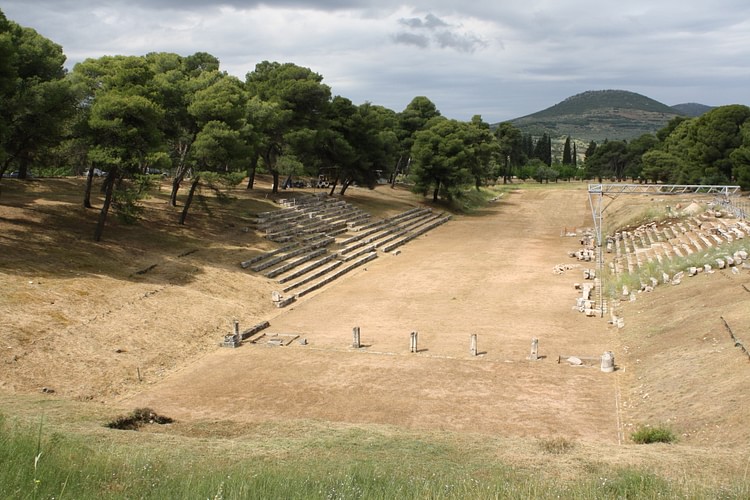 Stadium of Epidaurus Mark Cartwright (CC BY-NC-SA) ](https://www.worldhistory.org/image/701/stadium-of-epidaurus/ "Stadium of Epidaurus")At the height of the site's importance in the 4th century BCE (370-250 BCE), major buildings included two monumental entrances ([Propylaia](https://www.worldhistory.org/Propylaea/)); a large [temple](https://www.worldhistory.org/temple/) (380-375 BCE) with the typical 6 x 11 [column](https://www.worldhistory.org/column/) Doric layout, containing a larger than life-size Chryselephantine statue of a seated Asclepius (by Thrasymedes) and with pediments displaying in statuary the Amazonomachy and the Siege of [Troy](https://www.worldhistory.org/troy/); temples dedicated to [Aphrodite](https://www.worldhistory.org/Aphrodite/) (320 BCE), [Artemis](https://www.worldhistory.org/artemis/) and [Themis](https://www.worldhistory.org/Themis/); a sacred fountain; the Thymele (360-330 BCE) - a round marble building originally with 26 outer Doric columns, a 14 Corinthian columned cella and a mysterious underground [labyrinth](https://www.worldhistory.org/Labyrinth/), perhaps containing snakes which were associated with Asclepius; the columned Abato (or Enkoimeterion) in which patients waited overnight for divine intervention and remedy; other temples, hot and cold bath houses, stoas, [stadium](https://www.worldhistory.org/Stadium/), *palaistra* and large *gymnasia*; and a 6000 seat theatre (340-330 BCE). These latter sporting and artistic buildings were used in the Asklepieia festival, founded in the 5th century BCE and held every four years to celebrate theatre, sport and [music](https://www.worldhistory.org/disambiguation/Music/).
The theatre of Epidaurus, with 2nd century CE additions resulting in 55 tiers of seats and a capacity of perhaps 12,300 spectators, would become one of the largest ancient theatres ever built. The theatre has exemplary acoustics which allowed performers to be heard even at the very top rows of seats. Other Roman additions to the site in the 2nd century CE under the auspices of the Roman senator Antonius, included a temple of Hygieia, a large bath building and a small odeum.
The site was destroyed in 395 CE by the [Goths](https://www.worldhistory.org/Goths/) and the Emperor Theodosius II definitively closed the site along with all other pagan sanctuaries in 426 CE. In the 6th century CE the site was definitively abandoned following earthquakes in 522 and 551 CE. Excavations at the ancient site were first begun in 1881 CE under the auspices of the Greek Archaeological Society. Research continues to the present day, adding ever-more knowledge of the many ancient monuments that made up this impressive site. Artefacts can be seen at the Archaeological Museum of Epidaurus at the site. Today, the magnificent theatre of Epidaurus is still in active use for theatrical performances in an annual traditional [Greek theatre](https://www.worldhistory.org/Greek_Theatre/) festival.
#### Editorial Review
This human-authored definition has been reviewed by our editorial team before publication to ensure accuracy, reliability and adherence to academic standards in accordance with our [editorial policy](https://www.worldhistory.org/static/editorial-policy/).
## Bibliography
- Ananiades, D. *Ancient Greece Temples & Sanctuaries.* Toubis, Athens, 2010
- [Charitonidou, A. *Epidaurus.* Clio editions, 1978.](https://www.worldhistory.org/books/B0007BJ6S4/)
- [Cline, E.H. *The Oxford Handbook of the Bronze Age Aegean.* Oxford University Press, USA, 2012.](https://www.worldhistory.org/books/0199873607/)
- [Iakovidis, S.E. *Mycenae-Epidaurus Argos-Tiryns-Nauplion A complete guide to the museums and archaeological..* Ekdotike Athenon S.A., 1996.](https://www.worldhistory.org/books/B000VVZTWM/)
## About the Author
Mark is WHE’s Publishing Director and has an MA in Political Philosophy (University of York). He is a full-time researcher, writer, historian and editor. Special interests include art, architecture and discovering the ideas that all civilizations share.
## Timeline
- **c. 3000 BCE**: First habitation of [Epidaurus](https://www.worldhistory.org/epidaurus/) site.
- **c. 1450 BCE**: [Mycenaean](https://www.worldhistory.org/Mycenaean_Civilization/) monumental [architecture](https://www.worldhistory.org/disambiguation/architecture/) first appears at [Epidaurus](https://www.worldhistory.org/epidaurus/).
- **c. 1200 BCE - c. 1100 BCE**: [Mycenaean](https://www.worldhistory.org/Mycenaean_Civilization/) [Epidaurus](https://www.worldhistory.org/epidaurus/) at its peak of prosperity.
- **c. 500 BCE**: [Asclepius](https://www.worldhistory.org/Asclepius/) becomes principal [god](https://www.worldhistory.org/God/) of worship at [Epidaurus](https://www.worldhistory.org/epidaurus/).
- **c. 380 BCE - c. 375 BCE**: [Temple](https://www.worldhistory.org/temple/) to [Asclepius](https://www.worldhistory.org/Asclepius/) constructed at [Epidaurus](https://www.worldhistory.org/epidaurus/).
- **c. 340 BCE - c. 330 BCE**: [Theatre](https://www.worldhistory.org/disambiguation/theatre/) of [Epidaurus](https://www.worldhistory.org/epidaurus/) first constructed.
- **c. 320 BCE**: [Temple](https://www.worldhistory.org/temple/) dedicated to [Aphrodite](https://www.worldhistory.org/Aphrodite/) constructed at [Epidaurus](https://www.worldhistory.org/epidaurus/).
- **100 CE - 200 CE**: [Roman](https://www.worldhistory.org/disambiguation/Roman/) building additions to [Epidaurus](https://www.worldhistory.org/epidaurus/) under rule of senator Antonius.
- **395 CE**: [Epidaurus](https://www.worldhistory.org/epidaurus/) destroyed by invading [Goths](https://www.worldhistory.org/Goths/).
- **426 CE**: [Roman Emperor](https://www.worldhistory.org/Roman_Emperor/) Theodosius II orders closure of [Epidaurus](https://www.worldhistory.org/epidaurus/) sanctuary.
- **551 CE**: [Epidaurus](https://www.worldhistory.org/epidaurus/) site definitively destroyed by [earthquake](https://www.worldhistory.org/disambiguation/earthquake/).
## External Links
- [Oracles & Offerings - Ancient Greek World 04](https://ed.ted.com/on/kO96wl00)
## Cite This Work
### APA
Cartwright, M. (2012, June 18). Epidaurus. *World History Encyclopedia*.
### Chicago
Cartwright, Mark. "Epidaurus." *World History Encyclopedia*, June 18, 2012. .
### MLA
Cartwright, Mark. "Epidaurus." *World History Encyclopedia*, 18 Jun 2012, .
## License & Copyright
Submitted by [Mark Cartwright](https://www.worldhistory.org/user/markzcartwright/ "User Page: Mark Cartwright"), published on 18 June 2012. The copyright holder has published this content under the following license: [Creative Commons Attribution-NonCommercial-ShareAlike](https://creativecommons.org/licenses/by-nc-sa/4.0/deed.en). This license lets others remix, tweak, and build upon this content non-commercially, as long as they credit the author and license their new creations under the identical terms. When republishing on the web a hyperlink back to the original content source URL must be included. Please note that content linked from this page may have different licensing terms.